




Is AMD Catching Up With Nvidia? Here's the Best Stock to Buy Today.
Key Points
Advanced Micro Devices had a great second quarter, but Nvidia's could be even better.
AMD now has a major premium assigned to its stock compared with Nvidia's shares.
- 10 stocks we like better than Advanced Micro Devices ›
If you only looked at their stock prices, then you'd easily assume that Advanced Micro Devices (NASDAQ: AMD) is eating Nvidia's (NASDAQ: NVDA) lunch in 2026. Nvidia is up a respectable 20% this year, while AMD has skyrocketed about 125%. If you zoom out a little further, AMD is up 300% since 2025 began, while Nvidia has only risen 67%.
Considering that Nvidia is supposed to be the king of AI stocks, AMD sure appears to be quite the challenger to the crown. But there is more to this story than just stock performance.
Missed Nvidia in 2009? This Rare Signal Is Flashing Again. In 2009, a "Double Down" signal flashed for a little-known chipmaker called Nvidia. For the first time in years, that same "Total Conviction" signal is flashing for a company 1/100th the size of Nvidia. Continue »
Image source: The Motley Fool.
Nvidia is doing better as a business
Instead of focusing on stock performance, which could have a whole host of reasons why one is outperforming the other, let's take a look at how each company is doing. From a business standpoint, Nvidia seems to be crushing AMD.
AMD and Nvidia don't operate on the same fiscal calendar, so getting direct period comparisons is difficult. AMD operates on a calendar-year system, while Nvidia's quarter ends about one month later. AMD has already released its second-quarter results, while Nvidia's will be announced later this month.
However, with the AI arms race accelerating, the most recent results have been the best for every company involved in this sector, so AMD will likely receive an artificial boost in this analysis. But it still doesn't matter, because Nvidia is doing far better than AMD.
Starting with companywide results, during Nvidia's fiscal 2027 first quarter (ended April 2026), its revenue rose 85% year over year to $81.6 billion, with diluted earnings per share rising 214%. While not precisely the same time period, AMD's latest results weren't quite as impressive, as revenue rose 50% to $11.5 billion, while diluted earnings per share increased 156% in its second quarter (ended June 30).
Even more important is how each company's data center division is faring, as this is driving the most growth and will likely continue to do so for the foreseeable future. Nvidia's data center growth was up 92% while AMD's increased 107%. From this perspective, AMD is growing faster, but Nvidia will likely meet or exceed this growth when it announces its Q2 results.
Overall, Nvidia is the much larger and faster-growing company. This typically results in a better stock performance, but that hasn't been the case over the past two years. The reason? AMD's valuation has become a bit ridiculous.
AMD is valued at a high level
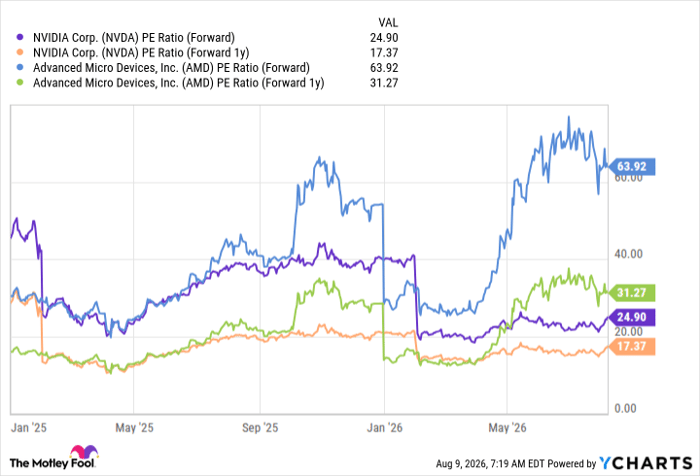
The market assigns each stock a multiple, and that conveys to investors how cheap or expensive a stock is. For fast-growing companies like these two, using the forward price-to-earnings P/E ratio is a smart idea. Given how strong next year's AI growth is expected to be, let's use 2027 projections. From this vantage point, AMD is far more expensive than Nvidia.
NVDA PE Ratio (Forward) data by YCharts
Because Nvidia and AMD are in the same industry, their long-term P/E ratio should roughly be the same. However, that's far from the case. If AMD hits Wall Street projections, then it will trade at 33 times next fiscal year's earnings, as long as the stock price stays flat from now until then. Nvidia trades for 17.6 times next fiscal year's earnings, revealing a huge gap.
AMD would need to double its earnings again after 2027 is over to reach the same valuation point that Nvidia would be at. This means that there is an extra year's worth of growth baked into AMD's stock price over Nvidia's, showing that Nvidia is the better value here.
Over the next year and a half, I'd expect this trend to reverse as Nvidia maintains its dominance while AMD takes a while to grow into its sky-high price tag. This makes Nvidia the far better stock to own moving forward.
Should you buy stock in Advanced Micro Devices right now?
Before you buy stock in Advanced Micro Devices, consider this:
The Motley Fool Stock Advisor analyst team just identified what they believe are the 10 best stocks for investors to buy now… and Advanced Micro Devices wasn’t one of them. The 10 stocks that made the cut could produce monster returns in the coming years.
Consider when Netflix made this list on December 17, 2004... if you invested $1,000 at the time of our recommendation, you’d have $432,621!* Or when Nvidia made this list on April 15, 2005... if you invested $1,000 at the time of our recommendation, you’d have $1,335,314!*
Now, it’s worth noting Stock Advisor’s total average return is 976% — a market-crushing outperformance compared to 214% for the S&P 500. Don't miss the latest top 10 list, available with Stock Advisor, and join an investing community built by individual investors for individual investors.
See the 10 stocks »
*Stock Advisor returns as of August 20, 2026.
Keithen Drury has positions in Nvidia. The Motley Fool has positions in and recommends Advanced Micro Devices and Nvidia. The Motley Fool has a disclosure policy.
Recommended Articles


