




Micron Shares Return to $1,000: After Short-Term Policy Catalysts, Can AI Demand Sustain MU Stock's Continued Rally?
TradingKey - On August 17 US Eastern Time, Micron Technology (MU) closed at $1,011.75, up 4.13%, reclaiming the $1,000 mark after more than a month and rebounding a cumulative 36% from its July low.
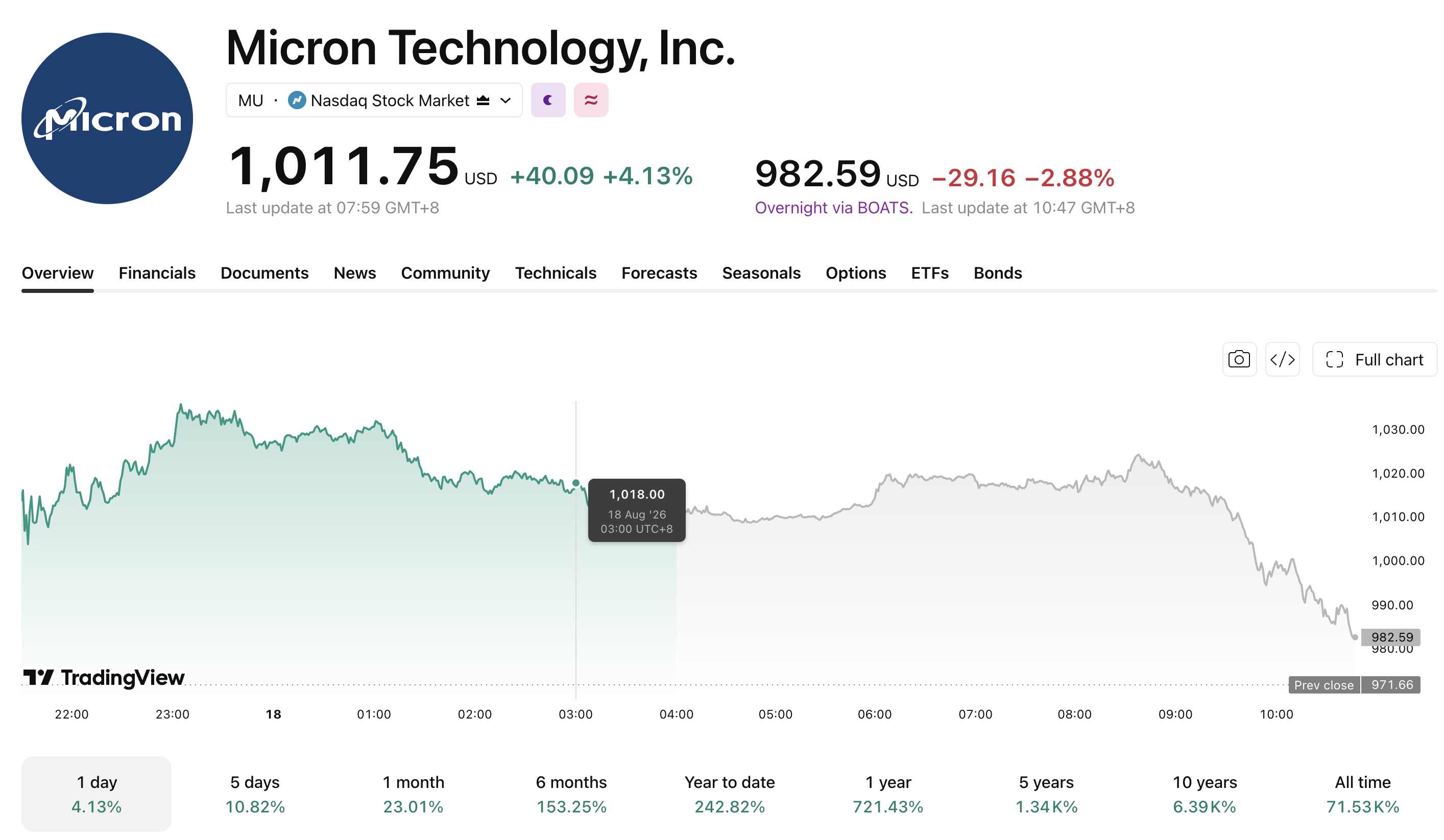
[Source: TradingView]
This rally is not merely a technical rebound, but the combined result of short-term catalysts and medium- to long-term logic. However, what the market truly cares about is whether AI demand can support Micron's stock price to hold firm above $1,000 and continue to rise after policy dividends fade.
Short-Term Policy Catalyst: Washington Closes Apple's China Storage Option
Over the past few months, Apple (AAPL) has been lobbying the White House, attempting to procure DRAM and NAND from Chinese memory chipmakers ChangXin Memory Technologies (CXMT) and Yangtze Memory Technologies (YMTC) to relieve surging memory costs under the squeeze of AI data center demand.
According to The Wall Street Journal, Apple has tested CXMT's DRAM across multiple product lines such as the iPhone and MacBook, with preliminary plans to prioritize equipping the chip in devices sold in the Chinese market.
This alternative route was blocked by Washington in mid-August. In mid-August, U.S. Commerce Secretary Howard Lutnick publicly stated that U.S. companies should avoid procuring memory chips from Chinese suppliers such as CXMT, noting that the Trump administration does not approve of Apple turning to Chinese memory, and that the shortage issue "needs to be resolved through other means."
Prior to this, a bipartisan group of senators led by Schumer sent a joint letter to Cook, demanding that Apple commit by August 21 not to procure Chinese memory chips.
Behind this pushback, Micron Technology was a key driver. Reports indicate that Micron began lobbying in July, warning that any deal between Apple and CXMT would "directly harm U.S. domestic manufacturing and run counter to Washington's semiconductor reshoring policy."
Medium-Term Support: Is AI Demand Strong Enough?
Policy tailwinds alone cannot sustain a year-to-date gain of over 240%; the core support lies on the industry side.
Long-term agreements (LTAs) are reshaping the business model of the memory industry. Cloud giants such as Microsoft (MSFT), Google (GOOGL), and Amazon (AMZN) have signed 3- to 5-year long-term supply agreements with Micron, locking in about 60% to 70% of server-grade DDR5 capacity. Even if consumer electronics demand shrinks, Micron's core revenue has been locked in by contracts in advance, structurally narrowing cyclical volatility.
A research report from UBS (UBS) pointed out that LTAs are changing the profitability characteristics of the memory industry, shifting the valuation baseline from a "cyclical P/B ratio" to a "growth P/E ratio," and raising the target multiple from 8 to 10 times to the 25 to 30 times range.
Meanwhile, the gross margin of commodity DRAM is dominating that of HBM, having climbed to 89%–91% between May and August 2026, and is projected to reach a peak of 93%–95% in 2027. In contrast, HBM gross margin is expected to be 75%–78% in 2027, widening the gap between the two to 20 percentage points. Manufacturing HBM consumes more than three times the wafer capacity; shifting capacity to HBM has instead exacerbated the supply tightness of commodity DRAM.
Based on current data, AI demand provides real and robust support for Micron. However, the market has already priced in a significant amount of positive news, and what is needed next is continuous validation of results exceeding expectations.
Long-Term Test: Is Micron a Cyclical or Growth Stock?
On July 10, SK Hynix (SKHY) CEO Kwak Noh-jung declared that the memory cycle has ended and AI has brought about a permanent shortage landscape. SanDisk (SNDK) CEO David Goeckeler pointed out that long-term contracts provide clear visibility into procurement volumes for the next four years.
On the institutional side, UBS believes that LTAs are breaking the cycle curse, while New Street Research stated outright that memory is "no longer a cyclical story."
AI has structurally altered demand dynamics, with long-term agreements locking in 60% to 70% of capacity. Even if consumer-side demand weakens, profits will not collapse as dramatically as in the past.
However, this view is not universally shared. Wu Zihao, CEO of Ronghe Semiconductor Consulting, stated that AI has not changed the underlying attribute of memory chips as a "tech commodity"—pricing power always remains in the hands of the supply and demand curve.
Whether the cycle is truly dead will face a key test in 2029. UBS model calculations show that even if DRAM spot prices pull back by about 50% in 2029, Micron Technology's earnings per share that year could still remain above $100. If this fails to hold, the market will once again price Micron within the framework of cyclical stocks.
Recommended Articles


