




SanDisk Reclaims $1,500: NBM Long-Term Agreement Expected to Break NAND Cycle
TradingKey - On August 13 ET, SanDisk (SNDK) broke above $1,500 and was up about 15% as of press time.
The market is no longer just trading the NAND price cycle, but a longer-term proposition: As AI moves from training to large-scale inference, can flash memory become an AI infrastructure asset closer to compute power with higher demand visibility? At its 2026 Investor Day, SanDisk's answer consisted of three parts: BiCS9/10 QLC technology iteration, long-term NBM agreements, and high-bandwidth flash (HBF), which remains in its early stages.
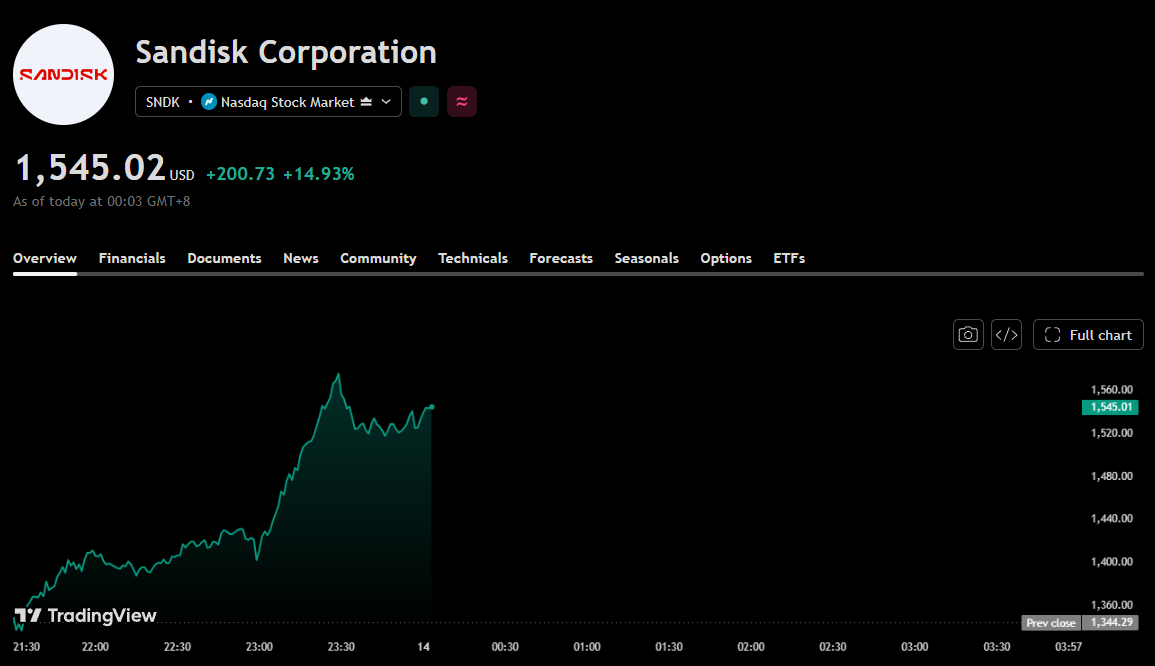
Source: TradingView
Why the Market Is Buying SanDisk Again: Trading Cycle Revaluation, Not Price Hikes
The key focus of SanDisk's Investor Day was shifting the valuation logic from "how long the next round of NAND prices will rise" to "whether AI inference demand can drive structural changes across storage architecture, supply-demand matching, and profitability models."
CEO David Goeckeler stated that the company's execution over the past 18 months has established a foundation for differentiation: NAND flash innovation, system-level capabilities, a product portfolio covering multiple end markets, capital efficiency, and full-stack technology management.
It extends SanDisk's competitiveness from standalone wafer manufacturing capability into a comprehensive ability to customize products to customer demand, plan capacity, and manage pricing. If this capability holds, SanDisk will gain not just price elasticity during an upcycle, but longer demand visibility and lower earnings volatility.
Technology Roadmap: BiCS9/10 Boosts Density, HBF Seeks to Fill Storage Hierarchy
SanDisk proposed a "2D scaling" strategy based on CBA (CMOS directly Bonded to Array). The core focus is not merely chasing the number of stacked layers, but combining mature arrays with newer CMOS wafers to more quickly create products that match different market demands while lowering manufacturing costs.
BiCS9 QLC is the first example, utilizing a BiCS8 array and a BiCS10-based CMOS wafer; BiCS10 QLC, meanwhile, delivers a 60% increase in bit density over BiCS8. For data center customers, higher density means more capacity per unit of space; if performance and power consumption improve concurrently, the total cost of ownership of storage systems will also decrease.
What holds even greater potential is HBF. Rather than replacing HBM, it aims to add a near-compute storage layer between HBM and SSDs that balances bandwidth and capacity.
SanDisk and SK Hynix have published the HBF technical specification through the OCP, with Google and Tenstorrent participating in technical validation and standard establishment. The value of an open specification lies in lowering the entry threshold for system vendors; however, publishing a specification does not equate to volume shipments, and the commercialization of HBF still awaits collaborative verification across products, customers, and the ecosystem.
Key Driver of SanDisk's Valuation Surge: Can NBM Dampen Cyclical Volatility
The NBM introduced by SanDisk includes committed purchase volumes, an enforceable contractual framework with minimum financial guarantees, and a structured pricing mechanism, aimed at aligning customer demand more closely with the company's capacity planning.
SanDisk has reportedly signed NBM agreements with eight customers, with sales volume accounting for approximately 50% of total sales volume in fiscal 2027 and about two-thirds of total sales volume in fiscal 2028.
The significance of these agreements lies not in eliminating NAND cycles, but in enhancing the predictability of market demand. SanDisk can plan supply on a firmer basis, while the market can depend less on short-term spot prices to evaluate revenue and cash flows.
It should be noted that contract execution, actual off-take, pricing terms, customer concentration, and industry supply will still affect final profits. NBM changes risk allocation and visibility, rather than automatically locking in profit margins.
SanDisk Discloses Multi-Year Financial Framework for FY2028 to FY2030
The company expects revenue to achieve double-digit growth from FY2028 to FY2030; non-GAAP gross margin is expected to stay around 80%, and non-GAAP operating margin around 75%. Operating expenses will account for about 5% of revenue; after factoring in taxes, capital expenditures, and working capital to support growth, the adjusted free cash flow margin is expected to be around 50%. The company also stated that after investing in the business, it will return 100% of excess cash to shareholders.
What is most worth dissecting are the underlying conditions: whether AI-driven demand growth can be sustained; whether NBM can enhance supply-demand synergy; and whether capital expenditures and operating expenses remain disciplined. Any deviation in any link will prompt a swift adjustment in market pricing for long-term margins.
Therefore, key areas to monitor going forward include the adoption of BiCS9/10 among AI data center customers and product mix improvements, the volume coverage and actual execution of NBM agreements, as well as customer qualification and product cadence of HBF. Only as these hard metrics continue to deliver can SanDisk be re-rated from a cyclical NAND supplier into an AI infrastructure beneficiary.
Recommended Articles


