




If the Fed's Next Move Shakes Up the Market, History Says Investments in This 1 Type of Stock Usually Hold Up Best During Times of Volatility
Key Points
Federal Reserve Chair Kevin Warsh has been coy about the outlook for interest rate adjustments.
High inflation continues to cloud the overall macroeconomic picture, creating a sense of unease among investors.
No matter what the Fed's next decision is, investing in low-beta stocks is usually a good strategy during volatile periods.
- 10 stocks we like better than S&P 500 Index ›
It's not uncommon for stocks to react with sharp unease whenever the Federal Reserve signals or executes on a new policy adjustment. The current macroeconomic environment features elevated inflation as well as new leadership at the central bank. These are conditions that can unsettle investors.
Luckily, history offers some guidance for navigating this turbulence. The one type of investment that has consistently held up during periods of uncertainty or outsized volatility is low-beta stocks. These are stocks whose price movements register a beta coefficient below 1.0 relative to the broader market. This financial jargon simply means these stocks tend to fluctuate in value less sharply than the market as a whole.
Missed Nvidia in 2009? This Rare Signal Is Flashing Again. In 2009, a "Double Down" signal flashed for a little-known chipmaker called Nvidia. For the first time in years, that same "Total Conviction" signal is flashing for a company 1/100th the size of Nvidia. Continue »
Let's explore how low-beta stocks have consistently displayed greater stability during periods when monetary policy decisions have rattled the broader market.

Image source: Getty Images.
Analyzing historical patterns during Fed-driven market stress
History illustrates the resilience of low-beta stocks with striking consistency. Consider what happened during the series of federal funds rate hikes that occurred throughout 2022. These aggressive tightening protocols were implemented to combat inflation; however, they also naturally fueled successive waves of anxiety for some investors.
During 2022, the S&P 500 (SNPINDEX: ^GSPC) experienced a drawdown of roughly 25% at peak stress points between early January and mid-October. By contrast, a select basket of lower-risk stocks declined by only about 4% for the full year.
Similar dynamics played out in late 2018. Successive interest rate hikes fueled a rapid sell-off in the final months of the year, with the S&P 500 falling nearly 14% in the fourth quarter alone. While the broader index shed significant value, low-beta names exhibited limited losses. For instance, the S&P 500 Low Volatility Index fell by around 6% while the S&P 500 Low Volatility High Dividend Index declined by about 8% during the same time frame.
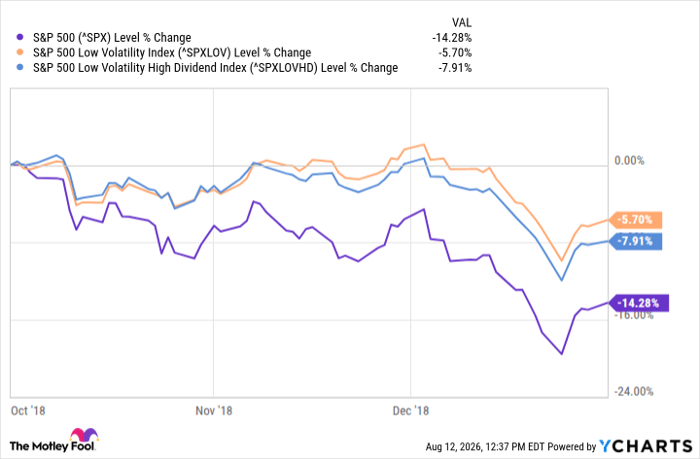
^SPX data by YCharts.
These patterns seem to recur because low-beta stocks often exhibit more insulated responses to rising interest rates or fears about the economy. In turn, this allows them to absorb policy shocks with less severity.
Why are low-beta stocks reliable?
Several attributes tend to support the durability of low-beta companies. Broadly speaking, their earnings power tends to be steadier because it is less tied to discretionary spending or capital-intensive expansion plans. Against this backdrop, shifts in borrowing costs or economic outlooks inherently have less of an effect on their business models.
These characteristics become especially valuable when communication out of the Federal Reserve leads to market uncertainty. During these periods, capital flows tend to rush toward safe harbor investments, but it does not abandon stocks entirely. The result is a relative outperformance by lower-risk companies. That can cushion investors' portfolios when broader sentiment turns cautious.
What are some examples of low-beta stocks?
Industries with companies that fit this profile include consumer staples, healthcare, and utilities. These types of companies sell everyday necessities or offer essential services, which allows them to enjoy largely sustained demand regardless of monetary conditions. Let's take a look at some specific names and how they held up during volatile periods.
In the consumer staples sector, shares of Procter & Gamble fell 7% in 2022. By comparison, the S&P 500 declined nearly 19%. Of note, Coca-Cola actually posted a positive return of around 7% that year.
Healthcare providers and pharmaceutical companies display similar strengths. During the 2022 bear market, Johnson & Johnson delivered a total return of 6% despite all the agitation over rate hikes. In addition, utility operators stood firm: That sector finished the year essentially flat while the S&P 500 declined by a double-digit percentage. Duke Energy ended the year modestly higher.
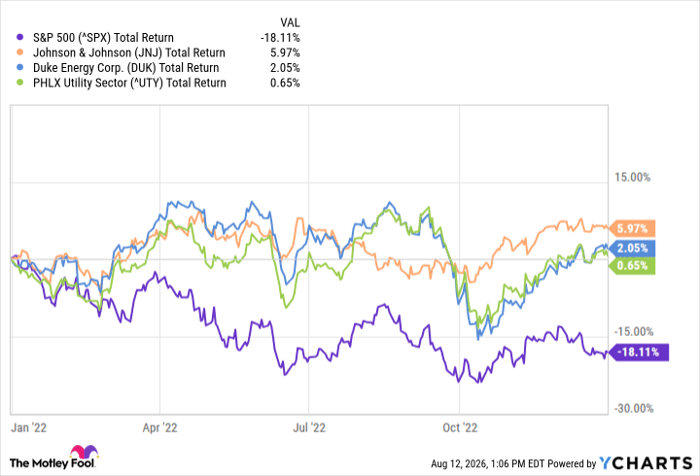
^SPX data by YCharts.
The common theme across these examples is that a low-beta profile often translates into relative outperformance during the most acute phases of policy-related market stress. Investors who allocate pockets of their portfolio to these types of stocks essentially gain a proven buffer, positioning themselves to weather the next potential surprise from the Fed with greater composure.
Should you buy stock in S&P 500 Index right now?
Before you buy stock in S&P 500 Index, consider this:
The Motley Fool Stock Advisor analyst team just identified what they believe are the 10 best stocks for investors to buy now… and S&P 500 Index wasn’t one of them. The 10 stocks that made the cut could produce monster returns in the coming years.
Consider when Netflix made this list on December 17, 2004... if you invested $1,000 at the time of our recommendation, you’d have $403,337!* Or when Nvidia made this list on April 15, 2005... if you invested $1,000 at the time of our recommendation, you’d have $1,334,946!*
Now, it’s worth noting Stock Advisor’s total average return is 958% — a market-crushing outperformance compared to 214% for the S&P 500. Don't miss the latest top 10 list, available with Stock Advisor, and join an investing community built by individual investors for individual investors.
See the 10 stocks »
*Stock Advisor returns as of August 13, 2026.
Adam Spatacco has no position in any of the stocks mentioned. The Motley Fool recommends Duke Energy and Johnson & Johnson. The Motley Fool has a disclosure policy.
Recommended Articles


