




Apple Dropped by 5% After Earnings. History Says This May Happen Next
Key Points
Apple's shares fell after its latest earnings report due to poor guidance.
The tech giant tends not to stay down too long following post-earnings dips.
Apple's business is rock-solid, and the stock can still deliver excellent returns over the long run.
- 10 stocks we like better than Apple ›
Apple (NASDAQ: AAPL) reported its financial results for the third quarter of its fiscal year 2026 -- for the period ending June 27 -- on July 30. The company delivered solid results. Apple's revenue jumped 16% year over year to $109.4 billion, while earnings per share were $2.02, up 29% from the year-ago period. However, Apple's guidance for its next quarter fell short of analysts' expectations, as the company continues to deal with supply constraints. Apple's shares dropped by about 5% following its quarterly update. What's next for the stock? Previous instances of Apple's stock dropping meaningfully post earnings may give us a clue.
Image source: The Motley Fool.
Missed Nvidia in 2009? This Rare Signal Is Flashing Again. In 2009, a "Double Down" signal flashed for a little-known chipmaker called Nvidia. For the first time in years, that same "Total Conviction" signal is flashing for a company 1/100th the size of Nvidia. Continue »
Apple tends to rebound
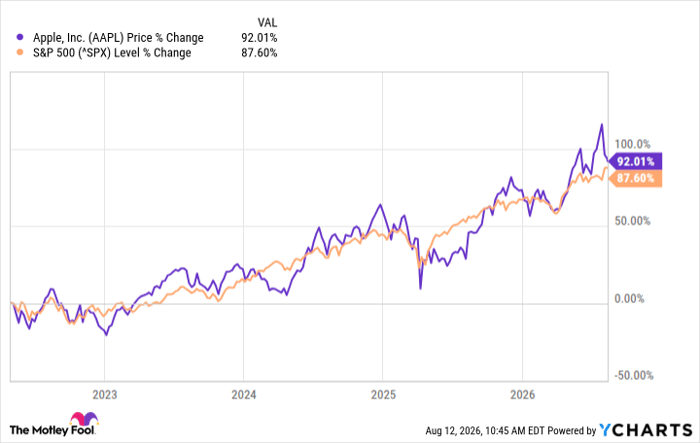
Apple is no stranger to significant post-earnings dips. Focusing on drops of 3% or more, the company has experienced several such declines over the past five years. Let's consider three examples. First, on April 28, 2022, Apple reported its financial results for its second quarter of 2022.
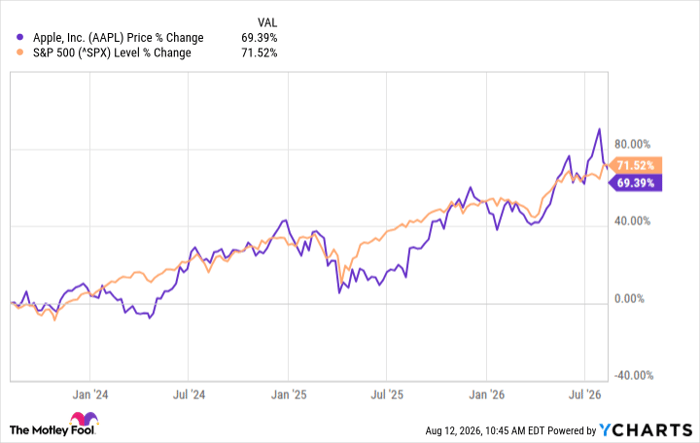
Revenue and earnings were strong. Yet the stock fell by about 4% on weak guidance, as management warned of supply constraints that would affect its financial results in the subsequent quarter. About a year and three months later, Apple released results for the third quarter of its fiscal year 2023 on Aug. 3 of that year.
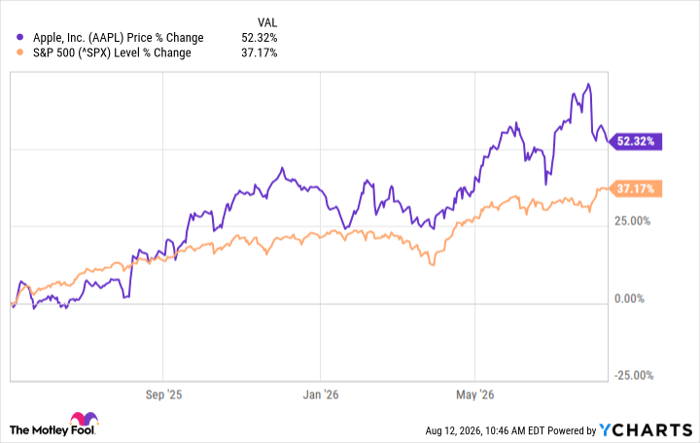
Weak performance in the company's iPhone segment led to an almost 5% post-earnings drop. Finally, on May 1, 2025, Apple reported its second quarter 2025 results. The company's financial results weren't particularly strong, and Apple's warning about an upcoming meaningful tariff hit led to a 4% post-earnings drop.
How has Apple performed following each of these dips? Here's how the stock did after the first.
AAPL data by YCharts
And the second.
AAPL data by YCharts
And the third.
AAPL data by YCharts
Notice what didn't happen on any of those occasions: Apple significantly extending its post-stock market losses for months -- or years -- after a post-earnings dip.
Should investors buy the dip?
The past is no guarantee of the future. It's entirely possible that Apple will not follow these precedents and will, instead, continue moving south. There are some reasons to believe this may happen. For instance, Apple is undergoing a change in management. Tim Cook will step down as CEO and transition to executive chairman. The company's senior vice president of Hardware Engineering, John Ternus, will take over.
For many investors, this creates uncertainty about the company's future, and the stock may experience greater volatility as a result. Then there is the fact that the economy isn't exactly doing well. The most recent Jobs Report in the U.S. was disappointing, renewing fears of a potential recession, especially amid geopolitical tensions and inflation. If a recession is on the horizon, it may hit Apple hard. After all, no one needs a new iPhone. All these factors (and others) may scare investors away from Apple right now.
However, even with some near-term uncertainty, my view is that Apple remains an excellent stock to buy for those focused on the long game. For one, Apple tends to perform surprisingly well during recessions. Even if no one needs a new iPhone, the company's customers are incredibly loyal, and many are more than happy to renew their devices, even when the economy isn't doing well.
Apple also generates significant free cash flow, enabling the business to meet its obligations while still returning substantial capital to shareholders via dividends and share buybacks, regardless of macroeconomic conditions. Further, Apple's new era under John Ternus could be successful, given the strengths the company boasts. Apple has a large base of more than 2.5 billion active devices.
The company should continue tapping into new monetization opportunities, and will likely double down on its artificial intelligence (AI)-related efforts. New AI features could help improve its devices and drive additional paid subscriptions in its high-margin services segment. Apple could also boost its installed base with new launches, including a foldable iPhone that it may introduce later this year.
Considering the success of similar devices its competitors have launched, this could be a meaningful addition to Apple's portfolio. In short, Apple's prospects remain attractive as the company leverages its large installed base to boost service revenue and expands its reach with new devices and AI-powered features. The stock may or may not extend its post-earnings losses, but over the long run, it should deliver competitive returns.
Should you buy stock in Apple right now?
Before you buy stock in Apple, consider this:
The Motley Fool Stock Advisor analyst team just identified what they believe are the 10 best stocks for investors to buy now… and Apple wasn’t one of them. The 10 stocks that made the cut could produce monster returns in the coming years.
Consider when Netflix made this list on December 17, 2004... if you invested $1,000 at the time of our recommendation, you’d have $403,337!* Or when Nvidia made this list on April 15, 2005... if you invested $1,000 at the time of our recommendation, you’d have $1,334,946!*
Now, it’s worth noting Stock Advisor’s total average return is 958% — a market-crushing outperformance compared to 214% for the S&P 500. Don't miss the latest top 10 list, available with Stock Advisor, and join an investing community built by individual investors for individual investors.
See the 10 stocks »
*Stock Advisor returns as of August 13, 2026.
Prosper Junior Bakiny has no position in any of the stocks mentioned. The Motley Fool has positions in and recommends Apple. The Motley Fool has a disclosure policy.
Recommended Articles


