




SanDisk Stock Price Forecast: Can SNDK Surpass $1,400 After Unveiling 9th-Gen AI Flash Tech with Kioxia?
TradingKey - On August 12, SanDisk (SNDK) and Japan's Kioxia jointly announced ninth-generation high-performance 2Tb QLC 3D NAND flash technology for AI infrastructure, cloud computing, and other data-intensive applications.
The launch of the new product once again focused market attention on an area being redefined by AI: beyond GPUs and HBM, as the scale of AI model training, inference, and data processing continues to expand, storage is becoming a critical component of data center infrastructure.
Following the announcement, SanDisk's stock price strengthened noticeably, rising 5.76% to close at $1,344.29 on August 12.
Why SanDisk Shares Are Rising
The market's positive feedback on the next-generation flash memory technology stems both from product performance itself and reflects investors' expectations for AI-driven growth in NAND demand.
Over the past year, SanDisk has been one of the strongest-performing storage stocks in the US market. However, its share price experienced a sharp pullback after reaching an all-time high of $2,335 in June and remains under intense volatility recently. SanDisk shares dropped 13.3% in a single day following its earnings release in early August; despite beating expectations, the market remains highly sensitive to its elevated valuation and future growth prospects.
The core improvement of the newly launched ninth-generation product goes beyond simply increasing capacity; it enhances both speed and energy efficiency through architectural upgrades. SanDisk and Kioxia adopted the CBA (CMOS Directly Bonded Array) technology jointly developed by the two companies, manufacturing the CMOS logic wafer and the memory cell array wafer separately before joining them via wafer bonding. This design allows each section to utilize its most suitable manufacturing process, thereby improving performance while controlling development and production costs.
Compared with the previous-generation 2Tb QLC product, the ninth-generation solution introduces a six-plane architecture and optimizes device and control design, delivering higher read/write bandwidth while reducing power consumption during read and write operations. Its NAND interface speed reaches up to 4.8 Gb/s, an increase of approximately 33% over eighth-generation products. For AI servers requiring massive data read and write operations, this improvement is particularly crucial, as the bottleneck in AI infrastructure is no longer concentrated solely on computing chips themselves; how rapidly data enters computing nodes and how efficiently models retrieve massive datasets also impact overall system efficiency.
This is also the most noteworthy aspect of SanDisk and Kioxia's product release. As generative AI gradually expands toward AI agents and physical AI, data usage scenarios are becoming increasingly complex. AI agents require continuous access to and processing of vast amounts of data, while physical AI applications such as robotics and autonomous driving demand that systems complete data access and processing in shorter timeframes. Against this backdrop, storage devices require not only larger capacities, but also higher bandwidth, lower latency, and superior energy efficiency.
Wall Street Sees SanDisk Shares Rising to $3,050
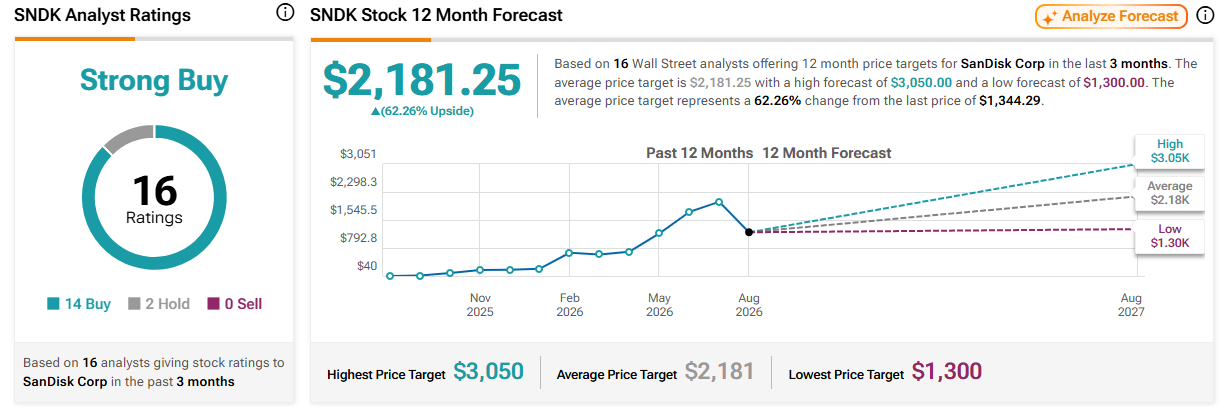
According to data from TipRanks, a total of 16 Wall Street analysts have issued 12-month price targets for SanDisk over the past three months, with an average target price of $2,181.25, representing a roughly 62.26% upside from the latest stock price of $1,344.29. Among them, the highest target price reaches $3,050, and the lowest is $1,300, indicating that analysts overall remain positive on SanDisk's future stock price performance.
Source: TipRanks
Cantor Fitzgerald recently screened companies with strong growth potential in the semiconductor and semiconductor equipment sector and selected SanDisk as its top pick. The firm gave it an "Overweight" rating with a price target set at $2,900.
Fitzgerald believes that SanDisk's future profitability is expected to benefit from structural changes in its business model, and projects that this growth trend will continue in 2028 and beyond. The firm particularly values the company's improving profitability, competitive market position, and support for shareholder returns.
For now, Wall Street's valuation of SanDisk is significantly higher than its current share price. If AI infrastructure continues to drive enterprise storage demand while flash memory prices and the company's profit margins remain strong, SanDisk still has room for further valuation re-rating.
SanDisk Stock Price Technical Analysis
Source: TradingView
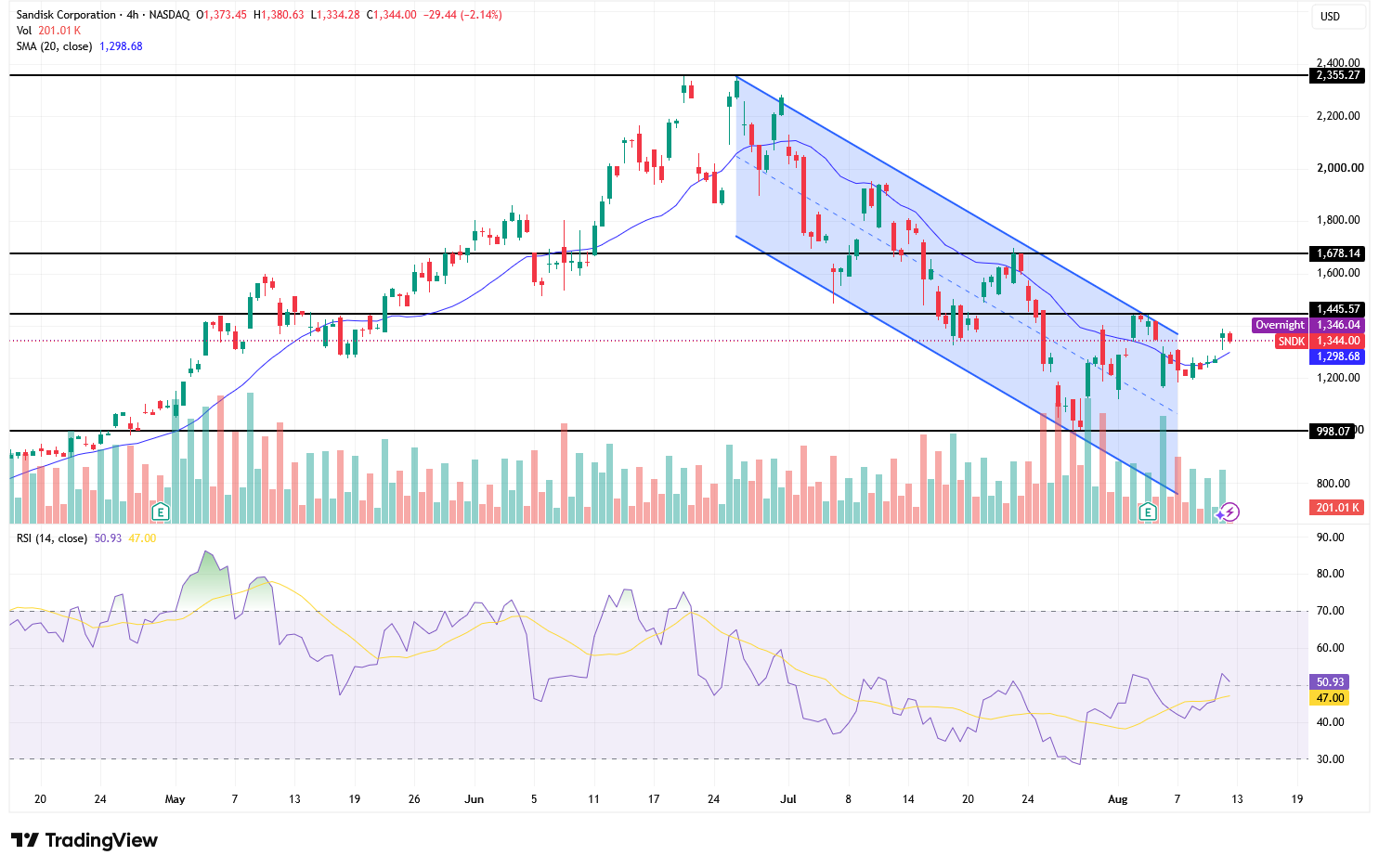
On the 4-hour chart, SanDisk has been trading in a descending channel after peaking near $2,355. However, the stock price recently broke above the upper boundary of the channel and reclaimed the 20-period moving average of $1,298.68, indicating that the previous downtrend is easing.
Currently priced at around $1,344, the short-term structure has turned moderately strong, but the round-number level of $1,400 remains the first key resistance to confirm a reversal.
In addition, the RSI has rebounded to 50.93 and climbed above its signal line of 47, showing that buying momentum is recovering, though it has not yet entered a distinctly strong zone. The recent rally was supported by some volume, but the stock pulled back after spiking near $1,380, implying that profit-taking pressure remains below $1,400.
If SanDisk can break above and hold $1,400 on heavy volume, the next target will be $1,445. A further breakout above $1,445 could expand the upside potential toward $1,510. Conversely, if the stock fails to clear $1,400 and turns lower, focus will first be on the support zone of $1,298–$1,313. Holding this area can still be regarded as a normal pullback after a breakout, whereas a break below it may lead to another test of $1,200–$1,240.
Recommended Articles


