




Can Palantir Reach $207 per Share to Claim a New All-Time High Before 2026 Is Over?
Key Points
Palantir's growth rate continues to impress.
The stock has a lot of growth already priced into it.
- 10 stocks we like better than Palantir Technologies ›
Palantir Technologies (NASDAQ: PLTR) had a very warm reception following its second-quarter earnings. The stock traded at nearly $120 per share, then skyrocketed to over $160 per share in the days following earnings. Still, it's way off its all-time high of $207 per share established last year.
Could Palantir reach a new all-time high before 2026 is over? Let's take a look.
Missed Nvidia in 2009? This Rare Signal Is Flashing Again. In 2009, a "Double Down" signal flashed for a little-known chipmaker called Nvidia. For the first time in years, that same "Total Conviction" signal is flashing for a company 1/100th the size of Nvidia. Continue »
Image source: The Motley Fool.
Palantir is a key partner for those wanting to deploy AI
Palantir has been in the AI game longer than most and has been an AI-first company since its founding in the early 2000s. Originally a government-focused business, it now has software for both commercial and government applications. Palantir got a huge business boost as AI became more mainstream over the last few years, with its integration of generative AI making the software more popular.
All of this has translated into a massive growth rate for Palantir. In Q2, companywide revenue grew at a 93% year-over-year pace to $1.9 billion. The U.S. part of its business has a particular strength, with U.S. commercial revenue rising 149% year over year and U.S. government revenue rising 90%. Those are some impressive figures, but there is one metric that I think really defines Palantir as a company: its net income margin.
Palantir isn't some growth-at-all-costs company; it's generating real profits. In Q2, its net income margin was an impressive 55%. Few companies ever reach this level, and for Palantir to do it while it's growing showcases that the product is basically selling itself. That's a great place to be, and investors really can't ask for much more.
So, why is the stock down around 25% from its all-time high? It all boils down to valuation.
What every investor has to ask themselves is how much growth is worth paying up for. Palantir trades for nearly 100 times 2026 earnings estimates and 68 times 2027 earnings estimates.
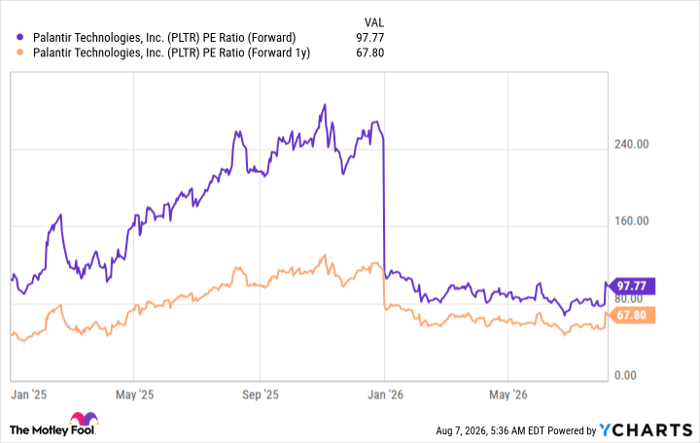
PLTR PE Ratio (Forward) data by YCharts
That's a very expensive price tag to pay, and it bakes in multiple years' worth of rapid growth into the stock price. I have not invested in Palantir's stock for this reason: it appears too expensive to me. Each investor will have to make their own call, because for Palantir to fall to a more reasonable valuation of 30 times earnings, it would need to triple its earnings after 2026's growth is baked in.
That's a lot of optimism, and while Palantir may be able to do it, I'd rather invest in companies growing about as fast as Palantir but at more reasonable price tags. Can Palantir return to $207 per share before 2026 is over? I'm sure it's possible, but if it does, it will be based on very high expectations for 2027 and 2028.
Should you buy stock in Palantir Technologies right now?
Before you buy stock in Palantir Technologies, consider this:
The Motley Fool Stock Advisor analyst team just identified what they believe are the 10 best stocks for investors to buy now… and Palantir Technologies wasn’t one of them. The 10 stocks that made the cut could produce monster returns in the coming years.
Consider when Netflix made this list on December 17, 2004... if you invested $1,000 at the time of our recommendation, you’d have $399,832!* Or when Nvidia made this list on April 15, 2005... if you invested $1,000 at the time of our recommendation, you’d have $1,374,595!*
Now, it’s worth noting Stock Advisor’s total average return is 968% — a market-crushing outperformance compared to 215% for the S&P 500. Don't miss the latest top 10 list, available with Stock Advisor, and join an investing community built by individual investors for individual investors.
See the 10 stocks »
*Stock Advisor returns as of August 10, 2026.
Keithen Drury has no position in any of the stocks mentioned. The Motley Fool has positions in and recommends Palantir Technologies. The Motley Fool has a disclosure policy.
Recommended Articles


