




New Fed Chair Kevin Warsh Sparked a "Credibility Shock" on Wall Street After His Latest Rate Decision. Here's Why Investors Should Care.
Key Points
Under previous Fed Chairs, guidance was provided to avoid economic uncertainty.
New Fed Chair Kevin Warsh believes a little more uncertainty would be a good thing.
- These 10 stocks could mint the next wave of millionaires ›
New Federal Reserve Chairman Kevin Warsh is upsetting Wall Street. But he's doing it on purpose, changing a dynamic that has been in place since the turn of the century. The switch has investors crying foul and questioning the Fed's credibility. There's a lot going on here, and investors definitely need to understand what's happening. Here's a quick look.
It all goes back to the dot-com bubble
At the turn of the century, the bursting of the dot-com bubble caused a massive market shock. In response, Fed Chairman Alan Greenspan began providing forward-looking statements to soothe the market. During the Great Recession, one of the deepest economic downturns in history, Greenspan's successor, Ben Bernanke, began providing even more explicit guidance. That level of guidance remained in place until this year, when new Fed Chair Kevn Warsh started to pull back on the guidance.
Missed Nvidia in 2009? This Rare Signal Is Flashing Again. In 2009, a "Double Down" signal flashed for a little-known chipmaker called Nvidia. For the first time in years, that same "Total Conviction" signal is flashing for a company 1/100th the size of Nvidia. Continue »

Image source: The Federal Reserve.
Wall Street doesn't like change, so investors are upset. And this change makes it harder to forecast the future, which is a key part of making investment decisions. Some of the pushback is just a reaction to the new approach.
But Warsh has a reason for what he's doing. The market has come to rely on what is known as the "Fed put," the belief that the Fed will step in to save it. That encourages risk-taking behavior that likely wouldn't occur without the so-called Fed put. Warsh appears to believe that providing less guidance will force investors to make better long-term investment choices.
Inflation is high, but rates didn't change
That said, there's another piece of the puzzle. Before stepping into the role as Fed Chair, Warsh was outspoken about wanting to lower interest rates. That is what the President would like to see happen, as he has said publicly many times. Only inflation is running hot right now, which would normally result in interest rate increases. That rates were not increased at the last meeting has some on Wall Street questioning whether or not Warsh is trying to avoid a rate increase to appease the President.
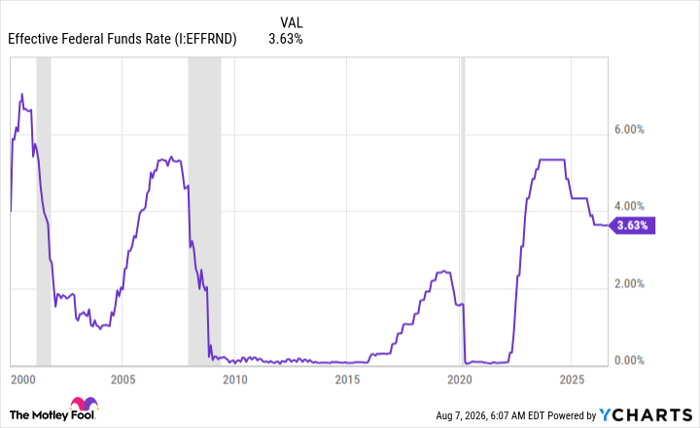
Effective Federal Funds Rate data by YCharts
That said, the bond market has reacted to the changed dynamic and economic situation by pushing long-term bond rates higher. Some market watchers argue that this is essentially Wall Street being forced to do the hard work it hasn't had to do under recent Fed regimes. And, more importantly, that this is a good outcome.
The one thing you should expect is less certainty
This isn't idle drama, given that changes in interest rates have real-world consequences. However, the big takeaway here is that a major change is taking shape in the market, driven by the Fed, and regardless of your view of the situation, there is one material outcome: increased uncertainty. But that seems to be what Warsh is aiming for, so you should probably get used to a less certain future.
Where to invest $1,000 right now
When our analyst team has a stock tip, it can pay to listen. After all, Stock Advisor’s total average return is 968%* — a market-crushing outperformance compared to 215% for the S&P 500.
They just revealed what they believe are the 10 best stocks for investors to buy right now, available when you join Stock Advisor.
See the stocks »
*Stock Advisor returns as of August 10, 2026.
The Motley Fool has a disclosure policy.
Recommended Articles


