




Alphabet $25 Billion Bond Sale Draws Over $100 Billion in Orders
TradingKey - Despite recent market concerns that continued debt issuance by big tech companies would dampen investor enthusiasm, Alphabet ( GOOGL )'s latest round of financing proves once again that high-quality AI assets remain highly attractive.
On Thursday local time, Alphabet issued $25 billion in investment-grade US dollar bonds, spanning 10 tranches with maturities from 2 to 40 years. This is not only the company's largest US dollar financing this year but also one of the transactions with the highest subscription volumes in the AI-related bond market since 2026.
According to market sources, the offering ultimately attracted approximately $115 billion in subscriptions, with the subscription amount exceeding four times the issuance size, second only to Oracle ( ORCL )'s approximately $129 billion and Amazon ( AMZN )'s record of approximately $126 billion earlier this year.
Source: Bloomberg
More Attractive Pricing Behind High Subscription
Judging by the outcome, Alphabet's debt offering went very smoothly, but this was not solely due to the company's excellent credit profile; more importantly, the offering pricing was more attractive than before.
Recently, the U.S. investment-grade bond market has seen a succession of large-scale offerings, while AI-related companies have continuously raised their capital expenditure budgets. The market was once concerned that supply would increase too rapidly, leading to a noticeable correction in tech bonds in July and a general widening of credit spreads in the secondary market.
Against this backdrop, Alphabet offered investors a higher yield premium than before, which significantly enhanced the attractiveness of the bonds and drove a rapid build-up of orders. Ultimately, the launch spread on the 40-year bonds narrowed from an initial approximately 155 basis points to 130 basis points, reflecting stronger-than-expected investor demand.
Some bond portfolio managers noted that debt offerings by mega-cap tech companies still need to offer certain concessions to investors for now, but as long as the pricing is reasonable, market capital remains willing to allocate to such high-grade assets.
Meanwhile, Alphabet also disclosed to investors that it plans to regularly conduct two U.S. dollar bond offerings per year in the future, aiming to increase the predictability of its issuance pace and ease market concerns over potential supply pressures from frequent financing.
AI Capital Expenditure Rises as Financing Methods Shift
The debt issuance comes against the backdrop of Alphabet's continuous expansion of AI infrastructure investment.
In July this year, the company once again raised its 2026 capital expenditure target, with full-year spending projected to reach up to $205 billion, more than doubling its 2025 level and surpassing market expectations.
The ongoing expansion of data center construction, AI chip procurement, and cloud infrastructure investment has also led to Alphabet's first quarterly negative free cash flow since its IPO.
For big tech companies that have long relied on operating cash flow for investment, this signals a shift in financing strategies.
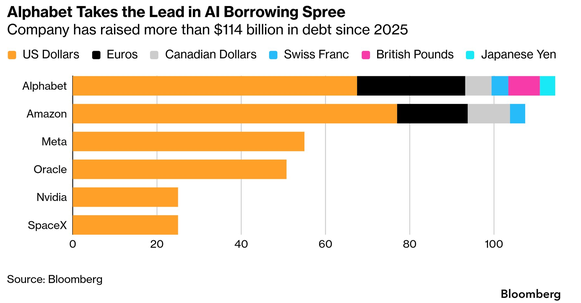
In addition to US dollar debt, Alphabet has also issued yen, euro, sterling, Swiss franc, and Canadian dollar bonds this year; meanwhile, the company had previously completed approximately $85 billion in equity financing to continuously replenish capital, funding its AI investments for the coming years.
In fact, this has already become a common trend across the entire AI industry.
Data shows that since the beginning of this year, hyperscalers such as Alphabet, Amazon, Meta ( META) and Oracle have seen their cumulative bond financing scale grow significantly compared to last year. As AI infrastructure development continues to advance, the bond market is gradually becoming an important channel for tech giants to raise long-term capital, rather than relying solely on their own cash flows.
Markets Re-Embrace AI Bonds
While this financing was enthusiastically received, it does not mean investors are entirely without concerns regarding AI-related debt.
Over the past few weeks, several AI-themed bond issuances failed to garner unanimous enthusiasm from the market. For instance, financing related to Meta's data center projects, Amazon's newly issued bonds, and debt from certain AI infrastructure companies all saw cooler-than-expected demand during the issuance phase, with credit spreads widening for some of the new notes upon entering the secondary market.
This suggests that as the scale of AI investment continues to swell, investors are beginning to focus more closely on whether companies' future cash flows can cover their rising capital expenditures, rather than merely buying into the industry narrative itself.
Alphabet undoubtedly remains one of the most highly regarded issuers. Supported by stable cash flow from its advertising business, a leading cloud computing unit, and a high credit rating, the company's borrowing costs have remained at relatively reasonable levels even as its capital expenditures continue to escalate.
However, the focus of capital markets has shifted. Investors not only want to see companies continue expanding their AI investments but also expect these outlays to gradually translate into revenue growth and improved profitability. Otherwise, ongoing financing could further exacerbate market concerns regarding cash flows and payback periods.
Recommended Articles


