




Prediction: After Losing $1 Trillion in Market Cap Since its IPO, SpaceX Stock Will Rebound in Epic Fashion. Here's Why.
Key Points
In early June, SpaceX completed the largest IPO of all time.
During the past few weeks, SpaceX stock has sold off as IPO investors locked in gains after an initial pop in the share price.
SpaceX has quietly been making significant progress in its artificial intelligence (AI) roadmap.
- 10 stocks we like better than Space Exploration Technologies ›
In a dazzling display of market enthusiasm last month, Space Exploration Technologies (NASDAQ: SPCX) completed the largest initial public offering (IPO) in history. Debuting at $150 per share, SpaceX was instantly propelled into the ranks of the world's most valuable companies.
The historic event reflected genuine excitement over the company's ability to lower the cost of putting satellites into orbit through reusable rocket technology, its expanding Starlink constellation, and an emerging role in the artificial intelligence (AI) landscape.
Missed Nvidia in 2009? This Rare Signal Is Flashing Again. In 2009, a "Double Down" signal flashed for a little-known chipmaker called Nvidia. For the first time in years, that same "Total Conviction" signal is flashing for a company 1/100th the size of Nvidia. Continue »
Supported by synergies from xAI and Cursor, these factors painted a picture of a company uniquely positioned to dominate not only launch services but also the data and connectivity layers that underpin modern society.

Image source: Getty Images.
SpaceX's post-IPO reality check
Within a month of going public, SpaceX's stock has now slipped below its $150 debut price, and the company's market capitalization has contracted by roughly $1 trillion from its highs. At the post-IPO peak, SpaceX commanded a $2.9 trillion market value -- a valuation that was undoubtedly stretched relative to its current revenue and inconsistent profitability.
Much of the selling pressure stemmed from a sober reassessment of the company's business model, which features heavy capital expenditures (capex) required to increase Starship production and Starlink deployments. Some investors also have doubts about the speed and scale at which the company can complement existing product lines with meaningful AI-driven revenue.
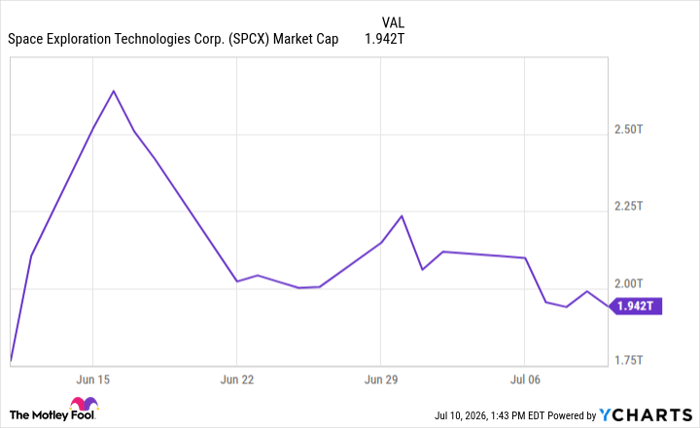
SPCX Market Cap data by YCharts
This fueled a typical post-IPO pattern: Momentum investors and day traders who had piled into the IPO for a quick pop began locking in gains, amplifying downward pressure and leaving unsuspecting investors holding the bag.
Tailwinds pointing toward a recovery in SpaceX stock
The same dynamics that fueled SpaceX's original surge could be the recipe for a credible path to recovery. SpaceX's vertically integrated model -- managing rocket design, manufacturing, launch cadence, and satellite production -- gives the company an edge when it comes to cost discipline and product iteration speed. This reduces the need to rely on external suppliers and accelerates the timeline for routine, low-cost heavy-lift capability with Starship.
Recent AI-focused agreements with Anthropic, Google Cloud, and Reflection further strengthen the bull case. These partnerships carry more than headline value; they provide tangible validation that established AI developers recognize the value of collaborating with SpaceX.
By combining Starlink's global, low-latency network with AI model deployment and edge computing, these collaborations help counter the notion that SpaceX cannot evolve into a serious player in AI infrastructure. Instead, they position the company as a core connectivity backbone for distributed AI workloads.
Against this backdrop, AI is becoming a natural extension of SpaceX's core segments: advancing space exploration through intelligent autonomy, expanding connectivity through low-orbit satellites, and ultimately reshaping telecommunications networks that legacy terrestrial carriers struggle to replicate.
How should you approach investing in SpaceX stock?
Investors weighing a position in SpaceX stock should exercise measured patience rather than hoping for a quick rebound. Although the pullback from its post-IPO highs has created a more attractive entry point, sentiment rarely reverses on a dime after such a dramatic retreat.
Operational milestones will be required before broader investor confidence returns, especially from institutional capital. These catalysts are more realistically recognized during the course of several quarters than in mere weeks.
Adopting a multiyear investment horizon makes the most sense. During this time frame, the compounding effects of lower launch costs, global broadband expansion, and AI-enabled services have a better chance of materially increasing revenue and expanding profit margins. The prudent way to invest in SpaceX stock is through dollar-cost averaging, committing capital across market cycles rather than attempting to time a bottom and going all-in. This strategy mitigates the inherent volatility that comes with investing in a high-growth, capital-intensive business.
Short-term traders will likely continue driving price swings. In the long run, however, the current environment favors disciplined investors who remain focused on SpaceX's gradual transformation over those who make speculative bets on an imminent turnaround.
Should you buy stock in Space Exploration Technologies right now?
Before you buy stock in Space Exploration Technologies, consider this:
The Motley Fool Stock Advisor analyst team just identified what they believe are the 10 best stocks for investors to buy now… and Space Exploration Technologies wasn’t one of them. The 10 stocks that made the cut could produce monster returns in the coming years.
Consider when Netflix made this list on December 17, 2004... if you invested $1,000 at the time of our recommendation, you’d have $395,679!* Or when Nvidia made this list on April 15, 2005... if you invested $1,000 at the time of our recommendation, you’d have $1,294,805!*
Now, it’s worth noting Stock Advisor’s total average return is 929% — a market-crushing outperformance compared to 211% for the S&P 500. Don't miss the latest top 10 list, available with Stock Advisor, and join an investing community built by individual investors for individual investors.
See the 10 stocks »
*Stock Advisor returns as of July 13, 2026.
Adam Spatacco has no position in any of the stocks mentioned. The Motley Fool has no position in any of the stocks mentioned. The Motley Fool has a disclosure policy.
Recommended Articles


