




Dow Jones Drops 1.4% as Trump Declares Iran Deal "Over"
Key Points
President Trump declared the interim cease-fire with Iran "over" at a NATO summit in Turkey, triggering a broad market selloff.
The Dow fell 1.4%, underperforming the S&P 500 and Nasdaq Composite, which each dropped 0.7%.
Semiconductor stocks rebounded after three days of losses, with Broadcom gaining 3.7%.
- 10 stocks we like better than Dow Jones Industrial Average ›
Remember when the biggest market worry was whether Samsung's (OTC: SSNLF) earnings were too good? That was Tuesday, aka ages ago. By Wednesday, investors have moved on to weightier concerns such as whether the United States and Iran are about to resume full-scale hostilities.
President Trump declared the interim cease-fire "over" at a NATO summit in Turkey, and Wall Street took the news about as well as expected. The Dow Jones Industrial Average (DJINDICES: ^DJI) fell 1.4% by 12:27 p.m. ET, bearing the brunt of the sell-off. The S&P 500 (SNPINDEX: ^GSPC) and Nasdaq Composite (NASDAQINDEX: ^IXIC) indexes each declined 0.7%.
Where to invest $1,000 right now? Our analyst team just revealed what they believe are the 10 best stocks to buy right now, when you join Stock Advisor. See the stocks »
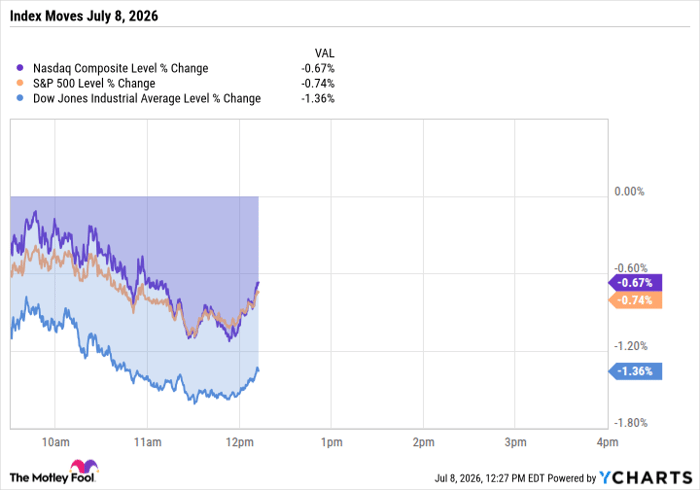
^IXIC data by YCharts
Iran escalation sends oil higher and stocks lower
Oil had another good day, which means something probably caught fire again. Sure enough, the Strait of Hormuz remains a mess. Ship traffic through the critical waterway had just started recovering when Tuesday's tanker attacks and subsequent U.S. strikes threw the region back into chaos. The United States Oil Fund (NYSEMKT: USO) jumped 4.4% as Brent crude climbed above $78 per barrel.
The Dow's underperformance relative to the tech-heavy Nasdaq reflects the composition of today's losers.
Goldman Sachs (NYSE: GS) dropped 2.8%, erasing roughly 176 points from the index by itself. Honeywell International (NASDAQ: HON) continued its post-spinoff slide, falling another 9.7% after losing 8.5% on Tuesday. Sherwin-Williams (NYSE: SHW), Home Depot (NYSE: HD), and American Express (NYSE: AXP) each shed more than 3%. Only six Dow stocks were trading in the green as of this writing.

Image source: Getty Images.
Meanwhile, semiconductor stocks decided they'd had enough of the doom and gloom. The iShares Semiconductor ETF (NASDAQ: SOXX) rose 1%, breaking a three-day losing streak. Broadcom (NASDAQ: AVGO) led the charge with a 3.7% gain. Micron Technology (NASDAQ: MU) traded flat, which counts as a stabilizing victory after losing 7% yesterday.
Alphabet (NASDAQ: GOOGL) and Amazon (NASDAQ: AMZN) weren't so lucky, falling 1.9% and 2%, respectively.
And investors lost interest in safe havens despite the turmoil in Iran. Gold (NYSEMKT: GLD) fell 1.75%, and Bitcoin (CRYPTO: BTC) dropped 3%. When both gold and crypto sell off during geopolitical turmoil, it usually means investors are being extra careful with their money. Who needs a safe investment when you can just convert your assets to cash, right?
What comes next?
The market's attention span is remarkably short. Just yesterday, everyone was convinced AI had peaked because Samsung made too much money. Today's semiconductor bounce suggests the "peak AI" panic may have been premature. It wouldn't be the first time Wall Street jumps to conclusions, only to reverse course right away.
The situation in the Persian Gulf remains fluid. Funeral processions for Iran's Supreme Leader Khamenei are scheduled to conclude July 9, after which negotiations could theoretically resume. But Trump's comments at the NATO summit in Turkey suggest the administration has little interest in returning to the table soon. And both sides are taking military action at the moment. The ceasefire looks fragile, to be polite.
For long-term investors, days like today are noise. For everyone else, buckle up. The road ahead looks bumpy.
Should you buy stock in Dow Jones Industrial Average right now?
Before you buy stock in Dow Jones Industrial Average, consider this:
The Motley Fool Stock Advisor analyst team just identified what they believe are the 10 best stocks for investors to buy now… and Dow Jones Industrial Average wasn’t one of them. The 10 stocks that made the cut could produce monster returns in the coming years.
Consider when Netflix made this list on December 17, 2004... if you invested $1,000 at the time of our recommendation, you’d have $410,833!* Or when Nvidia made this list on April 15, 2005... if you invested $1,000 at the time of our recommendation, you’d have $1,208,693!*
Now, it’s worth noting Stock Advisor’s total average return is 917% — a market-crushing outperformance compared to 209% for the S&P 500. Don't miss the latest top 10 list, available with Stock Advisor, and join an investing community built by individual investors for individual investors.
See the 10 stocks »
*Stock Advisor returns as of July 8, 2026.
American Express is an advertising partner of Motley Fool Money. Anders Bylund has positions in Alphabet, Amazon, American Express, Bitcoin, and Micron Technology. The Motley Fool has positions in and recommends Alphabet, Amazon, American Express, Bitcoin, Broadcom, Goldman Sachs Group, Home Depot, Honeywell Technologies, Micron Technology, and iShares Trust-iShares Semiconductor ETF. The Motley Fool recommends Sherwin-Williams. The Motley Fool has a disclosure policy.
Recommended Articles


