




6 Words From Fed Chair Kevin Warsh That Will Define This Era of Wall Street
Key Points
New Federal Reserve Chair Kevin Warsh has vowed to rein in inflation.
This has put investors on high alert for more hawkish Fed policy.
But there's an interesting question about how Warsh plans to evaluate inflation.
- These 10 stocks could mint the next wave of millionaires ›
Prior to his confirmation, many investors expected new Federal Reserve Chair Kevin Warsh to be dovish, especially on interest rates. The theory was Warsh would point to productivity gains driven by artificial intelligence to argue for lowering interest rates.
But less than two months in, Warsh has thus far adopted a more hawkish stance, leading investors to fear that interest rate hikes could be coming if inflation data doesn't improve.
Missed Nvidia in 2009? This Rare Signal Is Flashing Again. In 2009, a "Double Down" signal flashed for a little-known chipmaker called Nvidia. For the first time in years, that same "Total Conviction" signal is flashing for a company 1/100th the size of Nvidia. Continue »
These six words from Warsh will define this era of Wall Street.
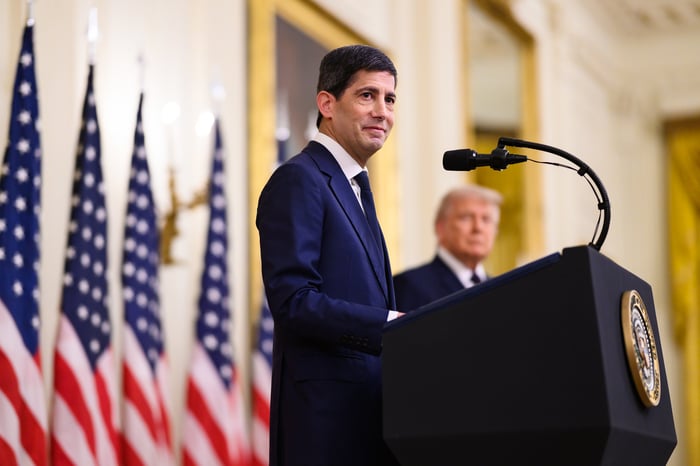
Official White House Photo by Daniel Torok.
Warsh is committed to reining in inflation
The Fed's inflation target has long been 2%. However, it's been over five years since inflation declined to this level, according to the Fed's preferred gauge of inflation, the Personal Consumption Expenditures (PCE) price index.
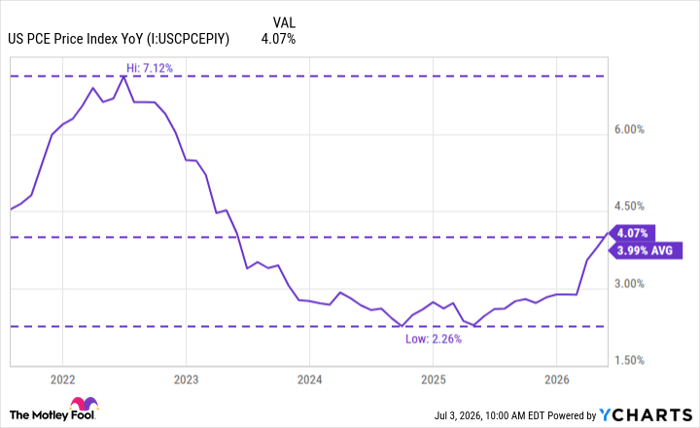
US PCE Price Index YoY data by YCharts
While former Fed Chair Jerome Powell managed to significantly lower inflation after it peaked at extraordinarily high levels in 2022, the Fed never brought it down to 2% during his tenure. The central bank actually lowered interest rates on several occasions in 2025 due to concerns about the labor market and an economic downturn.
Warsh still believes inflation is a problem and appears committed to bringing it down. Following its June meeting, the Federal Open Market Committee (FOMC) issued a policy statement including the words, "The Committee will deliver price stability."
These six words could come to define this era of Wall Street. Coming into Warsh's tenure, many investors wondered whether the Fed's preferred 2% target could change, but Warsh seemed to double down on the FOMC's statement recently at a panel hosted by the European Central Bank in Portugal.
"If there were people in the household or the business sector and the financial markets who thought that this central bank was going to be comfortable with an inflation objective above 2%, well, I guess they'd be disappointed. We're going to deliver price stability in the U.S.," he said.
Investors and other stakeholders in the U.S. economy will now take this claim seriously and probably expect the Fed to act if inflation remains stubbornly above its 2% target.
Will Warsh and the Fed move the goalposts?
At his first press conference after the FOMC meeting in June, Warsh announced the creation of five task forces to examine broad aspects of Fed policy, including how the Fed assesses inflation.
What's interesting is that Warsh recently said he doesn't think the agency is evaluating inflation through the right lens. He has also referred to inflation as a "choice."
During his confirmation hearing, Warsh said he thinks the Fed should look at inflation using "trimmed averages," which essentially remove the most extreme changes at the top and bottom of the prices examined.
The Fed already looks at core inflation, which strips out more volatile energy and food prices, but looking at "trimmed averages" would be a step further. According to the Brookings Institution, while headline inflation was 2.8% in February 2026, the trimmed mean was 2.3%.
That's a big gap, and it could help the Fed arrive at its 2% target much more quickly than expected if the task force examining inflation returns with a recommendation to focus on inflation through this lens.
Now, there's no guarantee this will happen. Warsh has also described prices as too high on several occasions, so I believe it will be difficult for him to simply change how inflation is measured and then say that inflation has been tamed.
But it does raise an interesting question: Which 2% will the Fed reference when discussing prices?
Either way, stabilizing prices will define this era of Wall Street. If the Fed continues to use traditional inflation gauges, investors will wonder whether it can ever bring inflation back to 2%. If inflation is measured via a trimmed mean, investors will wonder whether there is price stability even at the 2% level defined by this concept.
The Fed's journey under Warsh has only just begun and will likely be filled with plenty of plot twists.
Where to invest $1,000 right now
When our analyst team has a stock tip, it can pay to listen. After all, Stock Advisor’s total average return is 916%* — a market-crushing outperformance compared to 210% for the S&P 500.
They just revealed what they believe are the 10 best stocks for investors to buy right now, available when you join Stock Advisor.
See the stocks »
*Stock Advisor returns as of July 7, 2026.
The Motley Fool has a disclosure policy.
Recommended Articles


