




Apple Could Have Purchased Any of 487 S&P 500 Companies -- but CEO Tim Cook Chose to Invest $853 Billion Into This Game-Changing Opportunity
Key Points
Since current CEO Tim Cook took over for Steve Jobs in August 2011, shares of Apple have skyrocketed by more than 2,600%, including dividends.
For more than 13 years, Cook has overseen an investment that he and Apple's board consider the company's most prized asset.
This gargantuan investment has boosted Apple's earnings per share and continues to emphasize long-term investing.
- 10 stocks we like better than Apple ›
Although Nvidia is Wall Street's largest publicly traded company, no member of the "Magnificent Seven" paved the way for the stock market quite like Apple (NASDAQ: AAPL). Since current CEO Tim Cook took over for Steve Jobs in August 2011, shares of Apple have soared by more than 2,600%, including dividends.
Throughout much of Cook's nearly 15-year tenure, which is coming to a close when he steps down from the CEO role on Sept. 1 and transitions to executive chairman of Apple's board, the company's physical devices, such as iPhone, have done the heavy lifting. But a significant portion of Apple's outsize returns under Cook can be traced to what's been, in hindsight, a game-changing $853 billion investment.
Missed Nvidia in 2009? This Rare Signal Is Flashing Again. In 2009, a "Double Down" signal flashed for a little-known chipmaker called Nvidia. For the first time in years, that same "Total Conviction" signal is flashing for a company 1/100th the size of Nvidia. Continue »

Apple CEO Tim Cook delivering remarks at the White House. Image source: Official White House Photo by Daniel Torok.
Apple CEO Tim Cook bet big on himself and his company
I know what you're probably thinking, and no, Apple hasn't plowed $853 billion into artificial intelligence (AI) research. Despite several Magnificent Seven members outlaying north of $100 billion annually to expand their AI data centers, Apple's boss found a more intriguing way to put his company's capital to work.
With $853 billion, Apple could have acquired any of 487 S&P 500 (SNPINDEX: ^GSPC) companies, not including itself. But instead of making a big splash with an acquisition, Cook and the other members of Apple's board chose to invest in what they considered a prized asset: their own company's stock.
Beginning in 2013, Apple began repurchasing a lot of its own stock -- and it hasn't stopped:
- 2013: $22.95 billion in buybacks
- 2014: $45 billion
- 2015: $35.253 billion
- 2016: $29.722 billion
- 2017: $32.9 billion
- 2018: $72.738 billion
- 2019: $66.897 billion
- 2020: $72.358 billion
- 2021: $85.971 billion
- 2022: $89.402 billion
- 2023: $77.55 billion
- 2024: $94.949 billion
- 2025: $90.711 billion
- 2026: $36.989 billion (through the fiscal second quarter)
Collectively, Cook has overseen approximately $853.4 billion in share buybacks, which would be enough to acquire all but 12 S&P 500 companies. In the process, Apple has retired more than 44% of its outstanding shares.
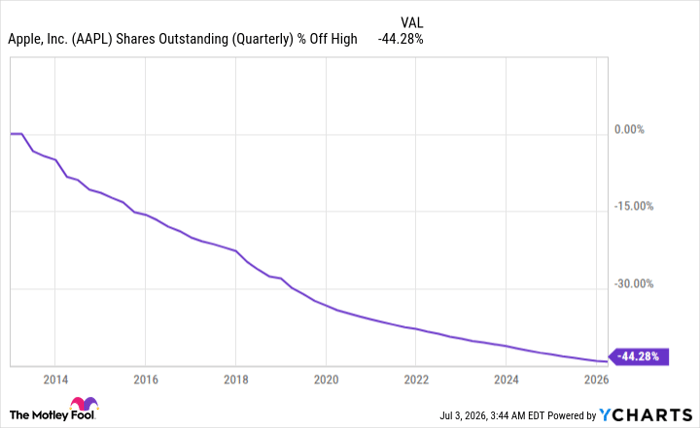
AAPL Shares Outstanding (Quarterly) data by YCharts.
One reason Apple has been aggressive with share buybacks is that it helps the company's optics. For companies with steady or growing net income, share repurchases can reduce their outstanding share count and increase earnings per share. In theory, this can make Apple more fundamentally attractive to value-focused investors.
Another reason Tim Cook and the Apple board went all-in on buybacks is that President Donald Trump's tax policies made it logical to do so. The Tax Cuts and Jobs Act, signed into law by Trump in December 2017, permanently lowered the peak marginal corporate income tax rate from 35% to 21% (the lowest level since 1939). Being able to retain more of its earnings gave Apple a clear path to repurchase its stock without pulling capital away from research and development. This is why buybacks catapulted higher in 2018 (and beyond).
Lastly, share repurchases often incentivize long-term investing, which can minimize volatility. It's a correlation that Berkshire Hathaway's now-retired billionaire CEO, Warren Buffett, appreciated -- especially since Berkshire was a significant stakeholder in Apple. As a company's share count declines over time, the ownership stakes of long-term investors incrementally increase.
Should you buy stock in Apple right now?
Before you buy stock in Apple, consider this:
The Motley Fool Stock Advisor analyst team just identified what they believe are the 10 best stocks for investors to buy now… and Apple wasn’t one of them. The 10 stocks that made the cut could produce monster returns in the coming years.
Consider when Netflix made this list on December 17, 2004... if you invested $1,000 at the time of our recommendation, you’d have $418,761!* Or when Nvidia made this list on April 15, 2005... if you invested $1,000 at the time of our recommendation, you’d have $1,195,804!*
Now, it’s worth noting Stock Advisor’s total average return is 918% — a market-crushing outperformance compared to 208% for the S&P 500. Don't miss the latest top 10 list, available with Stock Advisor, and join an investing community built by individual investors for individual investors.
See the 10 stocks »
*Stock Advisor returns as of July 6, 2026.
Sean Williams has no position in any of the stocks mentioned. The Motley Fool has positions in and recommends Apple, Berkshire Hathaway, and Nvidia. The Motley Fool has a disclosure policy.
Recommended Articles


