




What the Buffett Market Valuation Indicator at Record Highs Means for Investors
Key Points
Warren Buffett has long considered a comparison of two economic and market data points as an important measure of stocks’ collective value.
This measure was conceived at a time when the economic backdrop was very different.
From an earnings-based perspective, the U.S. stock market’s current value is very reasonable.
- 10 stocks we like better than S&P 500 Index ›
Warren Buffett's favorite market valuation measure is at a record high, suggesting that the stock market is exceedingly expensive. Specifically, the total market capitalization of the U.S. stock market is now 136% greater than the nation's gross domestic product, or GDP. That's roughly 70% above the long-term norm.
The narrative surrounding this indicator's surge since the bull market began in late 2022 is bearish, of course, and perhaps rightly so.
Missed Nvidia in 2009? This Rare Signal Is Flashing Again. In 2009, a "Double Down" signal flashed for a little-known chipmaker called Nvidia. For the first time in years, that same "Total Conviction" signal is flashing for a company 1/100th the size of Nvidia. Continue »
However, there may also be a gaping flaw in the very premise of the Buffett indicator.
Not the same
Don't misread the message. Warren Buffett isn't just a brilliant stock picker. He's also got a great feel for how the economy and the stock market affect one another.
This particular approach to assessing the overall market's value, however, isn't necessarily one worth worrying about.
The sum total market cap of every publicly listed U.S. stock specifically doesn't include privately owned for-profit corporations. Nor does the so-called Buffett indicator consider the combined profitability of these companies, which is considerably greater (absolutely and relatively) than it used to be.
The chart below tells the tale, comparing taxable corporate profits to the same domestic GDP used in Warren Buffett's valuation measure going back to the 1970s. As it illustrates, corporate profits are now in the ballpark of 12% of the nation's GDP. That's roughly twice what they were just a few decades ago.
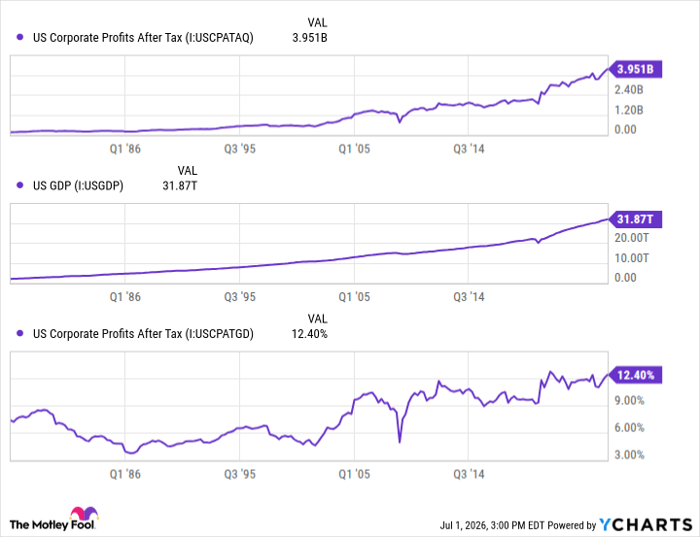
U.S. Corporate Profits After Tax data by YCharts.
Yes, you're seeing and interpreting that right. America's corporate profit growth has dramatically outpaced the nation's GDP growth, boosted by a steady widening of profit margins, as well as more earnings coming from overseas. Indeed, FactSet reports that more than 40% of S&P 500 (SNPINDEX: ^GSPC) companies' first-quarter revenue came from foreign economies that don't affect the United States' GDP figure.
From this perspective, the market isn't overvalued. The S&P 500 is reasonably valued, in fact, at a forward-looking price-to-earnings ratio of 21.5.
No longer a measure to worry about
It's no shade on Buffett's valuation model, which he never claimed is an end-all, be-all anyway. It's just one of many pieces of information that all investors should consider before coming to a conclusion about the broad market's value and likely future.
To be sure, there's still plenty to worry about with this market. Namely, those persistently widened profit margins are at risk of collapsing now that interest rates are higher and the fervor surrounding the artificial intelligence revolution is finally leveling off. Stocks could still suffer a setback.

Image source: Getty Images.
They're just not likely to do so, because their collective market cap is too big compared to the country's GDP. The market's sum total market value is just shockingly big right now because there are so many publicly traded companies, several of which have figured out a way to generate outsize profits even without commensurate domestic GDP growth.
So, in answer to the question -- despite the noisy rhetoric -- the fact that the Buffett market valuation indicator is at record-breaking highs right now doesn't actually mean a whole lot to investors, and it certainly doesn't suggest a major crash is imminent.
This also doesn't mean a major correction is impossible, either. As has always been the case, picking stocks simply remains a case-by-case matter.
Should you buy stock in S&P 500 Index right now?
Before you buy stock in S&P 500 Index, consider this:
The Motley Fool Stock Advisor analyst team just identified what they believe are the 10 best stocks for investors to buy now… and S&P 500 Index wasn’t one of them. The 10 stocks that made the cut could produce monster returns in the coming years.
Consider when Netflix made this list on December 17, 2004... if you invested $1,000 at the time of our recommendation, you’d have $418,761!* Or when Nvidia made this list on April 15, 2005... if you invested $1,000 at the time of our recommendation, you’d have $1,195,804!*
Now, it’s worth noting Stock Advisor’s total average return is 918% — a market-crushing outperformance compared to 208% for the S&P 500. Don't miss the latest top 10 list, available with Stock Advisor, and join an investing community built by individual investors for individual investors.
See the 10 stocks »
*Stock Advisor returns as of July 5, 2026.
James Brumley has no position in any of the stocks mentioned. The Motley Fool has no position in any of the stocks mentioned. The Motley Fool has a disclosure policy.
Recommended Articles


