




Warning of a 30% Correction in AI Chip Stocks. "Big Short" Burry Shorts Micron at $1,051, Is the Cyclical Turning Point Alarm Sounding?
T radingKey - Mi chael Burry, th e "Big Short" i nvestor famous f or accurately pr edicting the 20 08 subprime mort gage crisis, has once again drop ped a bombshell on the market .
On Thur sday local time , the real-life inspiration beh ind the movie "The Big Sho rt" revealed in a Substack post that he has established a short position in Micron Technology ( MU) at $1,051.87, pointing to significant downside risk for the memory chip giant's stock price.
Burry's decision to short the stock directly rather than buying put options stems from his view that Micron's current put options are overpriced. In his view, Micron's recent surge is entirely sentiment-driven—with 'FOMO (fear of missing out), the greater fool theory, and public commitment bias' replacing rational analysis and driving the stock to historical extremes.
He pointedly noted that Micron's valuation, technical patterns, and industry cycle patterns all point to an imminent correction, even bluntly stating that 'Micron defines cyclicality to the extreme.'
To support his thesis, Burry cited a range of data points: over the past 42 years, Micron's stock has suffered 34 major drawdowns of over 30%. The stock's current deviation from its 200-day moving average is at its highest level since 1984, even surpassing the peak of the dot-com bubble.
He also criticized Micron's concerning long-term profitability, noting that its median return on invested capital (ROIC) is only 4% and its median return on equity (ROE) is 7%—metrics he described as 'frankly, terrible.'
Furthermore, Burry believes Micron has lost its dominance in the memory sector, as the capital expenditure plans of South Korean rivals are forcing Micron to spend heavily, further squeezing its profit margins.
Burry's short position on Micron aligns with his broader bearish stance on the semiconductor sector. On June 30, he disclosed short positions in Nvidia, Applied Materials, and the iShares Semiconductor ETF (SOXX), while warning that AI-related chip stocks face a 30% correction.
This time, he further emphasized that the South Korean semiconductor capital expenditure plans announced by Samsung and SK Hynix mark 'the beginning of the transition from boom to bust' for the industry cycle, and that valuations of AI infrastructure-related companies are severely bloated.
Semiconductor sector hit by heavy sell-off
Just as Burry made his move, the global semiconductor sector was experiencing a wave of intense sell-offs. The Philadelphia Semiconductor Index plunged 12% in two trading days, and Micron Technology's stock price plummeted consecutively—falling over 10% on July 1 and another 5.5% on July 2, with a cumulative decline of nearly 15% over the past five trading days, closing at $975.56 per share as of July 2.
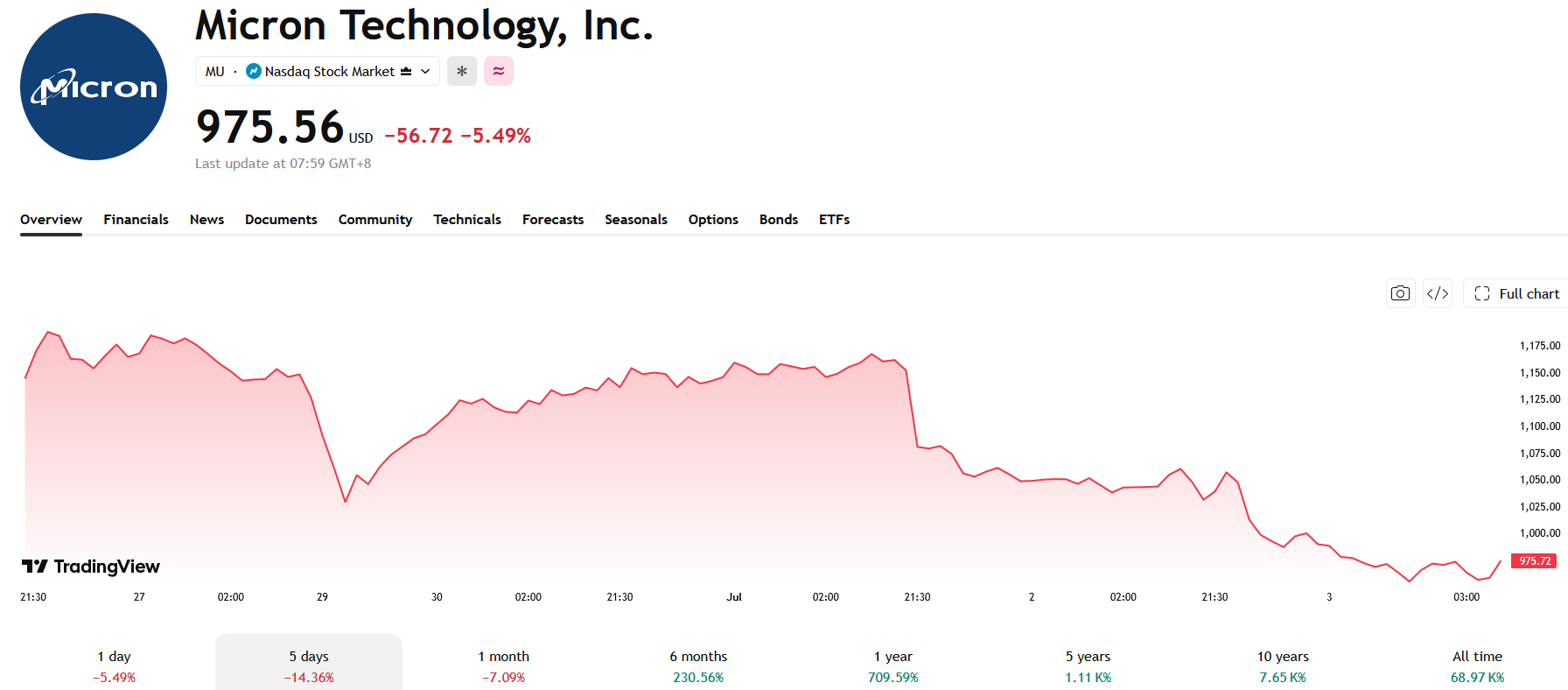
Source: TradingView
However, even with the recent correction, Micron's stock price has still more than doubled so far this year, which makes Burry's short position look even more challenging.
The shift in market sentiment did not come without warning. A recent series of news items has sparked investor concerns over a slowdown in the growth of demand for AI chips.
Meta ( META) plans to build its own cloud business and sell excess AI computing power, which has been interpreted as capital expenditures peaking for hyperscalers. Anthropic has begun developing its own AI chips, which could reduce its reliance on third-party chipmakers. Mark Zuckerberg stated that Meta's AI agent development has fallen short of expectations, further intensifying market worries about underperforming returns on AI. The combination of these factors has abruptly increased short-term pressure on the semiconductor sector.
Given Burry's previous successful short of Palantir ( PLTR ), the market has paid close attention to his short position this time. However, some analysts believe that although valuations in the AI chip sector are indeed on the high side, the long-term growth trend of the AI industry remains unchanged, and short-term corrections may provide buying opportunities for investors.
For Burry, whether this short on Micron can replicate his success during the subprime mortgage crisis remains to be seen, but his warning has undoubtedly sounded an alarm for the frenetic AI chip market—after more than a year of skyrocketing gains, the market may be standing on the brink of a cyclical turning point.
Recommended Articles


