




Apple Just Made 2 Moves That Could Make It a Long-Term Winner for Investors
Key Points
Apple faces rising prices for certain components for its devices, particularly memory chips.
The consumer tech giant is leaning into demand for memory with its latest moves.
The result could be steady earnings growth over the long run, justifying its stock price today.
- 10 stocks we like better than Apple ›
Apple (NASDAQ: AAPL) finds itself in a tough position. It has avoided the heavy spending associated with artificial intelligence (AI) compute build-outs. Nonetheless, the surging demand for chips from some of its "Magnificent Seven" peers has put pressure on its business. In particular, the price of memory chips has soared over the last year or so. Micron Technology just reported that prices for its DRAM memory chips climbed more than 60% from the previous quarter.
But two recent moves could help mitigate the near-term pressure of higher memory prices on Apple while benefiting patient long-term investors willing to stick with the leading smartphone maker.
Where to invest $1,000 right now? Our analyst team just revealed what they believe are the 10 best stocks to buy right now, when you join Stock Advisor. See the stocks »
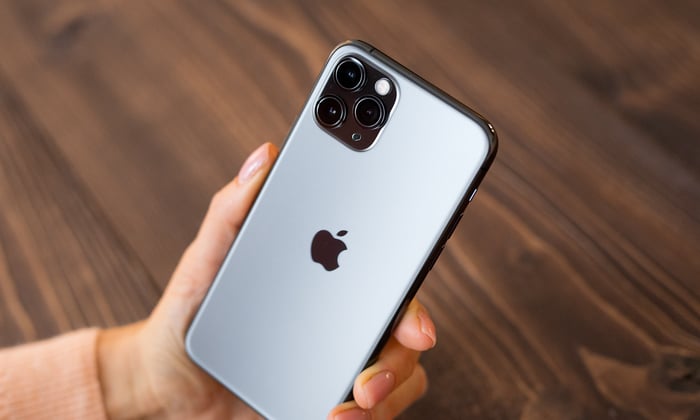
Image source: Getty Images.
Apple is leaning into high memory prices
While memory chip prices are soaring, Apple's latest software updates are heavily reliant on increased memory capacity for its devices. Apple rebuilt Siri using Alphabet's Gemini large language model (LLM). The new AI features demonstrated at its Worldwide Developers Conference (WWDC) event earlier this month are far from cutting edge, but they take advantage of the personal information and context of your iPhone, providing unique capabilities that leading AI companies can't replicate.
Under the hood, Apple is heavily focused on keeping your private data private. That means running as many queries as possible on the iPhone itself instead of sending the prompt to a remote server for processing. Apple took pains to reduce the memory requirements for on-device AI, but there's only so much it can do while providing the most useful AI features. As a result, the upgraded Siri won't work with many older iPhones.
It might seem counterintuitive to increase memory requirements for its premier software update at a time when memory prices are so high. However, the timing could prove fortuitous for Apple. The new Siri update could help drive many owners of older devices to upgrade this fall with the next iPhone release. And that gives Apple the opportunity to raise the price on the iPhone.
Indeed, Apple just announced price increases for certain MacBook and iPad units. CEO Tim Cook suggested more price hikes could be coming in a recent interview. Apple had held back on price hikes despite increased component costs for several quarters, while its biggest competitors, including Samsung Electronics, raised prices. That may have helped fuel strong iPhone sales over the last few quarters, which are up 22% through the first six months of fiscal 2026.
A price hike will allow Apple to maintain most of its gross margin, while the demand driven by the Siri upgrade should help maintain unit sales. The result should be modest revenue growth with slightly slower profit growth in fiscal 2027, but the long-term potential of the two moves could be significant.
Thinking long term
It's important to note that the memory chip market is extremely cyclical. In times of high demand, prices for memory chips climb considerably higher. However, memory chipmakers eventually add capacity, bringing supply back in line with demand and ultimately leading to lower prices. That is to say, Apple won't be stuck paying the outrageously high prices the market currently demands forever.
On the other hand, consumer prices are much stickier. While Apple has introduced some low-end models to appeal to more budget-conscious consumers, it's rarely lowered the prices of its flagship devices.
As a result, Apple should be able to produce meaningful revenue growth with minimal margin compression in the near future. And while revenue growth might slow in later years, it should drive margin expansion as memory prices decline. The recent moves leverage its strong brand and its position as the leading smartphone manufacturer to maintain steady profit growth over time.
With the stock trading around 32 times forward earnings expectations, some may see it as too expensive for a relatively slow-growing business. But Apple is demonstrating its ability to deliver steady gains without significant capital expenditures, using its massive free cash flow to buy back stock and boost earnings per share. That makes it worth paying a premium price, especially for patient, long-term investors.
Should you buy stock in Apple right now?
Before you buy stock in Apple, consider this:
The Motley Fool Stock Advisor analyst team just identified what they believe are the 10 best stocks for investors to buy now… and Apple wasn’t one of them. The 10 stocks that made the cut could produce monster returns in the coming years.
Consider when Netflix made this list on December 17, 2004... if you invested $1,000 at the time of our recommendation, you’d have $398,052!* Or when Nvidia made this list on April 15, 2005... if you invested $1,000 at the time of our recommendation, you’d have $1,181,688!*
Now, it’s worth noting Stock Advisor’s total average return is 892% — a market-crushing outperformance compared to 205% for the S&P 500. Don't miss the latest top 10 list, available with Stock Advisor, and join an investing community built by individual investors for individual investors.
See the 10 stocks »
*Stock Advisor returns as of June 29, 2026.
Adam Levy has positions in Alphabet and Apple. The Motley Fool has positions in and recommends Alphabet, Apple, and Micron Technology. The Motley Fool has a disclosure policy.
Recommended Articles


