




Grok 4.5 Undergoing Internal Testing at SpaceX and Tesla, Musk Says Performance May Exceed Claude Opus, New Models to Be Released Monthly
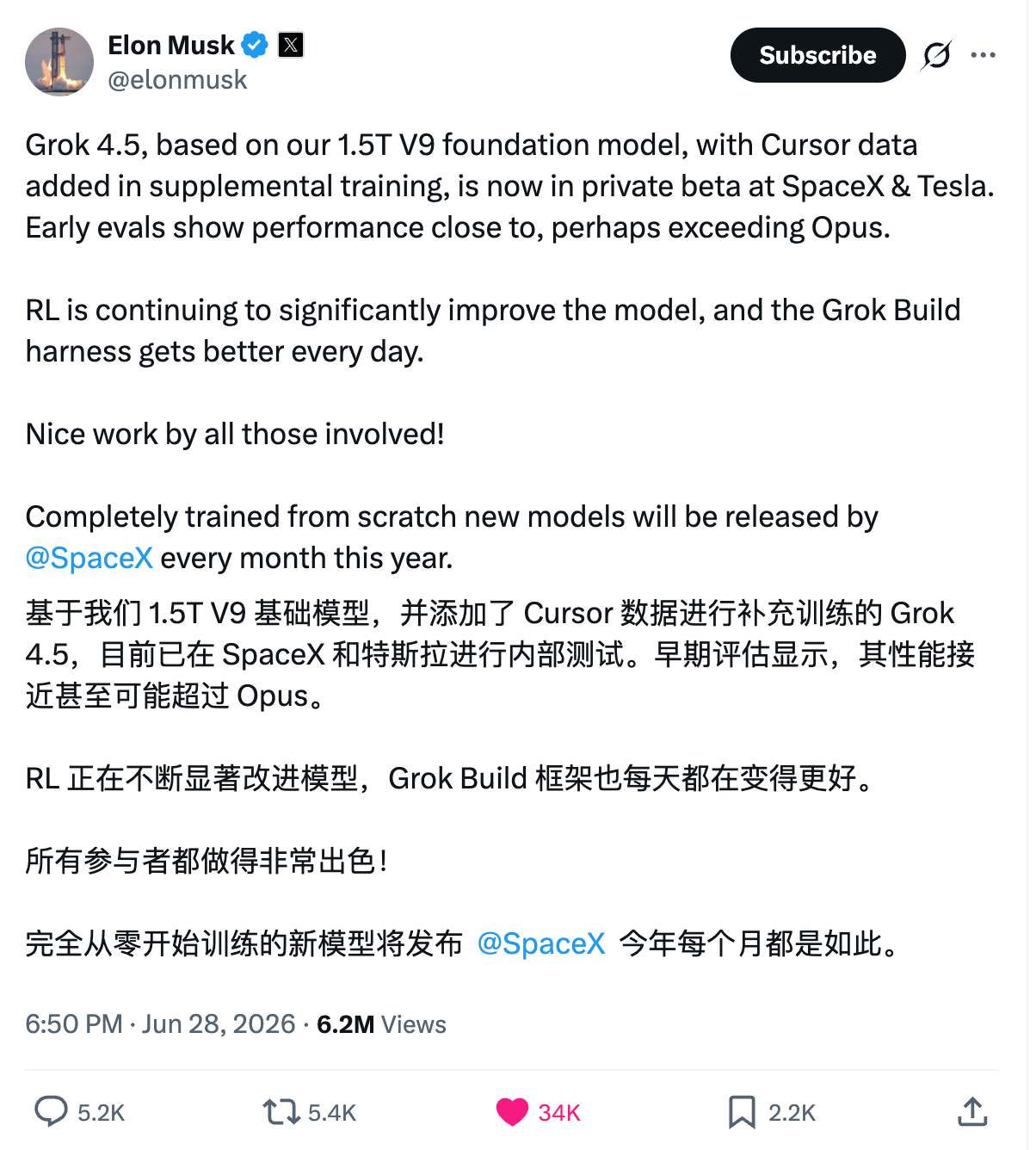
TradingKey — On June 28, Eastern Time, Elon Musk disclosed via the X platform that Grok 4.5, developed by xAI, is undergoing internal testing at SpaceX ( SPCX) and Tesla ( TSLA ), and announced plans to release a brand-new AI model "trained completely from scratch" every month for the remainder of this year.
[Source: X]
Grok 4.5 is based on xAI's proprietary 1.5-trillion-parameter V9 foundation architecture, with relevant data from the AI programming tool Cursor introduced in supplementary training. Earlier this month, SpaceX announced the acquisition of Anysphere, the parent company of Cursor, for $60 billion, with the transaction expected to close in the third quarter of 2026. Injecting Cursor's code data into Grok's training is clearly a strategic move by xAI to quickly catch up with competitors in coding capabilities.
In his post, Musk stated that internal evaluations show Grok 4.5's performance is close to, and potentially surpasses, Anthropic's Claude Opus. However, he also admitted that the model is still undergoing continuous optimization, particularly with reinforcement learning from human feedback (RLHF) still in progress. The accompanying "Grok Build" internal testing benchmark is also iterating daily.
Regarding the public release date—the point of greatest public interest—Musk did not provide a specific timeline. Following past patterns, xAI tends to roll out models to X platform subscribers in phases once internal testing is complete. However, the focus this time does not seem to be on the release timing of a single model; the proposition of releasing a new model "trained from scratch" every month has completely altered external expectations for xAI's R&D pace.
Traditional iterations of large language models are typically incremental upgrades; a "new model every month" means rebuilding the foundation model for each version, exponentially increasing R&D investment and computing power consumption. If this plan materializes, xAI will launch six independently trained large models within half a year, an R&D density far exceeding any competitor in the industry.
Notably, Grok 4.5 is being piloted and validated within SpaceX's and Tesla's internal business scenarios. Musk has repeatedly emphasized that for AI to be useful in the real world, it must be tested by the real world. The engineering complexity and error costs involved in rocket launches and automotive production are far higher than those of daily conversation scenarios; allowing the model to encounter pitfalls in internal operations first is more valuable for subsequent optimization than any benchmark test.
In February this year, SpaceX completed its acquisition of 100% of xAI at a valuation of $1 trillion. In May, xAI was officially integrated into SpaceX and renamed SpaceXAI. Backed by SpaceX's computing power and capital, xAI has secured resource support unmatched by other AI startups.
However, the cash burn rate is equally staggering. According to internal documents, xAI's operating loss for the first quarter of 2026 reached $2.47 billion, with capital expenditures at $7.7 billion. Although it completed a $20 billion Series E financing round in early 2026, most of those funds have already been funneled into data center construction and R&D expenses. Training a brand-new foundation model every month will only place greater pressure on cash flow.
This is also why Musk is so eager to accelerate product commercialization. The competitive landscape of the AI industry is becoming increasingly cutthroat, with OpenAI, Anthropic, Google ( GOOGL ), and DeepMind all continuously iterating. The capital market's patience with pure cash-burning models is wearing thin. xAI needs to prove to the outside world that its massive investments can translate into commercializable products, rather than just technical specifications on paper.
For the AI industry as a whole, Musk's "new model every month" strategy—regardless of whether it ultimately succeeds—has pushed the pace of competition to a new level of intensity. To match or not to match is a dilemma for competitors. Matching means substantially increasing R&D budgets and computing investments; not matching risks being left behind in the pace of iteration. At present, the public release date for Grok 4.5 remains unconfirmed.
Recommended Articles


