




NVIDIA Enters a Critical Week at $192 — Can Core PCE Spark the Next AI Stock Rebound?
TradingKey - NVIDIA (NASDAQ: NVDA) closed the week at $192.76, sliding within the blue channel sloping down under the 200-day EMA at $206.18. The Relative Strength Index (RSI) is at 31.82, clearly oversold. Recent candles are characterized by long lower shadows, signifying that buying is occurring in the $190 to $184 area.
The stock is down in most sessions since the May 20 earnings call where NVIDIA said it earned $81.6 billion in fiscal Q1 2027, a YoY growth rate of 85%. That was arguably the best quarter ever in the history of the semiconductor industry. The discrepancy between the company’s fundamentals and the stock’s price action is obvious as several issues, B200 lease pricing, exposure to China, selling by executives, and a valuation that may be a bit high, remain unaddressed.
This is in the week before a major calendar macro event that is most likely to trigger a re-rating of the stock: Core PCE for the month of May.
Why $192 Is More Important Than It Looks — The Channel Math
Although $192.76 may seem like just another low price, the significance lies in its location relative to horizontal support, which now extends in the vicinity of the $184.75 and $190.09 price levels where the downtrend channel is now pressing against. Only a move to below $184.75 leaves us with little in the way of structural support below that level before we hit $180.31, the channel extension target. Anything below $180.31 would test price levels that last existed before the price gap in the earnings report. $206.18, the point at which the 200-day moving average (EMA200) was broken, is now overhead resistance, not support, the structural change meaning that a rebound to the 200-day average now requires not a simple bounce, but a recovery.
The distance from $192.76 to the 200-day moving average at $206.18 is 6.9 percent, large enough that anyone looking to enter at these levels would need something more than an RSI oversold bounce on the fundamentals to get them there.
The 31.82 reading on the RSI signals that the indicator is in oversold conditions. With the positive divergence, a case where prices are hitting lower lows but the RSI is holding higher lows, the technical situation points to what we would consider the most likely tactical bounce in a down market. It does not, however, mean that the downtrend is over, it means that the selling wave is spent, and the next move in the market is a counter-trend rally. $196.00-plus entry targets $205.70, right below the 200-day EMA at $206.18, which represents a very reasonable first target that does not necessarily demand a change of trend, only a relief rally on an oversold market to the resistance of the 200-day EMA.
The Three Catalysts That Could Re-Rate NVDA in the Week of June 30
First and foremost, we’re looking at the May core Personal Consumption Expenditures (PCE) price index, which is the Federal Reserve’s preferred inflation reading. The Warsh Fed held rates steady at June 16 to 17 with April core CPI at 4.1 percent. That “higher for longer” rate posture is what’s driven tech valuations lower since May. If the May PCE release next week reveals a substantial slowdown compared to April, it would fundamentally alter the multiple compression narrative for NVDA.
The primary justification offered by sellers active since May 20 has been the stock’s lofty valuation. While a softer PCE number won’t resolve issues like China revenue or declining B200 rental rates, it does eliminate the macro backdrop that fuels anxiety over those specific factors; a hotter number would likely extend the compression cycle.
The next potential market mover would be any comments from major hyperscalers regarding AI capital expenditures. Microsoft, Google, Meta, Amazon, and Oracle are all currently utilizing Vera Rubin, the Blackwell successor to B200 that began mass manufacturing in Q3 2026. If a hyperscaler chief financial officer makes any public remarks at upcoming conferences or investor days confirming that AI capex has not been reduced, or has instead increased, this would directly counter the argument that soft B200 rental prices mean demand is slowing.
Rental price is an indicator of availability on a spot market, while hyperscaler capex reflects the value of the GPU purchases they are already contracting, which are not always tied one-to-one to spot pricing; comments from hyperscalers provide the clearest available evidence that the decline in B200 spot pricing is not necessarily due to a reduction in overall demand.
The final catalyst is strictly technical: If NVDA holds the $184.70-$190.09 support zone all week and the relative strength index (RSI) continues its positive divergence trend, then a bounce leading into the PCE becomes an increasingly likely outcome.
Three weeks of lower lows coupled with higher RSI lows constitute a textbook “bullish accumulation” trend, usually found leading up to the largest short-term price bounces for large-cap tech semiconductor stocks. A price hold all week with declining volume, already seen on the most recent trading candle, is itself a signal worth acknowledging.
NVDA Technical Setup Into the New Week
At $192.76, on the 4-hour chart NVDA remains below the 200 Exponential Moving Average (EMA) at $206.18. It is also trading within a falling downtrend marked by lower highs and lower lows, represented by the blue trend channel. RSI is at 31.82, indicating the market is severely oversold and with strong positive RSI divergence. The recent red candles feature substantial lower wicks, implying that support has been formed by buyer demand in the $190 to $184.75 price cluster. If the price breaks back out of the blue falling channel, we can assume it’s going to continue its fall back to the $184.75 lower bound of the support zone.
At $180.31, we have another support cluster. A price break through $196.00 indicates a bounce off oversold territory with an initial price target of $205.70 on the way to the 200 EMA at $206.18. A price drop back through $184.70 indicates support is broken, with the first target of the downside being $180.31.
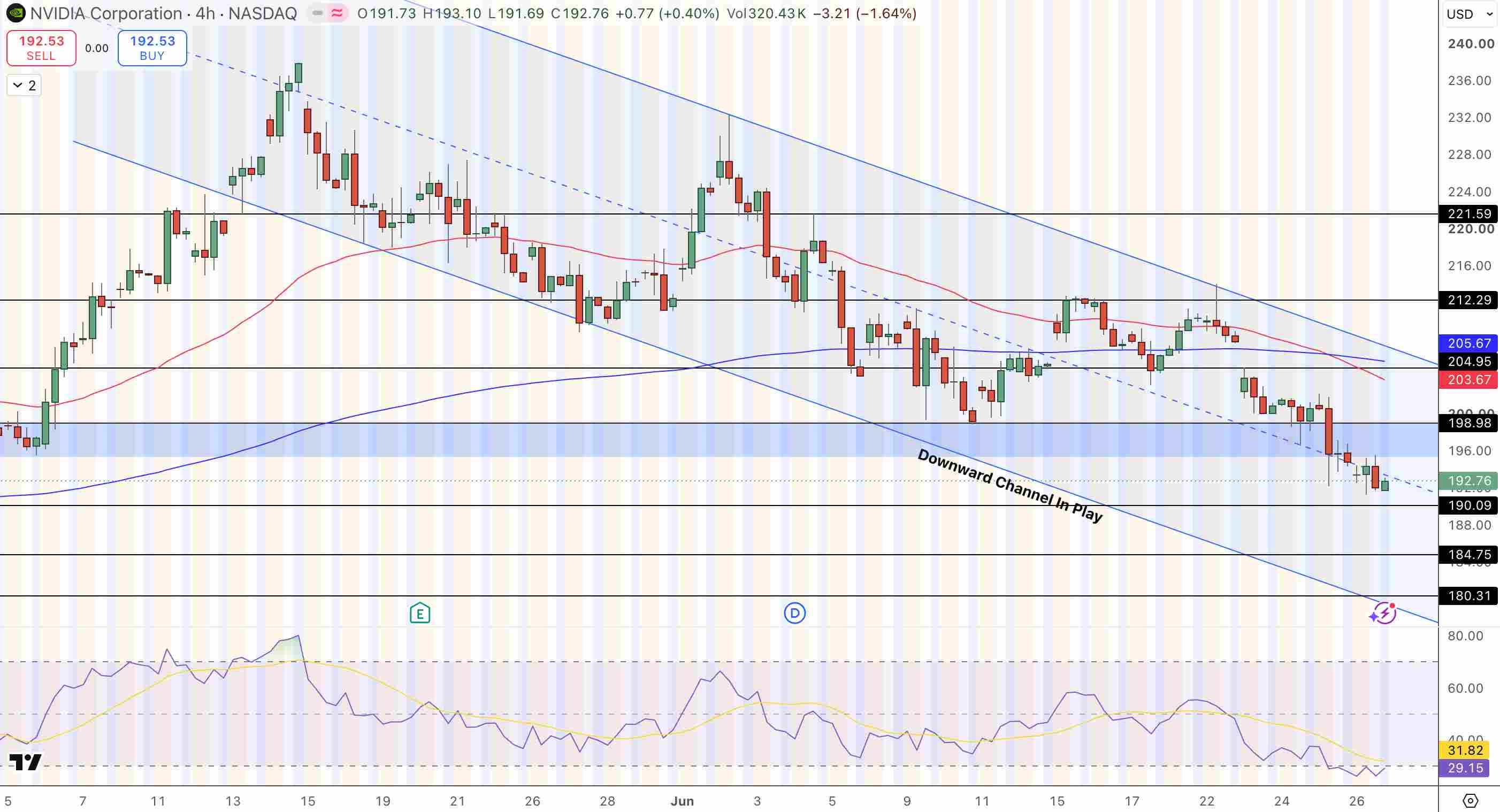
- Entry: Buy a break of 4H close through $196.00
- Target: $205.70, short term resistance is the EMA 200 at $206.18
- Support cluster: $190.09 to $184.75, the first area of structural support
- Stop Loss: Close below $184.70, $180.31 is the next major support cluster
- Primary catalyst: May PCE, week of June 30
- Secondary catalyst: Any major hyperscaler comments on AI capex or capex plans during the week of June 30
Why Has NVIDIA's Stock Fallen Despite Record Earnings?
Since hitting an all-time high (ATH) of $236.54 on May 14, NVDA has fallen in spite of its fiscal first quarter of 2027 (FY27Q1) results showing $81.6 billion in revenue, representing an 85% year-on-year (YoY) increase. The reason behind the decline comes from the combination of four overlapping factors: the rental price of the B200 GPU dropped from $6.11 to $4.22 in the space of three weeks, representing a 31% decrease. This price decline can be viewed as a real-time reflection of supply outstripping new workload demands.
In addition, NVIDIA’s China data center revenues declined from $4.6 billion a year ago to essentially nothing in a span of a few weeks when US export restrictions finally shut the offshore loophole. In the past three months, NVIDIA executives have sold off stock worth $410.6 million, and by the beginning of 2026, the stock was priced with a massive valuation premium that leaves little room to re-rate higher in any case, even in the presence of fundamental earnings beats.
What Is Vera Rubin and Does It Change the Investment Case?
Vera Rubin is NVIDIA’s Blackwell successor data center platform and has entered full production in Q3 2026. Among other names, major AI customers include OpenAI, Anthropic, xAI, Dell, Oracle, and CoreWeave. In addition, all three major memory HBM4 suppliers have been qualified and have commenced shipping.
Vera Rubin ramping during the second half of FY27 will be the most relevant forward revenue driver for whether NVIDIA’s Q2 earnings guidance of $91 billion represents an upper or lower bound on its next earnings call. Vera Rubin doesn’t change the price action for the current quarter but is the fundamental element that would be key to whether a bull narrative is reset in the following report.
What Is the Most Important Macro Event for NVDA Next Week?
The primary event is Core PCE inflation for May. The Warsh Fed’s higher-for-longer rate stance has served as a macro overhang compressing the NVDA stock’s valuation multiple since the May highs. Therefore, a lower-than-expected PCE number will provide better macro support to help offset the sell-off in NVDA. Conversely, a higher-than-expected PCE print will extend that macro overhang compressing NVDA’s multiple.
The other key catalyst is the AI infrastructure investment (capex) guidance from hyperscaler AI customers in any investor day events or analyst meetings. This will be the secondary catalyst that will directly address the key bearish case against NVIDIA’s B200 GPU rental price.
Bottom Line
NVDA ended the week at $192.76, near the low boundary of the descending channel’s support zone with RSI at 31, a heavily oversold reading which is showing positive price/RSI divergence. However, the same four factors that have weighed on the stock from $236.54 remain in force, and May’s PCE will be the next macro event most likely to alter the market’s narrative around NVDA’s multiple compression.
An entry above $196.00 sets a $205.70 price target with $184.70 as the exit stop. The three-week pattern of lower price lows with rising RSI lows setup with next week’s PCE data as the catalyst for the rally sets the stage, while Vera Rubin ramping and Q2 FY27 guidance of $91 billion provide the fundamental underpinning for where the oversold rally could go beyond just a bounce.
Recommended Articles


