




The Biggest IPOs in History -- and How They Performed
Key Points
Some of the biggest U.S.-listed public offerings are names that might surprise you.
Just as surprising is how little money these outfits actually raised at the time compared to their current size.
Even so, breaking fundraising records in place at the time of their IPOs merits a closer look.
- 10 stocks we like better than Alibaba Group ›
SpaceX's initial public offering is now officially imminent. Its final pricing is expected on June 11, with public trading to begin on June 12. The latest word is that the company aims to raise $75 billion by selling 555.6 million shares at $135 apiece, implying a corporate valuation of $1.75 trillion.
That would make it the biggest IPO ever in terms of the total amount of money raised, and in terms of market capitalization at the time the public offering is made. Indeed, that valuation would instantaneously make SpaceX the world's ninth biggest publicly traded company, right behind Broadcom, and just ahead of Elon Musk's other company, Tesla.
Will AI create the world's first trillionaire? Our team just released a report on the one little-known company, called an "Indispensable Monopoly" providing the critical technology Nvidia and Intel both need. Continue »
Almost needless to say, expectations are high.
This begs the question: What were the biggest U.S.-listed initial public offerings up until this point, and how did they perform out of the gate?
Uber Technologies
IPO date: May 10, 2019
Amount raised: $8.1 billion
Initial valuation: $82.4 billion
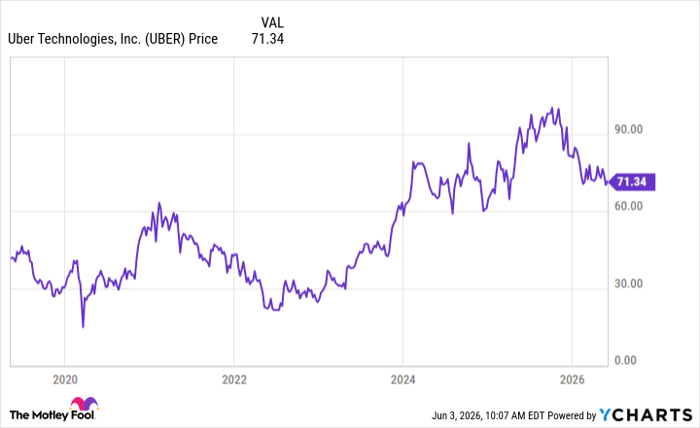
Ride-hailing outfit Uber Technologies (NYSE: UBER) arguably waited just a little too long to go public. While the company was still satisfied with its result in early 2019, insiders were disappointed with a final price that came in nearer the bottom of its suggested price range. Had it happened just a few months earlier -- when the hype surrounding the company was stronger -- Uber might have fared better.
Things worked out better in the long run for its earliest shareholders, though, letting them in at a lower price in front of a 58% gain since its IPO.
UBER data by YCharts.
Uber shares were losing ground shortly after the initial hype faded, but before the onset of the COVID-19 pandemic in early 2020 brought the world to a screeching halt, including companies' businesses. We'll never know for sure if the capitulation in March 2020 was caused by the contagion, or if it was going to happen anyway.
AT&T Wireless
IPO date: April 27, 2000
Amount raised: $10.6 billion
Initial valuation: $68.1 billion
Contrary to a common assumption, the AT&T Wireless of the early 2000s isn't really the AT&T (NYSE: T) of today. In fact, AT&T Wireless was technically a spinoff from AT&T that would go on to be acquired by Cingular in 2004. Cingular was part of SBC Communications, which would also eventually acquire the rest of AT&T anyway, and use the familiar name as an umbrella for all of its businesses. It's also been through several evolutions in the meantime, including the acquisition and eventual sale of DirecTV, as well as the purchase and exit of entertainment giant Time Warner.
That's why any lookback at this stock's post-IPO performance would be meaningless. Making it even more meaningless is the fact that it happened right at the beginning of the tech-wreck of 2000. It wasn't a publicly traded outfit long enough to really matter.
Image source: Getty Images.
For what it's worth, though, AT&T Wireless' IPO was still record-breaking at the time.
Rivian Automotive
IPO date: Nov. 10, 2021
Amount raised: $11.9 billion
Initial valuation: $66.5 billion
Although it happened smack-dab in the middle of the coronavirus contagion, that was actually a brilliant time for electric vehicle up-and-comer Rivian Automotive (NASDAQ: RIVN) to go public. Interest in stocks was high, and investor interest in electric vehicle manufacturers was particularly pronounced.
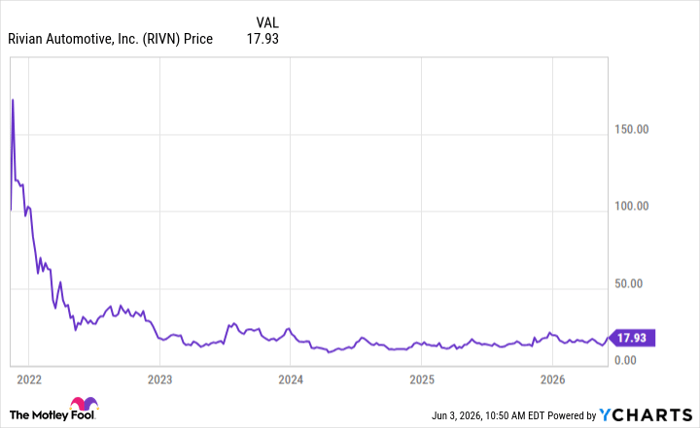
Unfortunately, that apparent bullishness would implode shortly thereafter. RIVN shares peaked just a few days after the company's IPO, leading into a sell-off that still has this stock valued 77% below its public offering price of $78.
RIVN data by YCharts.
Deutsche Telekom
IPO date: Nov. 18, 1996
Amount raised: €10.0 billion ($13 billion)
Initial valuation: $50 billion
Yes, Deutsche Telekom (OTC: DTEGY) is a German company serving the German market. It's got strong links to the U.S. market, though, and was very much a U.S. stock when the state-owned telecom carrier went public with a New York Stock Exchange (NYSE) listing in November 1996. The company is still the majority owner of American wireless powerhouse T-Mobile, and is currently even exploring the prospect of a full-blown merger of the two wireless outfits.
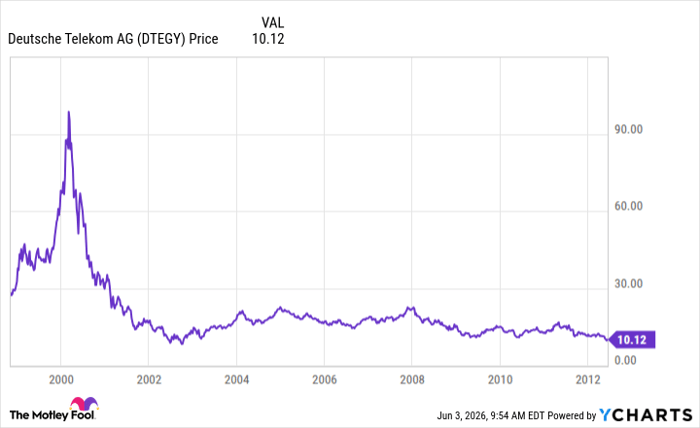
The NYSE listing of this ADR (American depositary receipt), created in conjunction with its listing in Germany, has since been downgraded to an over-the-counter -- or OTC -- issue. The stock hasn't performed particularly well since tumbling during, and because of, the dot-com meltdown of 2000.
DTEGY data by YCharts.
There's no denying that it had a very strong start, even if it was fueled by the unsustainably bullish hype that was starting to firm up in the latter half of the 1990s.
General Motors
IPO date: Nov. 17, 2010
Amount raised: $20.1 billion
Initial valuation: $63 billion
It's true! The General Motors (NYSE: GM) of today has only been publicly traded since late 2010. There's some important context to remember. The old General Motors went bankrupt in 2009, forcing a reorganization that led to the creation of brand new shares.
Regardless, at the time of their public debut, their sale represented the stock market's largest-ever fundraising.
They've performed pretty well in the meantime, too. Although they ran into a headwind in early 2011 that would linger into and through most of 2012, shares are now up a little over 150% since then. That's pretty impressive for an automobile maker.
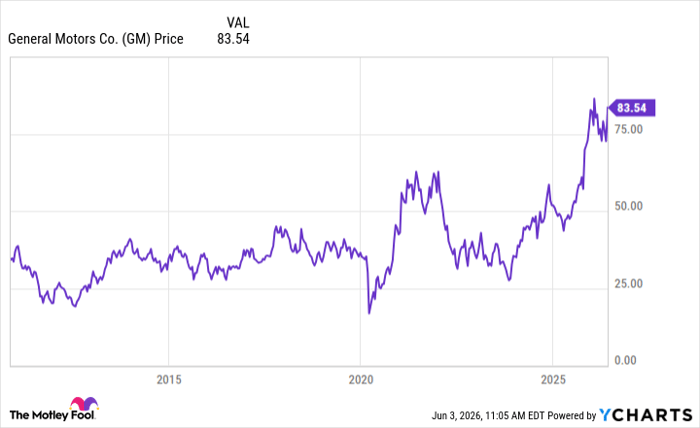
GM data by YCharts.
IPO date: May 18, 2012
Amount raised: $16 billion
Initial valuation: $104 billion
Meta Platforms (NASDAQ: META) -- back when it was still just Facebook -- tells one of the market's most cautionary tales about insisting on buying newly minted stocks as soon as you can. It tumbled right out of the gate, falling more than 50% over the course of the 18 weeks following its May 2012 public offering.
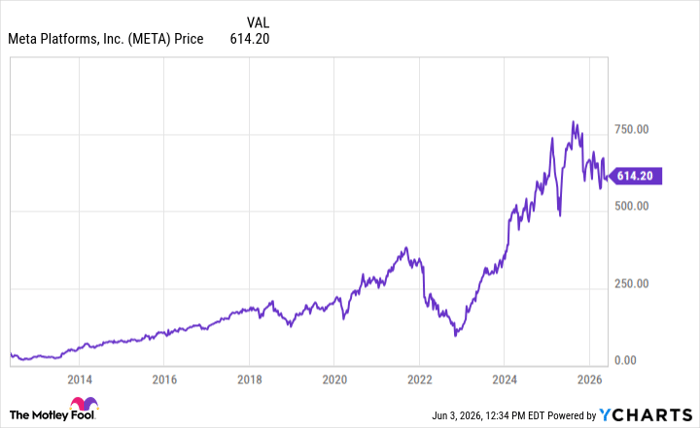
META data by YCharts.
Granted, it's since gone on to gain more than 1,600% from its public offering price, clearly paying off for patient shareholders.
Visa
IPO date: March 19, 2008
Amount raised: $19.1 billion
Initial valuation: $39 billion
Although it's been around seemingly forever, credit card payment network giant Visa (NYSE: V) has only been publicly traded since early 2008. It's done very well during this 18-year stretch, surging immediately after its shares began trading on the NYSE.
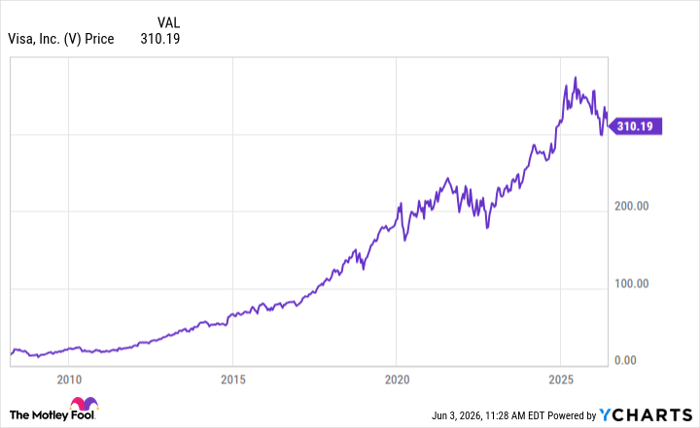
V data by YCharts.
Now look more closely at the chart above. While it rallied right out of the gate and is well up for the entirety of its existence, less than three months after its IPO, it was down more than 50% from its post-IPO peak.
Even so, at the time, its public offering broke U.S. fundraising records.
Alibaba
IPO date: Sept. 18, 2014
Amount raised: $25 billion
Initial valuation: $167.7 billion
Finally, add China's e-commerce powerhouse Alibaba (NYSE: BABA) to the list of the biggest-ever U.S. public offerings. At a total of $25 billion raised, it's still technically the biggest, in fact, even if that title is doomed by the looming SpaceX IPO.
Like most of the other names on -- and not on -- this list, BABA stock got a pretty good start as a publicly traded equity. However, also like most other well-watched IPOs, this one rolled over about a month after its public offering. A little over a year later, shares were down by more than half of their post-IPO high, falling under their public offering price in the process.
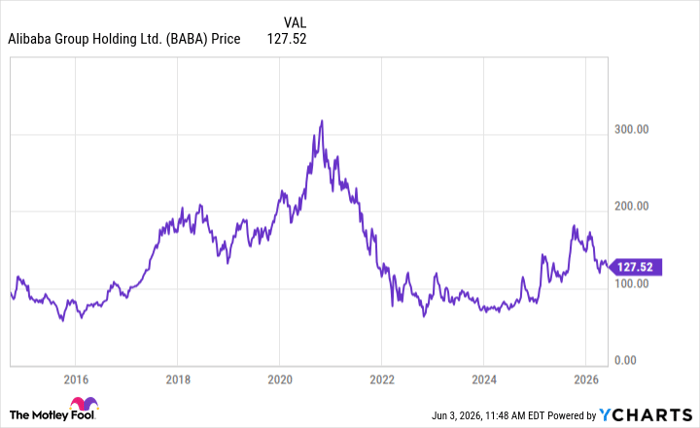
BABA data by YCharts.
The stock's obviously overcome this early setback in the meantime, although it's been a spectacularly wild ride.
The takeaway
There are arguably some names missing from this list, like Saudi Aramco, SoftBank, NTT Mobile, and Enel SpA, just to name a few. These tickers are largely excluded because these companies' primary stock listings aren't in the United States, or these names were -- and are -- of little interest to most U.S. investors.
The same underlying patterns that apply to the tickers discussed above apply to them, however, just as they're likely to apply to the upcoming IPO of SpaceX stock. That's a whole lot of bullish interest shortly after the stock starts trading, followed by a prolonged period of weakness rooted in the reality that these stocks' early valuations don't make a whole lot of sense. There was simply too much hype doing too much work early on.
Still, there's no denying that most of these sizable, high-profile public offerings ended up panning out nicely for patient early shareholders.
Should you buy stock in Alibaba Group right now?
Before you buy stock in Alibaba Group, consider this:
The Motley Fool Stock Advisor analyst team just identified what they believe are the 10 best stocks for investors to buy now… and Alibaba Group wasn’t one of them. The 10 stocks that made the cut could produce monster returns in the coming years.
Consider when Netflix made this list on December 17, 2004... if you invested $1,000 at the time of our recommendation, you’d have $443,191!* Or when Nvidia made this list on April 15, 2005... if you invested $1,000 at the time of our recommendation, you’d have $1,258,838!*
Now, it’s worth noting Stock Advisor’s total average return is 941% — a market-crushing outperformance compared to 211% for the S&P 500. Don't miss the latest top 10 list, available with Stock Advisor, and join an investing community built by individual investors for individual investors.
See the 10 stocks »
*Stock Advisor returns as of June 6, 2026.
James Brumley has positions in AT&T. The Motley Fool has positions in and recommends Broadcom, Deutsche Telekom Ag, Meta Platforms, Tesla, Uber Technologies, and Visa. The Motley Fool recommends Alibaba Group, General Motors, and T-Mobile US. The Motley Fool has a disclosure policy.
Recommended Articles


