




Is Snowflake the New Market Darling of AI Software -- or Will It Follow Palantir's Path?
Key Points
Snowflake's stronger-than-expected growth and improved guidance led to a sharp jump in its stock price following its recent results.
However, the stock is expensive, and that could weigh on its performance in the future.
We have already seen that expensively valued software stocks, such as Palantir, have struggled on the market this year despite delivering phenomenal growth.
- 10 stocks we like better than Palantir Technologies ›
Snowflake (NYSE: SNOW) stock was down in the dumps until May 27 this year, but a solid set of results for the first quarter of fiscal 2027 (which ended on April 30) sent it skyrocketing the following day.
Snowflake stock surged a whopping 36% on May 28, as it beat Wall Street's expectations and raised its full-year revenue and earnings guidance. The stock -- which had lost 19% of its value in 2026 before the release of its fiscal Q1 results on May 27 -- seems to have become the new darling of the artificial intelligence (AI) software space.
Will AI create the world's first trillionaire? Our team just released a report on the one little-known company, called an "Indispensable Monopoly" providing the critical technology Nvidia and Intel both need. Continue »
That's not surprising, as Snowflake's AI business is taking off. The company operates a cloud-based data platform, which helps customers store and analyze both structured and unstructured data. Snowflake's platform also enables customers to share data, derive analytics and insights from their proprietary data, and build applications, among other use cases.
As Snowflake has been offering AI software tools to its customers to get more out of their data, it is easy to see why it is anticipating faster growth. However, is it a good idea to buy this AI stock following its latest results? Or will it meet the same fate as Palantir Technologies (NASDAQ: PLTR), a stock that has slipped substantially this year despite delivering phenomenal growth?
Let's find out.
Image source: The Motley Fool.
AI is going to supercharge Snowflake's growth
Snowflake's fiscal Q1 revenue increased 33% year over year to $1.39 billion. Its non-GAAP earnings per share increased by an impressive 62.5% year over year to $0.39. Snowflake management noted on the latest earnings call that its overall customer count increased by 38% year over year to almost 14,000.
Snowflake notes that the adoption of its AI tools is increasing rapidly. It is worth noting that 13,600 customer accounts were using its AI solutions last quarter, up from 5,200 in the year-ago period. Even better, Snowflake's robust customer growth is accompanied by increased spending by existing customers.
This is evident from the company's net revenue retention rate of 126%. This metric, which is calculated by dividing the product revenue generated by Snowflake's customers in a period by the spending by those same customers in the year-ago period, expanded by a couple of percentage points year over year. A net revenue retention rate of more than 100% means that Snowflake's existing customers are spending more money on its offerings.
Given that Snowflake continues to add new customers at a nice clip, it won't be surprising to see its revenue pipeline getting better in the future. In fact, Snowflake's remaining performance obligations (RPO), which is the value of contracts yet to be fulfilled at the end of a quarter, increased by 38% year over year in fiscal Q1 to $9.2 billion.
That was higher than the company's revenue growth, suggesting its future growth is likely to accelerate. This is precisely why Snowflake management now expects 31% growth in its product revenue in fiscal 2027, higher than the 27% growth it had expected earlier.
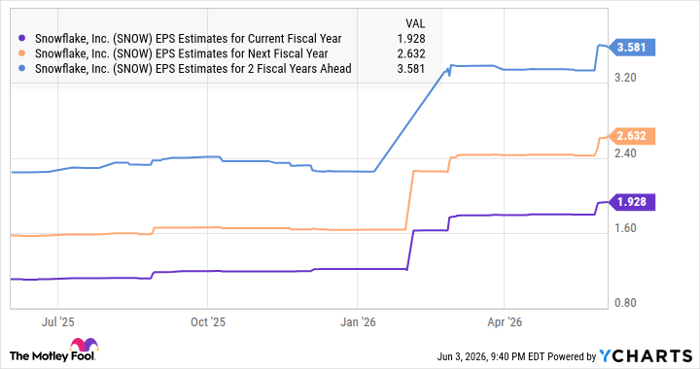
Analysts are expecting its earnings per share to increase by 54% in the current fiscal year to $1.93, and they have hiked their growth expectations for the next couple of years as well.
Data by YCharts
Ideally, the potential acceleration in Snowflake's bottom-line growth should be rewarded with more upside. However, there is one factor that may limit its upside potential, and that's precisely why I think that Snowflake could get the Palantir treatment on the stock market.
An expensive valuation could weigh on the stock, just like what Palantir investors have been experiencing
Palantir stock is down by 15% so far in 2026. That's despite the company's impressive growth. Palantir's Q1 revenue increased by 85% year over year to $1.63 billion. Its adjusted earnings per share increased by 2.5x to $0.33 per share. What's more, Palantir raised its full-year guidance, but that hasn't boosted investor confidence in the stock.
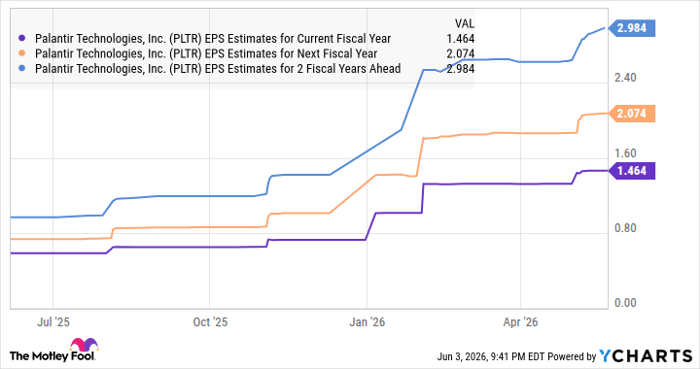
Just like Snowflake, even Palantir is building a solid revenue pipeline. Its remaining deal value, which is the total value of contracts yet to be fulfilled at the end of a quarter, nearly doubled year-over-year in Q1 to $11.8 billion. This explains why consensus estimates are projecting a 95% spike in Palantir's earnings this year, followed by impressive growth over the next couple of years.
Data by YCharts
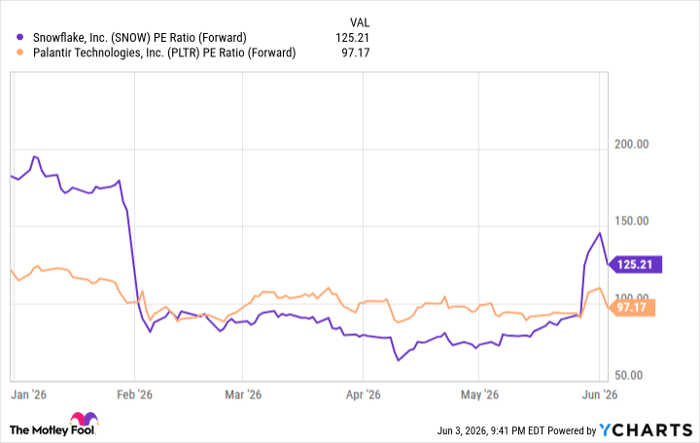
However, the stock trades at an expensive 161 times earnings. Its forward earnings multiple of 97 isn't cheap either. However,, Palantir's forward earnings multiple is lower than Snowflake's.
Data by YCharts
Additionally, Palantir is growing at a much stronger pace, and its future growth is likely to be better than Snowflake's, as per the charts above. So, the post-earnings pop in Snowflake stock doesn't necessarily guarantee that it will go on a sustained bull run from here. Palantir investors are already experiencing this pain in 2026.
That's why investors would do well to assess their risk profile before buying Snowflake stock, as its expensive valuation could weigh on its performance in the future.
Should you buy stock in Palantir Technologies right now?
Before you buy stock in Palantir Technologies, consider this:
The Motley Fool Stock Advisor analyst team just identified what they believe are the 10 best stocks for investors to buy now… and Palantir Technologies wasn’t one of them. The 10 stocks that made the cut could produce monster returns in the coming years.
Consider when Netflix made this list on December 17, 2004... if you invested $1,000 at the time of our recommendation, you’d have $439,632!* Or when Nvidia made this list on April 15, 2005... if you invested $1,000 at the time of our recommendation, you’d have $1,316,532!*
Now, it’s worth noting Stock Advisor’s total average return is 960% — a market-crushing outperformance compared to 211% for the S&P 500. Don't miss the latest top 10 list, available with Stock Advisor, and join an investing community built by individual investors for individual investors.
See the 10 stocks »
*Stock Advisor returns as of June 4, 2026.
Harsh Chauhan has no position in any of the stocks mentioned. The Motley Fool has positions in and recommends Palantir Technologies and Snowflake. The Motley Fool has a disclosure policy.
Recommended Articles


