




Pinduoduo Earnings Preview: Can Temu Sustain the Overseas Growth Story?
TradingKey - On May 27, Eastern Time, PDD Holdings ( PDD) will release its first-quarter 2026 financial results before the U.S. market opens and will hold an earnings call at 7:30 AM Eastern Time that same day.
The market generally expects PDD Holdings' revenue for the first quarter of this year to reach approximately $16.1 billion, with revenue projected to continue growing compared to the same period last year.
Compared to the past when the market focused solely on revenue growth, the focus of this earnings report is whether PDD Holdings can maintain its profit margins against the backdrop of intensifying competition in China's e-commerce sector and rising overseas regulatory and tariff pressures for Temu.
Can Growth Engine Temu’s Profit Margins Withstand the Test?
The market's primary focus for this earnings report remains Temu. Over the past two years, Temu has been a significant driver of Pinduoduo's valuation expansion, proving that the company's supply chain and low-price model can be rapidly replicated overseas. However, shifting U.S. tariff policies, adjustments to de minimis tax exemption rules for low-value packages, and rising overseas compliance costs are all eroding Temu's original price advantage.
Temu's greatest external pressure stems from changes in U.S. trade policy. The United States has officially terminated the tariff exemption policy for small packages valued under $800. This means that regardless of value or shipping method, all low-value packages entering the U.S. no longer receive tax-exempt treatment. Consequently, the low-price model Temu relies on—direct shipping from China—has been hit, forcing the platform to adjust its logistics and localized fulfillment models.
Wall Street's concerns regarding Pinduoduo are also centered here: if Temu continues to expand, it will require more investment in subsidies, warehousing, logistics, and compliance; if expansion slows, the market will worry that the overseas growth story is cooling down.
Regarding the upcoming first-quarter earnings report, the market will closely observe whether U.S. policy changes have already been reflected in Pinduoduo's costs and margins. If tariffs, customs clearance, warehousing, and local fulfillment costs rise significantly, Temu may further depress the group's gross and operating margins, even if it continues to contribute to revenue growth.
Beyond the U.S. market, Temu's regional expansion path will also be a key focus. Facing U.S. policy uncertainty, Temu needs to accelerate its expansion in markets such as Europe, Latin America, and the Middle East, while pushing forward a "local-to-local" fulfillment model. This involves introducing local sellers, local warehousing, and regional supply chains to reduce dependence on direct shipping from China. While this transition helps improve compliance and delivery experience, it also implies higher investment in the short term: the platform must build local merchant ecosystems, logistics networks, after-sales capabilities, and compliance teams, making it difficult to alleviate margin pressure quickly.
The market will also focus on whether Temu possesses pricing power. Low prices are key to Temu's market entry, but if rising tariffs and logistics costs are borne entirely by the platform or merchants, profitability pressure will intensify. Conversely, passing some costs on to consumers could weaken price competitiveness and impact order growth. Business Insider previously reported that tariff changes had forced Temu to raise prices on some goods while continuing to maintain stable supply through partnerships with regional merchants.
Overall, Temu remains Pinduoduo's most imaginative business segment and its greatest source of uncertainty. If the first-quarter report shows that Temu can maintain growth while offsetting costs despite the impact of U.S. policies, the market may reconfirm Pinduoduo's global e-commerce narrative. However, if Temu's growth slows and marketing and fulfillment investments continue to climb, Pinduoduo's valuation could be further weighed down by downward pressure on profit margins.
China Domestic Main Site: Low-price advantage persists, but competitive pressure continues to rise.
In terms of domestic operations in China, Pinduoduo's main site still possesses strong user mindshare and low-cost supply chain advantages, but competitive pressure is mounting.
Platforms like Alibaba, JD.com, and Meituan are continuously doubling down on instant retail, low-price subsidies, local fulfillment, and membership systems. Domestic e-commerce competition has shifted from traditional shelf-based models to instant retail scenarios with 30-minute to 1-hour delivery. Barron's reported that China's instant retail market is expanding rapidly, with Alibaba, JD.com, and Meituan all investing in infrastructure and subsidies to compete for market share, a move that will exacerbate industry-wide margin pressures.
For Pinduoduo, the difficulty lies in how to further improve user retention, merchant quality, and supply chain efficiency beyond low-price tactics. Management previously proposed increasing supply chain investment and emphasized that 2026 marks the beginning of the next decade. If the growth of domestic marketing service revenue slows this quarter, the market may worry that the traffic dividend of the main site is waning; however, if the platform can stabilize growth through merchant support, supply chain upgrades, and high-frequency consumption scenarios, it would help mitigate valuation pressures stemming from Temu's uncertainty.
What should investors focus on? How did the stock price react post-earnings?
For investors, the key focus should be whether the quality of growth reflected in Pinduoduo's earnings report is high enough.
If first-quarter revenue meets or exceeds expectations while profit margins do not significantly deteriorate further, it would indicate that Pinduoduo can still maintain strong operating efficiency during a high-investment cycle, potentially providing momentum for a stock price recovery.
Conversely, if revenue growth slows, profit margins continue to decline, and management continues to emphasize long-term investment without a clear path for short-term improvement, the market may continue to downgrade its earnings forecasts, putting further downward pressure on Pinduoduo's stock price.
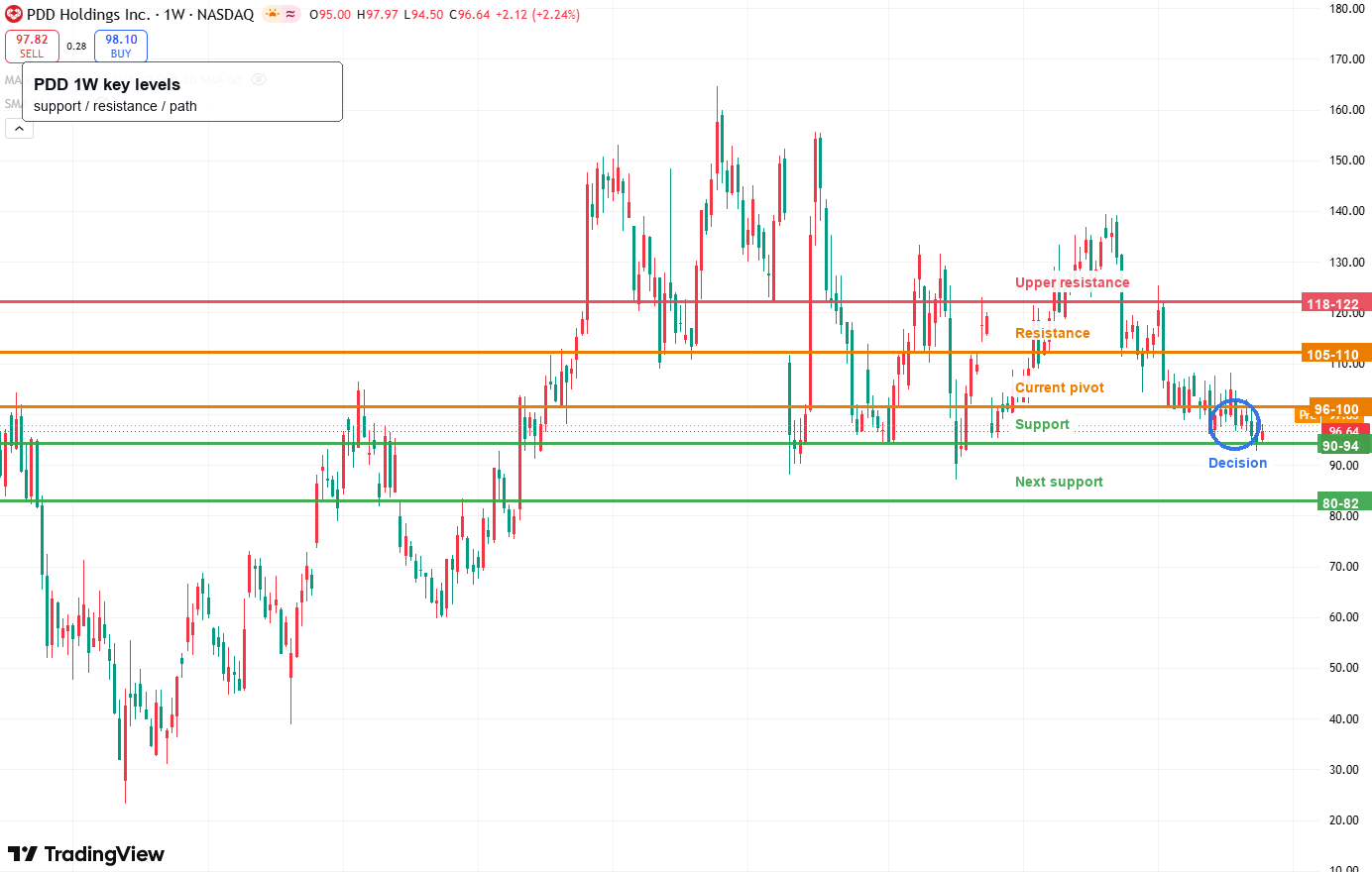
Pinduoduo Stock Price Daily Chart, Source: TradingView
From a technical perspective, PDD's weekly chart is currently oscillating near the previous pivot of 96-100, with the structure on the right showing signs of downward pressure as highs gradually lower. The 90-94 range is key short-term support; if it breaks below this area, the next level to watch is 80-82. To the upside, the initial resistance is at 105-110; only a break back above this zone would provide an opportunity to retest 118-122. A stronger overhead resistance zone lies at 135-140.
Recommended Articles


