




This AI Stock Has Been Called Overvalued for 3 Years. The Bears Keep Losing.
Key Points
Nvidia has been labeled "overvalued" for years due to its rapid growth.
The numbers don't back that up, as it trades at a lower valuation than other top chipmakers.
Nvidia has also consistently delivered strong revenue growth.
- 10 stocks we like better than Nvidia ›
Nvidia (NASDAQ: NVDA) has been one of the best-performing stocks ever, thanks to the growth of artificial intelligence, but for much of its run, people have called it overvalued. Cathie Wood wrote that it was "priced ahead of the curve" in May 2023. In early 2024, Morningstar analysts called it overvalued.
This is Exhibit A for why investors shouldn't see "overvalued" as a bad word. Over the last three years, Nvidia has been up 600%. The S&P 500 has increased 78% over the same period. The bears have been wrong so far, and based on Nvidia's financial performance, I think that trend will continue.
Will AI create the world's first trillionaire? Our team just released a report on the one little-known company, called an "Indispensable Monopoly" providing the critical technology Nvidia and Intel both need. Continue »

Image source: Nvidia.
The numbers keep proving the bears wrong
Nvidia has consistently surpassed expectations. Since it recently released its fiscal Q1 2027 earnings (which ended April 26, 2026), we have fresh data to review.
Revenue hit a record $81.6 billion, up 85% year over year and marking 14 consecutive quarters of revenue growth. Data center revenue, which now makes up the bulk of Nvidia's earnings, rose 92% year over year to $75.2 billion. Not only does Nvidia continue to deliver excellent growth quarter after quarter, but it also does so with high profit margins, most recently 74.9%.
Detractors often point to Nvidia's massive market cap, currently over $5 trillion, as an argument against much future growth. But when you look at how much money it's making, the price makes sense, since it's not a particularly expensive company. Nvidia trades at 25 times forward earnings, significantly less than fellow semiconductor stocks Advanced Micro Devices and Broadcom, which trade at 61 and 37 times forward earnings, respectively.
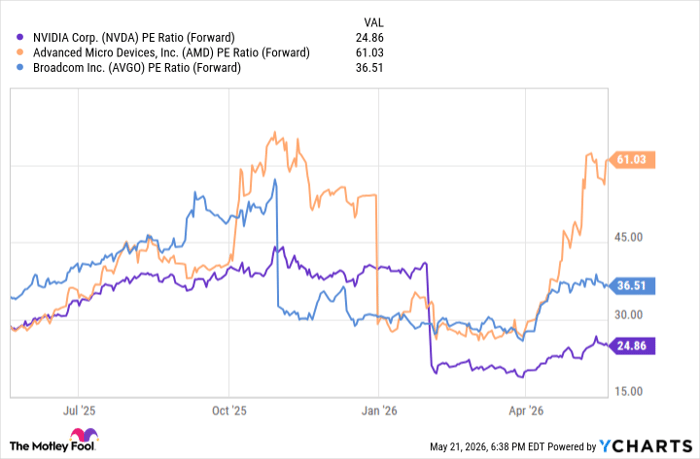
NVDA PE Ratio (Forward) data by YCharts
Will Nvidia continue to outperform?
Nvidia almost certainly won't keep growing at the same rate it has over the last three years. After all, three years ago, it was worth less than $1 trillion. However, it could still be a market-beating investment, especially considering its sales projections.
It expects approximately $91 billion in revenue in its fiscal Q2 2027, which would be another record-breaker. At Nvidia's 2026 GTC conference, CEO Jensen Huang projected that the company's Blackwell and Vera Rubin GPUs would see at least $1 trillion in sales through 2027.
Most analysts remain bullish on Nvidia, too, with 52 of 54 covering the company rating it a buy. The average price target is $299, a 35% increase from where Nvidia stock is at the time of this writing.
The AI infrastructure build-out is accelerating, and Nvidia remains one of the top AI stocks. With Nvidia's earnings growth, there's a much stronger argument that it's undervalued, not overvalued.
Should you buy stock in Nvidia right now?
Before you buy stock in Nvidia, consider this:
The Motley Fool Stock Advisor analyst team just identified what they believe are the 10 best stocks for investors to buy now… and Nvidia wasn’t one of them. The 10 stocks that made the cut could produce monster returns in the coming years.
Consider when Netflix made this list on December 17, 2004... if you invested $1,000 at the time of our recommendation, you’d have $477,813!* Or when Nvidia made this list on April 15, 2005... if you invested $1,000 at the time of our recommendation, you’d have $1,320,088!*
Now, it’s worth noting Stock Advisor’s total average return is 986% — a market-crushing outperformance compared to 208% for the S&P 500. Don't miss the latest top 10 list, available with Stock Advisor, and join an investing community built by individual investors for individual investors.
See the 10 stocks »
*Stock Advisor returns as of May 25, 2026.
Lyle Daly has positions in Broadcom and Nvidia. The Motley Fool has positions in and recommends Advanced Micro Devices, Broadcom, and Nvidia. The Motley Fool has a disclosure policy.
Recommended Articles


