




TBUX vs. TLT: Which Bond Fund Is the Better Buy?
Key Points
The T. Rowe Price Ultra Short-Term Bond ETF has delivered annualized returns of 4.1% for the past four-plus years.
The iShares 20+ Year Treasury Bond ETF has lost 1.37% per year for the past 10 years.
Longer-duration bonds are vulnerable to long-term interest rate risks and may not be a good choice for most individual investors.
- 10 stocks we like better than T. Rowe Price Exchange-Traded Funds - T. Rowe Price Ultra Short-Term Bond ETF ›
People buy bonds for a few reasons: to earn steady interest income, diversify their portfolio away from stocks, and avoid the risk of losing money on stock market downturns. But bonds aren't always "safe." Bond prices can go down just as stock prices do, and bond returns can be negative for years at a time.
Choosing the right bond-focused exchange-traded fund (ETF) can help protect against those risks. Let's look at two popular bond funds with highly different strategies.
Will AI create the world's first trillionaire? Our team just released a report on the one little-known company, called an "Indispensable Monopoly" providing the critical technology Nvidia and Intel both need. Continue »
The T. Rowe Price Ultra Short-Term Bond ETF (NYSEMKT: TBUX) is a bond fund that focuses on short-term debt (mostly with maturities of 1.5 years or less) from investment-grade corporate and government bond issuers. The iShares 20+ Year Treasury Bond ETF (NASDAQ: TLT) is, as its name suggests, invested in U.S. Treasury bonds with maturities greater than 20 years.
During the past four-plus years since its inception, the short-term bond fund has strongly outperformed the longer-duration iShares bond fund:
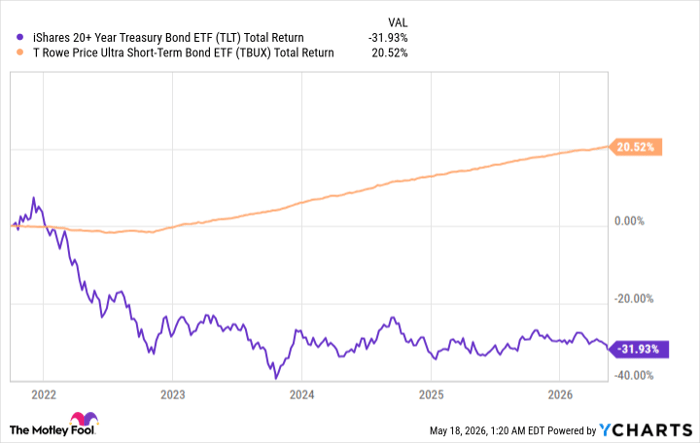
TLT Total Return Level data by YCharts
Let's see which fixed-income fund is the better buy for most long-term investors.
TBUX: Four-plus years of 4.1% annualized returns
The past few years haven't been great for most bond investors. That's because the Federal Reserve started raising interest rates in 2022, and when interest rates go up, bond prices tend to go down.
This might sound surprising. Wouldn't higher interest rates be good for bond investors because they earn more money on the higher bond yields?
Think of it this way: When a bond is issued at a certain interest rate, it is expected to pay a certain amount of income for the bondholder during the duration of the bond -- such as a 10-year U.S. Treasury bond paying 5% per year. But if a new bond is issued at a higher interest rate (like a 10-year Treasury paying 6% per year), the older 5% bond is now worth less because investors can buy a higher-yielding bond that will pay more income.

Image source: Getty Images.
Bond investors face a few types of risk:
- Default risk: Not getting repaid by the company or government that issued the bond and borrowed investors' money
- Credit risk: The bond issuer becoming less creditworthy
- Interest rate risk: Interest rates will go up, making the bond's price go down
Faced with all these risks, the T. Rowe Price Ultra Short-Term Bond ETF has performed decently well. The fund has delivered average annual total returns (by net asset value) of 4.10% since the fund was launched in September 2021, 5.81% for the past three years, and 4.96% for the past year (as of April 30).
This short-term bond fund only invests in investment-grade bonds, so its credit and default risks are low. It holds bonds from 292 issuers.
The fund's top five holdings by sector are:
- Corporate bonds and notes (60.9% of the fund)
- Asset-backed securities (20.2%)
- Mortgage-backed securities (8.4%)
- U.S. Treasury bonds and notes (5.8%)
- Commercial mortgage-backed securities (CMBS) (2%)
Since this fund only invests in short-term bonds, it's less sensitive to interest rate risk from long-term interest rates that are beyond anyone's control. But be aware of the fees -- its expense ratio is 0.17%. Some of the best bond ETFs charge expense ratios of 0.07% or lower.
TLT: 10 years of negative returns (-1.37% annualized)
The iShares 20+ Year Treasury Bond ETF is an example of the dangers of interest rate risk. This fund has delivered negative returns over the past 10 years, losing an average of 1.37% per year for the past 10 years. And the fund charges an expense ratio of 0.15%.
Because this fund only invests in U.S. Treasury bonds, you might think it can't lose money. But when long-term Treasury yields (aka interest rates) rise, this bond fund's price falls. And during the past few years, the yield on the 20-year U.S. Treasury bond has gone up considerably -- from lows of around 1% in 2020 to its current level of over 5%.
Brighter days could be ahead for investors in this bond fund. As of May 14, its 30-day SEC yield was 4.98%. But with inflation and concerns about the U.S. national debt and the costs of the Iran war, long-term interest rates could rise. That would bring more bad news for investors in this long-duration bond fund.
Why buy TBUX instead of TLT
I don't believe long-duration bond funds are a good choice for most individual investors. Most long-duration bonds are a better choice for institutional investors like pension funds and insurance companies -- they want reliable long-term yields and can hold on to those bonds for the long run, no matter what happens to interest rates and bond prices along the way.
But for most people trying to save for retirement or live off their investment portfolio in retirement, the risks of long-duration interest rates are too big. Bonds should give you safety and a reliable income, not years of big losses.
The iShares 20+ Year Treasury Bond ETF will likely lose money if interest rates rise. If inflation stays higher for longer or bond investors demand higher yields from the U.S. government, that's a risk investors should try to avoid. I don't want to bet that long-term interest rates will go down anytime soon -- the U.S. government is borrowing too much money for that.
For those reasons, if I had to choose between these two bond funds, I'd buy the T. Rowe Price Ultra Short-Term Bond ETF. But neither fund ranks among the best bond ETFs. You might want to keep searching.
Should you buy stock in T. Rowe Price Exchange-Traded Funds - T. Rowe Price Ultra Short-Term Bond ETF right now?
Before you buy stock in T. Rowe Price Exchange-Traded Funds - T. Rowe Price Ultra Short-Term Bond ETF, consider this:
The Motley Fool Stock Advisor analyst team just identified what they believe are the 10 best stocks for investors to buy now… and T. Rowe Price Exchange-Traded Funds - T. Rowe Price Ultra Short-Term Bond ETF wasn’t one of them. The 10 stocks that made the cut could produce monster returns in the coming years.
Consider when Netflix made this list on December 17, 2004... if you invested $1,000 at the time of our recommendation, you’d have $469,293!* Or when Nvidia made this list on April 15, 2005... if you invested $1,000 at the time of our recommendation, you’d have $1,381,332!*
Now, it’s worth noting Stock Advisor’s total average return is 993% — a market-crushing outperformance compared to 207% for the S&P 500. Don't miss the latest top 10 list, available with Stock Advisor, and join an investing community built by individual investors for individual investors.
See the 10 stocks »
*Stock Advisor returns as of May 18, 2026.
Ben Gran has no position in any of the stocks mentioned. The Motley Fool has no position in any of the stocks mentioned. The Motley Fool has a disclosure policy.
Recommended Articles


