




Is the SpaceX IPO Overpriced? Here's How Much It Could Be Worth, According to a Valuation Expert.
Key Points
A valuation expert sees SpaceX's revenue soaring during the next decade with excellent profit margins.
SpaceX holds a significant competitive advantage in its launch and satellite internet businesses.
Valuing SpaceX requires making a lot of assumptions.
- 10 stocks we like better than Alphabet ›
SpaceX is set to make history this summer with its public market debut. The company confidentially filed for an initial public offering (IPO) with the Securities and Exchange Commission (SEC) in April, aiming for a potential listing in June. The company could be valued at $1.75 trillion or more, offering $75 billion of stock to the public. That would make it the largest IPO ever.
To put that in perspective, there are only a handful of companies, public or private, that are valued at more than $1.75 trillion. It's easy to forget that fact when some of the most popular companies in the world are also worth trillions of dollars. But only eight companies are currently valued higher than SpaceX's target.
Will AI create the world's first trillionaire? Our team just released a report on the one little-known company, called an "Indispensable Monopoly" providing the critical technology Nvidia and Intel both need. Continue »
That may make investors wonder whether the Elon Musk-led company is really worth the price. The "Dean of Valuation," New York University finance professor Aswath Damodaran, recently took a look at the limited publicly available information about SpaceX's financials and made his best guess at how much the company is actually worth. Here's what he thinks about the blockbuster IPO.
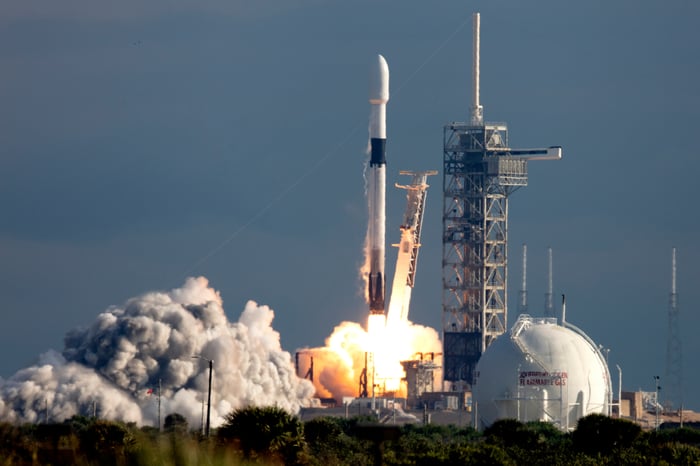
Image source: Getty Images.
Evaluating the three businesses within SpaceX
SpaceX is a company without comparison. It operates three main businesses: space launch services, satellite internet service, and an artificial intelligence (AI) lab. Writing in a blog post, Damodaran looked at each business separately and evaluated its future addressable market, SpaceX's potential market share, and the company's operating profits. Damodaran also sees the potential for Musk to find another business opportunity that he incorporated into his model.
He sees future revenue potential across all three existing businesses, and any future business, reaching $320 billion, with a blended operating margin approaching 50%. Ultimately, discounting SpaceX's future cash flows at its 8% cost of capital led Damodaran to a $1.22 trillion valuation.
That $1.22 trillion valuation is certainly lower than the proposed IPO value of $1.75 trillion, which should give investors pause when deciding whether to buy the stock at its debut. However, Damodaran also notes that there's significant uncertainty in the business, which puts $1.75 trillion within a reasonable range. What's more, the uncertainty is skewed such that there's more upside potential than downside risk, he thinks.
He also notes the details yet to be revealed in a public IPO filing are unlikely to make a significant difference in his valuation since it's based heavily on the company's potential future earnings. After all, SpaceX reportedly generated just $15.6 billion in revenue last year, which is incredibly small compared to the growth Damodaran sees ahead of it and relative to its projected market value (112 times sales).
But there are a few things investors should consider carefully before the IPO.
A closer look at SpaceX's competitive advantages
SpaceX's launch services and satellite internet businesses hold incredible competitive advantages. That's because SpaceX has been developing reusable rockets for 24 years. The ability to reuse rocket parts (or entire rockets) reduces the time between launches and the cost per launch. That lead could expand if it successfully launches Starship, a gigantic, fully reusable rocket.
SpaceX's cost advantage in launch services enabled it to put thousands of satellites in orbit to support its satellite internet service, Starlink. That's given it a significant advantage in attracting and serving customers at a high profit margin, while other competitors struggle to make the economics work as well as SpaceX has. The same advantage also extends to SpaceX's plans for orbital data centers.
Deep-pocketed competitors, including Amazon (NASDAQ: AMZN) and Alphabet (NASDAQ: GOOG) (NASDAQ: GOOGL), are also working to build satellite constellations for internet service and data center operations. But both tech giants have to partner with launch companies to put their satellites in space. Alphabet is notably in talks with SpaceX for its launch services, while Amazon's Project Leo is behind where it intended to be when it applied with the Federal Communications Commission to launch its constellation.
As a result, SpaceX should be able to maintain a dominant market share in both launch services and satellite internet. How big these markets become is uncertain. Damodaran sees the market for space launches expanding from $30 billion to $100 billion in 10 years, and the market for satellite internet expanding 10-fold to reach $160 billion.
SpaceX doesn't seem to have any advantage as an AI lab, though. And that could weigh on its profits for a long time. Damodaran expects xAI to carve out a niche with consumers that could ultimately keep its revenue small but profit margin high. Still, he expects the business to account for 25% of SpaceX's total revenue in 2036, or $80 billion. However, I believe the market will consolidate to just a few dominant players, leaving little revenue for anyone else. I also think consumers will want to use the same AI models they use at work.
Although the core businesses provide a base level of certainty for SpaceX, the AI business and business exploration create significant risks. With the market already pricing the IPO higher than Damodaran's valuation, investors will likely be better off waiting for a cheaper entry point.
That opportunity could present itself at some point, too. Early pre-IPO SpaceX investors, including Alphabet, will likely want to liquidate their shares to diversify and explore additional investment opportunities once the lockup period expires. That could put tremendous selling pressure on the stock, considering only about 4% of the shares will be made available through the IPO.
Should you buy stock in Alphabet right now?
Before you buy stock in Alphabet, consider this:
The Motley Fool Stock Advisor analyst team just identified what they believe are the 10 best stocks for investors to buy now… and Alphabet wasn’t one of them. The 10 stocks that made the cut could produce monster returns in the coming years.
Consider when Netflix made this list on December 17, 2004... if you invested $1,000 at the time of our recommendation, you’d have $469,293!* Or when Nvidia made this list on April 15, 2005... if you invested $1,000 at the time of our recommendation, you’d have $1,381,332!*
Now, it’s worth noting Stock Advisor’s total average return is 993% — a market-crushing outperformance compared to 207% for the S&P 500. Don't miss the latest top 10 list, available with Stock Advisor, and join an investing community built by individual investors for individual investors.
See the 10 stocks »
*Stock Advisor returns as of May 18, 2026.
Adam Levy has positions in Alphabet and Amazon. The Motley Fool has positions in and recommends Alphabet and Amazon. The Motley Fool has a disclosure policy.
Recommended Articles


