




Berkshire Hathaway Has a Cash Problem Most Companies Would Love to Have
Key Points
Its cash position exceeds the market capitalization of most companies.
Management is open for an acquisition -- but only at the right price.
- 10 stocks we like better than Berkshire Hathaway ›
Are you familiar with the old saying, "Cash is king"? A great cash position makes everything easier, providing some massive advantages both in business and for individual investors.
Berkshire Hathaway (NYSE: BRKA) (NYSE: BRKB) seems to be taking the old axiom to an extreme -- the company has a massive cash position right now that's bigger than the market capitalizations of most companies. At the end of the first quarter, Berkshire had nearly $400 billion in cash and cash equivalents.
Will AI create the world's first trillionaire? Our team just released a report on the one little-known company, called an "Indispensable Monopoly" providing the critical technology Nvidia and Intel both need. Continue »
Why is Berkshire Hathaway amassing so much cash -- and what will it do with it?
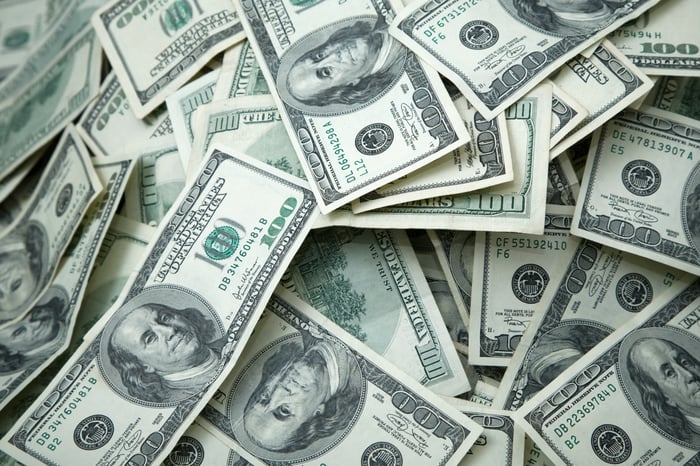
Image source: Getty Images.
The $400 billion question
At the end of the first quarter, Berkshire Hathaway had $390.7 billion on its books in cash, cash equivalents, and short-term investments in U.S. Treasury bills. That's a 14% increase from Berkshire's cash position a year ago.
But it can't be overstated how unusual this cash position is for companies. Berkshire is sitting on more cash than the market capitalization of most companies, including Chevron ($367 billion), Netflix ($359 billion), and Bank of America ($358 billion). Fewer than 30 publicly traded companies in the entire world have a market cap of more than $400 billion.
The cash position also dwarfs those of other major companies. Alphabet currently has a cash position of $126.8 billion, while Microsoft is sitting on $94.6 billion.
Granted, Berkshire has to keep some cash on hand -- it's in the insurance business, operating GEICO and multiple insurance firms under the Berkshire Hathaway name. As such, it collects regular premiums and must maintain cash reserves to pay claims. But Berkshire's cash position has grown so much that even former CEO Warren Buffett has spoken out about it.
Berkshire wants to spend -- when the time is right
In an interview with CNBC, the legendary Buffett discussed Berkshire Hathaway's cash position and his desire to make a deal last year before he stepped down as CEO and turned over the company's reins to top lieutenant Greg Abel. Buffett said that he didn't see any opportunities to make a major acquisition at a reasonable price, settling instead on a comparatively smaller $9.7 billion purchase of OxyChem, a chemical business once owned by Occidental Petroleum.
"I'd rather have $100 billion and a really good business at a sensible price than have $100 billion in cash," Buffett said. "At certain levels, cash is necessary, but cash is not a good asset."
Finding companies at a sensible price is challenging when the market is elevated. The stock market is trading at this writing at all-time highs despite the Iran war and inflation concerns. The so-called Buffett indicator, which is a measurement of the stock market to GDP, currently stands at 230% -- and Buffett has said anything over 200% is overvalued.
So Buffett and Berkshire Hathaway will likely continue to sit on cash for the foreseeable future. And that's a problem which many companies would like to have. As Buffett told CNBC:
You always want to have enough. You don't have to pay a lot for it. But you do need oxygen. And cash is that way. You always need to have it available because you do not know what will happen. I do not know what the stock market will do, and I do not know what business will do.
Should you buy stock in Berkshire Hathaway right now?
Before you buy stock in Berkshire Hathaway, consider this:
The Motley Fool Stock Advisor analyst team just identified what they believe are the 10 best stocks for investors to buy now… and Berkshire Hathaway wasn’t one of them. The 10 stocks that made the cut could produce monster returns in the coming years.
Consider when Netflix made this list on December 17, 2004... if you invested $1,000 at the time of our recommendation, you’d have $472,205!* Or when Nvidia made this list on April 15, 2005... if you invested $1,000 at the time of our recommendation, you’d have $1,384,459!*
Now, it’s worth noting Stock Advisor’s total average return is 999% — a market-crushing outperformance compared to 208% for the S&P 500. Don't miss the latest top 10 list, available with Stock Advisor, and join an investing community built by individual investors for individual investors.
See the 10 stocks »
*Stock Advisor returns as of May 14, 2026.
Bank of America is an advertising partner of Motley Fool Money. Patrick Sanders has no position in any of the stocks mentioned. The Motley Fool has positions in and recommends Alphabet, Berkshire Hathaway, Chevron, Microsoft, and Netflix. The Motley Fool recommends Occidental Petroleum. The Motley Fool has a disclosure policy.
Recommended Articles


