




Failure to Launch: United Launch Alliance Is in Trouble. Who Wins From Its Loss?
Key Points
ULA's Vulcan rocket lost a Space Force contract after an engine anomaly in February.
Space Force switched to SpaceX's reliable Falcon 9 rocket instead.
SpaceX's IPO probably will take place this summer.
- 10 stocks we like better than Northrop Grumman ›
I don't know about you, but the idea of space travel gets me a little misty-eyed. And most of the news coming out of companies like SpaceX and NASA's renewed interest in lunar expeditions with the Artemis Program is incredibly exciting.
Human spaceflight, however, doesn't elicit tears of wonder, joy, or optimism at United Launch Alliance these days. ULA, a joint venture between Boeing (NYSE: BA) and Northrop Grumman (NYSE: NOC), was established in 2006 to combine the resources and expertise of two of America's aerospace leaders.
Will AI create the world's first trillionaire? Our team just released a report on the one little-known company, called an "Indispensable Monopoly" providing the critical technology Nvidia and Intel both need. Continue »
Mind you, both companies participated in getting U.S. astronauts to the moon back in 1969. Boeing was behind the Saturn V rocket that sent Apollo 11 into space, and Northrop Grumman designed and built the lunar lander from which Neil Armstrong took his iconic one small step.
A venture between the two should have been a slam dunk, so what's the issue?
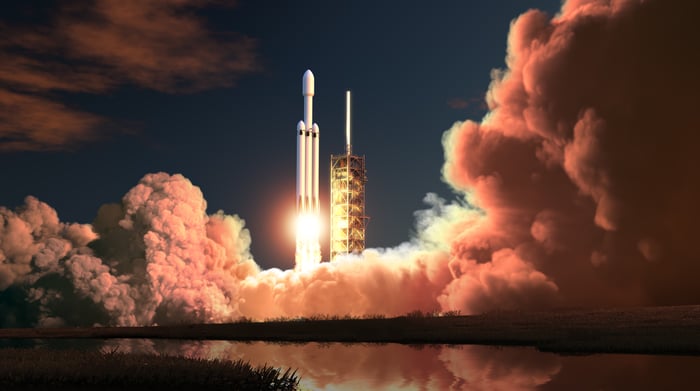
Image source: Getty Images
Houston, we have a problem
The bulk of United Launch Alliance's problems have to do with its most advanced product, the Vulcan rocket.
On Feb. 12, there was an anomaly in one of the Vulcan's four solid rocket motors noticed by the U.S. Space Force during a satellite launch. The rocket delivered its payload, but Space Force investigated.
A month later, in late March, ULA lost the contract and Space Force switched to SpaceX's proven Falcon 9 rocket for its next mission. ULA has since switched to the older Atlas V rocket for its next few launches for private clients.
The rocket motor that caused the anomaly was Northrop Grumman's GEM 63XL. On April 21, Northrop Grumman said it took a $71 million charge in its first-quarter results as a result of the issue. The GEM 63XL is being investigated before the Vulcan can fly again, and it has not launched since at the time of writing.
So, with the Vulcan grounded for the foreseeable future, who wins from ULA's troubles? The answer is pretty obvious -- it's SpaceX.
To boldly go where no man has gone before
SpaceX's Falcon 9 rocket is a proven space vehicle that has completed 629 missions, delivering both satellite payloads to orbit and personnel to the International Space Station. It's no wonder the Space Force opted for it when it needed a rocket on short notice.
The rocket's Merlin engine is an in-house design from SpaceX itself and has contributed to the Falcon 9's 99.4% success rate. Of all the 632 missions the rocket has flown, it has had only had three failures and one partial failure.
Falcon 9 is also reusable, a feature ULA is working on adding to the Vulcan but which it still lacks. Being more reliable and less expensive is a winning mix in most industries, I expect space travel will be no different.
And one of SpaceX's other big competitors, Jeff Bezos' Blue Origin, has only recently introduced a competitor to the Falcon with its reusable New Glenn rocket (named for John Glenn, the first American to orbit the earth in 1962.)
However, on its third-ever mission (launched April 19), the New Glenn lost its payload, though the rocket's first stage did successfully land on the drone ship meant to catch it.
So, while it is a competitor to the Falcon, the New Glenn has a long way to go before it comes anywhere near the Falcon 9's reputation for reliability and demonstrated ability to be reused.
But how do you and I play this? SpaceX is still a private company.
The good news is it won't be for much longer.
Late last month, news of SpaceX filing for its initial public offering (IPO) caused numerous space stocks to pop, and some have even continued that rally through April. The company might be valued at as much as $1.75 trillion, which would make it the largest IPO in market history.
And SpaceX has targeted July for its IPO; the preliminary prospectus is in the works, but the process seems to be moving quickly. So, I would be willing to bet the IPO is coming this summer and I fully intend to buy shares.
Given that one of its competitors has grounded its rockets and the other has a long way to go before it even begins to catch up to SpaceX, Elon Musk's rocket company is likely to remain the biggest name in private spaceflight for a very long time.
Should you buy stock in Northrop Grumman right now?
Before you buy stock in Northrop Grumman, consider this:
The Motley Fool Stock Advisor analyst team just identified what they believe are the 10 best stocks for investors to buy now… and Northrop Grumman wasn’t one of them. The 10 stocks that made the cut could produce monster returns in the coming years.
Consider when Netflix made this list on December 17, 2004... if you invested $1,000 at the time of our recommendation, you’d have $498,522!* Or when Nvidia made this list on April 15, 2005... if you invested $1,000 at the time of our recommendation, you’d have $1,276,807!*
Now, it’s worth noting Stock Advisor’s total average return is 983% — a market-crushing outperformance compared to 200% for the S&P 500. Don't miss the latest top 10 list, available with Stock Advisor, and join an investing community built by individual investors for individual investors.
See the 10 stocks »
*Stock Advisor returns as of April 28, 2026.
James Hires has no position in any of the stocks mentioned. The Motley Fool has positions in and recommends Boeing. The Motley Fool has a disclosure policy.
Recommended Articles


