




Is It Safe to Invest in S&P 500 Funds Right Now, or Should You Wait for a Decline?
Key Points
The S&P 500 went from dropping 9% to setting a new all-time high in just a few months.
Anticipated annualized earnings growth of 13% and a forward P/E ratio of just 21 support the case for buying the S&P 500.
The Iran war and its lingering impact on oil prices and inflation are negative wild cards to consider.
- 10 stocks we like better than S&P 500 Index ›
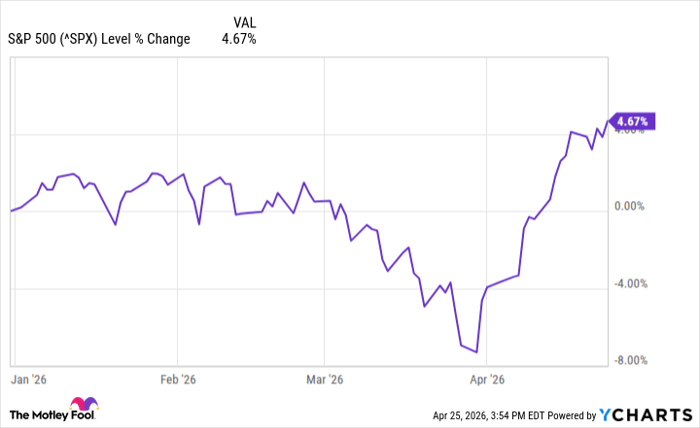
The S&P 500 (SNPINDEX: ^GSPC) has been all over the place in 2026. A sector rotation early in the year suppressed some of its returns relative to other sectors, such as energy. The Iran war sent it 9% lower in a little over a month. But in April, we're all the way back to new all-time highs again.
With all this volatility and uncertainty, it's tougher to figure out whether U.S. stocks are still a buy. You could wait for a dip that might not come. You could keep buying with many unknowns still looming.
Will AI create the world's first trillionaire? Our team just released a report on the one little-known company, called an "Indispensable Monopoly" providing the critical technology Nvidia and Intel both need. Continue »
Let's break down the case for buying or selling and determine which one makes more sense right now.
Image source: Getty Images.
The case for buying the S&P 500
S&P 500 companies are on track to report 13.2% year-over-year earnings growth in the first quarter of 2026, which would mark the sixth consecutive quarter of double-digit earnings growth. The forward-12-month price-to-earnings (P/E) ratio on the S&P 500 is 20.9. That's above the 10-year average of 18.8 but well below earlier levels.
The fundamental case for the S&P 500 is still strong. Recessions are generally unlikely when earnings growth is solid. Right now, S&P 500 earnings are on pace to grow more than 13% year over year in Q1 2026. If that number is achieved, it would make the sixth consecutive month that earnings have grown by double digits.
Investor sentiment also seems to be improving. A weekly sentiment survey conducted by the American Association of Individual Investors of its members in early April showed bearish sentiment topping 50%. But it's down to just 34% currently.
While short-term market behavior can be driven by many factors, long-term performance is mostly determined by earnings growth. If you're a long-term S&P 500 investor, the growth narrative is still very much intact. Plus, valuations have come way down from 2025 highs. The forward P/E ratio on the index is just under 21, not far above its 10-year average of 19.
The case for waiting to buy the S&P 500
As we saw earlier this year, the S&P 500 can swing violently on short-term events. The index fell sharply during the early stages of the Iran war. Stocks recovered on optimism that a resolution could be reached, but that has yet to materialize. If the Iran conflict is ongoing, why have stocks moved back to all-time highs?
As time goes on, the impacts of the war, namely oil prices and inflation, run the risk of getting worse. If that happens, stocks are prone to another sharp pullback.
Data by YCharts.
Verdict: Buy the S&P 500, but do so cautiously
The long-term case for buying the S&P 500 is still quite clear. If you're willing to ride out some of the current volatility, long-term earnings growth is set to push U.S. stock prices higher.
In the short term, there's still a case for buying, but cautiously. If your anticipated holding period is short, it might be wise to keep some chips off the table in case things turn south again.
Should you buy stock in S&P 500 Index right now?
Before you buy stock in S&P 500 Index, consider this:
The Motley Fool Stock Advisor analyst team just identified what they believe are the 10 best stocks for investors to buy now… and S&P 500 Index wasn’t one of them. The 10 stocks that made the cut could produce monster returns in the coming years.
Consider when Netflix made this list on December 17, 2004... if you invested $1,000 at the time of our recommendation, you’d have $498,522!* Or when Nvidia made this list on April 15, 2005... if you invested $1,000 at the time of our recommendation, you’d have $1,276,807!*
Now, it’s worth noting Stock Advisor’s total average return is 983% — a market-crushing outperformance compared to 200% for the S&P 500. Don't miss the latest top 10 list, available with Stock Advisor, and join an investing community built by individual investors for individual investors.
See the 10 stocks »
*Stock Advisor returns as of April 27, 2026.
David Dierking has no position in any of the stocks mentioned. The Motley Fool has no position in any of the stocks mentioned. The Motley Fool has a disclosure policy.
Recommended Articles


