




Powell Says No Rate Hike Needed to Fight Oil Shock: Here Is Why Investors Should Not Declare Victory on Inflation Just Yet
Key Points
Surging oil prices have put significant pressure on the global economy.
Despite spiking inflation, the Federal Reserve is holding off on raising interest rates for now.
However, that doesn't necessarily mean a recession is off the table.
- These 10 stocks could mint the next wave of millionaires ›
Escalating tensions in the Middle East are continuing to ripple through global markets, with rising oil prices wreaking havoc on supply chains.
Soaring gas prices not only force many consumers to cut back on discretionary spending, but they also result in businesses paying more to transport goods and manufacture plastic products, fertilizer, and other items that use oil during the production process.
Will AI create the world's first trillionaire? Our team just released a report on the one little-known company, called an "Indispensable Monopoly" providing the critical technology Nvidia and Intel both need. Continue »
Historically, prolonged spikes in oil prices have been linked to economic pullbacks and recessions. In fact, the Federal Reserve itself has noted that "nearly all post-World War II recessions were preceded by higher oil prices."
When inflation increases, the Federal Reserve will often hike interest rates in an attempt to rein in runaway prices. However, raising interest rates comes with its own set of risks. When inflation reached record highs in 2022, for example, the Fed had to hike rates so quickly that the S&P 500 entered a bear market that lasted most of the year. Fortunately for markets, a rate hike is not on the horizon at the moment.
Image source: Getty Images.
The Fed is not raising rates -- for now
Late last month, while speaking at Harvard University, Fed Chairman Jerome Powell offered insights into the bank's decision not to raise interest rates at this time.
Powell explained that policymakers are taking a "wait and see" approach regarding the war in Iran. The Fed aims to maintain a long-term outlook when deciding on rate changes, as it often takes months after an adjustment to see the desired effect. Because the conflict in the Middle East could be resolved by then, the Fed is choosing not to raise rates for now.
This news reassured many investors, and the S&P 500 surged by more than 3% in the days following Powell's remarks.
However, Powell also noted that the Fed is in a tough spot right now. Keeping interest rates low benefits the weakening labor market in the U.S., but raising rates could help cool inflation. "You've got tension between the two objectives," Powell said, highlighting the Fed's difficult position.
It may not be time to celebrate just yet
The primary concern among many Americans is how long the war in the Middle East will continue. If it's resolved quickly, oil prices may drop back to normal levels and inflation might slow on its own. But the longer it goes on, the higher the risk of a recession.
Experts at Vanguard warned in a report published last month that if oil prices surpass $150 per barrel for the remainder of 2026, it could trigger a recession in the U.S. Whether we face a recession or not, though, rising oil prices can still continue to impact inflation.
As of this writing, oil is priced at roughly $110 per barrel. According to Vanguard's analysis based on historical data, oil prices above $100 per barrel for at least two quarters could push inflation up by 80 basis points, or around 0.8%, while reducing GDP by 20 basis points.
Because the U.S. has its own oil reserves, it's not as dependent on international oil as it was decades ago. However, oil prices are set globally, which will continue to influence supply chains and affect inflation rates. Consumer spending accounts for a significant share of GDP, so the longer oil prices remain elevated, the greater the risk of a recession.
What does this mean for the stock market?
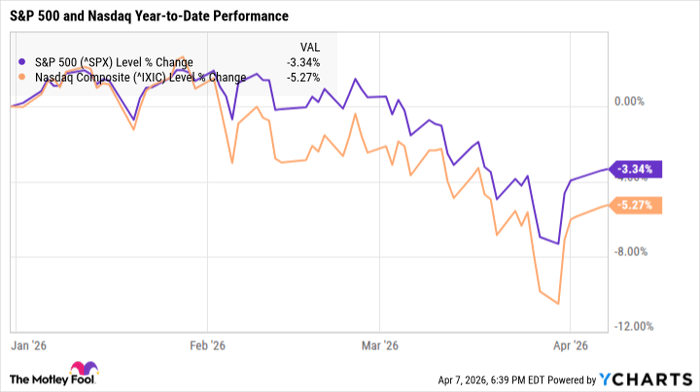
Major market indexes are in flux right now. The S&P 500 reached a new low for the year in late March, falling by close to 9% from its peak. The tech-heavy Nasdaq was hit even harder, plunging by more than 12%.
Since then, though, prices have somewhat recovered. With a lot of uncertainty surrounding the U.S.'s future in Iran, however, there's no telling where the market may go.
^SPX data by YCharts
Now more than ever, it's wise to keep a long-term outlook when investing. Withdrawing from the market may be tempting if a recession is looming, but volatility is not guaranteed. If the conflict in the Middle East is resolved soon and inflation eases, the odds of a recession could drop significantly.
Rather than trying to predict where the market is headed, it's generally safer to simply hold your stocks through all the rough patches. The stock market has proven to be incredibly resilient over time, and by investing in strong stocks with healthy foundations, it's likely your portfolio will survive potential volatility, too.
Where to invest $1,000 right now
When our analyst team has a stock tip, it can pay to listen. After all, Stock Advisor’s total average return is 928%* — a market-crushing outperformance compared to 186% for the S&P 500.
They just revealed what they believe are the 10 best stocks for investors to buy right now, available when you join Stock Advisor.
See the stocks »
*Stock Advisor returns as of April 9, 2026.
The Motley Fool has a disclosure policy.
Recommended Articles


