




This Decision in 2019 Was Oracle's Smartest Move -- and It May Be the Ticket to Explosive AI Growth.
Key Points
Oracle is a nearly 50-year-old company specializing in database management.
In recent years, it’s become a key player in the hot field of artificial intelligence.
- 10 stocks we like better than Oracle ›
Oracle (NYSE: ORCL) has long been known as a database specialist, and that's helped the company grow earnings over time and build relationships with customers across industries -- from healthcare to financial services. But today, when you think of Oracle, you may not necessarily think "database management," and instead you might think, "artificial intelligence" or AI.
That's because this tech giant has become one of the players leading the AI revolution. This is thanks to its cloud business, which offers customers access to capacity for their workloads. Customers are rushing to get in on these Oracle services, and this has supercharged growth in recent quarters -- with demand often surpassing supply.
Will AI create the world's first trillionaire? Our team just released a report on the one little-known company, called an "Indispensable Monopoly" providing the critical technology Nvidia and Intel both need. Continue »
Of course, Oracle isn't alone in the cloud market and faces competition from others such as leader Amazon, and giants Microsoft, and Alphabet. How did this player carve out share and set itself on the path to an AI win? The following decision, back in 2019, was Oracle's smartest move, and now it may be the company's ticket to explosive AI growth. Let's check it out.

Image source: Getty Images.
A database giant
As mentioned, Oracle, a tech powerhouse that's nearly 50 years old, has built dominance in the database industry, from its initial system to the release of the world's first autonomous database cloud in 2017. The company launched its general cloud services about a year earlier. And it's this push into cloud that sparked a wave of growth about a decade ago.
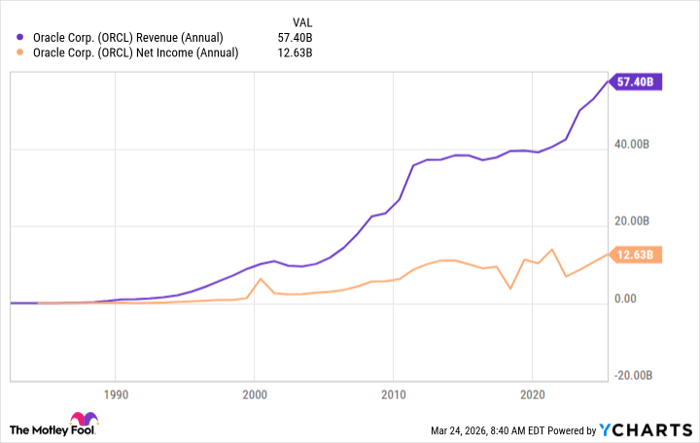
ORCL Revenue (Annual) data by YCharts
Oracle gained market share by serving the broad customer base it had already developed over the years and providing affordable cloud services to suit their specific needs. But it was a 2019 decision that has proven to be Oracle's smartest move, setting it on the path to AI performance down the road.
At that time, Oracle took a first step toward becoming a multicloud giant by developing an interconnect with Microsoft Azure, a move that could, for example, allow the running of enterprise applications across clouds. Oracle later took this a step further by locating its enterprise database platform and cloud infrastructure within its partners' data centers as well as within its own cloud.
Since, Oracle has advanced its multicloud business, signing partnerships with cloud leaders so that today, customers can harness the power of Oracle through Amazon's AWS, Microsoft Azure, and Alphabet's Google Cloud. This means, for instance, that a customer can link up its Oracle database with an AWS service such as Amazon Bedrock -- a fully managed AI platform.
A game changer for Oracle
Now, let's talk about why this could be a game changer for Oracle. The decision to go multicloud means customers don't have to choose between Oracle and a rival; instead, they can use Oracle across all major cloud providers.
"Those partnerships unlock an enormous backlog of demand -- our database customers who want to use our database in other clouds," Clay Magouyrk, co-chief executive of Oracle, said during the recent earnings call.
Oracle already has started reaping the benefits of its decision. In the latest quarter, multicloud database revenue surged more than 500% year over year, and demand has been surpassing supply. And as more and more companies opt to apply AI to their businesses and turn to cloud providers for help, Oracle should see further gains.
Oracle continues to expand its region presence in partner clouds -- it just finished the latest quarter with eight AWS regions live and aims to finish the next quarter with 22. The company has 33 regions live with Microsoft and 14 with Google. This broad reach should "rapidly turn billions of pipelines into highly profitable database service revenue," Magouyrk said.
So, Oracle, instead of trying to beat its fellow cloud players, found a way to work with them, and revenue momentum is showing this was the right decision. In fact, with AI demand soaring, the company's initial move back in 2019 may have been its smartest ever -- as it could be Oracle's ticket to explosive revenue growth as the AI boom marches on.
Should you buy stock in Oracle right now?
Before you buy stock in Oracle, consider this:
The Motley Fool Stock Advisor analyst team just identified what they believe are the 10 best stocks for investors to buy now… and Oracle wasn’t one of them. The 10 stocks that made the cut could produce monster returns in the coming years.
Consider when Netflix made this list on December 17, 2004... if you invested $1,000 at the time of our recommendation, you’d have $490,325!* Or when Nvidia made this list on April 15, 2005... if you invested $1,000 at the time of our recommendation, you’d have $1,074,070!*
Now, it’s worth noting Stock Advisor’s total average return is 900% — a market-crushing outperformance compared to 184% for the S&P 500. Don't miss the latest top 10 list, available with Stock Advisor, and join an investing community built by individual investors for individual investors.
See the 10 stocks »
*Stock Advisor returns as of March 26, 2026.
Adria Cimino has positions in Amazon and Oracle. The Motley Fool has positions in and recommends Alphabet, Amazon, Microsoft, and Oracle. The Motley Fool has a disclosure policy.
Recommended Articles


