




Microsoft Is Having Its Worst Start to a Year Since 2008. Is That a Red Flag or a Once-in-a-Decade Buying Opportunity?
Key Points
Microsoft stock has been stuck in a downward spiral following the company's earnings report last month.
While AI-driven growth remains strong, investors worry about the impact of its rising infrastructure spending.
Still, the company is sitting on a number of catalysts that should fuel margin expansion in the long run.
- 10 stocks we like better than Microsoft ›
Following a brutal reaction to the earnings report for its fiscal second quarter (ended Dec. 31), Microsoft (NASDAQ: MSFT) has seen its shares plummet into their sharpest correction since 2008.
This drawdown has sparked a debate about the "Magnificent Seven" member: Is Microsoft stock a falling knife, or has the market overreacted, presenting a rare opportunity to buy a preeminent artificial intelligence (AI) stock at a discount? The volatility swirling around Microsoft stock stems from AI infrastructure spending, shifting competitive dynamics, and macroeconomic uncertainties.
Will AI create the world's first trillionaire? Our team just released a report on the one little-known company, called an "Indispensable Monopoly" providing the critical technology Nvidia and Intel both need. Continue »
Let's look at the nuanced picture plaguing big tech investors to assess whether Microsoft is merely suffering from short-term panic selling and has the strength to deliver more explosive growth in the future.
Image source: Getty Images.
Risks are piling up amid an uncertain landscape
The main reason investors are ditching Microsoft stock stems from concerns around the company's capital expenditure budget. Accelerating investment in AI infrastructure -- from custom silicon designs, GPU procurement, capacity agreements, and data center buildouts -- puts pressure on free cash flow.
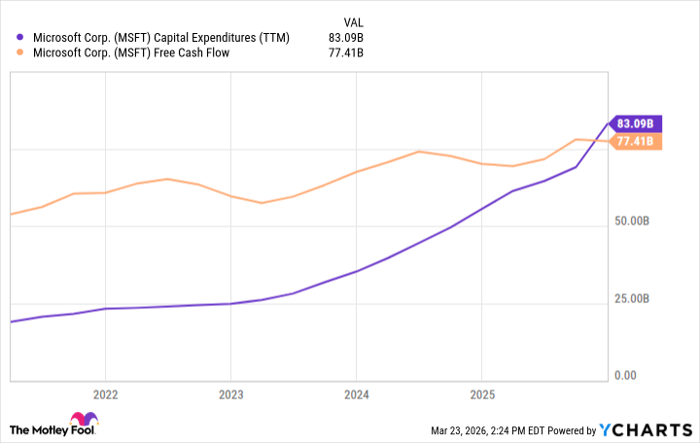
MSFT Capital Expenditures (TTM) data by YCharts
Faster growth from other cloud providers such as Amazon Web Services (AWS) and Alphabet's Google Cloud Platform (GCP) could put a dent in Microsoft's pursuit of making Azure the go-to suite for enterprise AI adoption.
Compounding these vulnerabilities are cloudy macroeconomic conditions. Should an economic slowdown come to fruition, businesses are likely to taper their software and cloud infrastructure spending.
In addition, the generative AI partnership ecosystem is changing rapidly, introducing more variables to the equation as legacy tech developers such as Microsoft scramble to remain relevant.
Taken together, it's easy to see why bears are beginning to think the growth narrative around Microsoft begins to look fragile.
Microsoft's core business demonstrates resilience
Given the degree to which Microsoft stock has plunged, it could be argued that investors are discounting the company's structural advantages. The company's ecosystem -- which spans Office, Windows, cybersecurity tools, social networking, and gaming -- creates immense switching costs.
At the heart of Microsoft's growth is high-margin recurring revenue driven by subscriptions to Azure and other products, all of which are becoming enhanced through the power of AI. This makes the company's business model relatively predictable and quite durable during periods of uncertainty.
Moreover, Microsoft has a rich history of reinventing itself. From navigating the rise of personal computing, cloud infrastructure, and now AI, the company has proved it has the innovation prowess and financial flexibility to adapt.
On top of that, Microsoft boasts a rock-solid balance sheet. With nearly $90 billion of cash and equivalents and a low debt profile relative to the company's size, Microsoft is well equipped to double down on its AI vision, fund potential acquisitions, or pursue shareholder return programs with relative ease.
What could cause Microsoft stock to rebound?
I think Microsoft has a number of compelling forward-looking catalysts that support buying the dip right now.
As AI transitions from training to the inference era, the phase at which models can make decisions, tools such as Copilot have the potential to be deployed in new formats across the enterprise. As such, Microsoft could be on the cusp of unlocking higher subscription tiers as AI-driven growth fuels further productivity gains and expanded adoption.
Moreover, despite competitive headwinds from AWS and GCP, Azure is poised for acceleration as AI workloads scale and demand greater computing capacity. Longer-term tailwinds include the rise of AI agents as the integration of digital services becomes a cornerstone of digital transformation for businesses around the globe.
While patience is always required for outsize value creation, the dynamics explored here suggest that the current pullback in Microsoft stock offers asymmetric upside for investors focused on the next decade, as opposed to the company's next quarterly performance.
While drawdowns can certainly test nerves, Microsoft's unique blend of risk mitigants and secular tailwinds underscore the idea that concerns around the company are likely to be overblown, positioning shares for a compelling comeback in the long run.
For these reasons, I see Microsoft stock as a great opportunity to buy and hold rather than one to run away from.
Should you buy stock in Microsoft right now?
Before you buy stock in Microsoft, consider this:
The Motley Fool Stock Advisor analyst team just identified what they believe are the 10 best stocks for investors to buy now… and Microsoft wasn’t one of them. The 10 stocks that made the cut could produce monster returns in the coming years.
Consider when Netflix made this list on December 17, 2004... if you invested $1,000 at the time of our recommendation, you’d have $490,325!* Or when Nvidia made this list on April 15, 2005... if you invested $1,000 at the time of our recommendation, you’d have $1,074,070!*
Now, it’s worth noting Stock Advisor’s total average return is 900% — a market-crushing outperformance compared to 184% for the S&P 500. Don't miss the latest top 10 list, available with Stock Advisor, and join an investing community built by individual investors for individual investors.
See the 10 stocks »
*Stock Advisor returns as of March 26, 2026.
Adam Spatacco has positions in Alphabet, Amazon, and Microsoft. The Motley Fool has positions in and recommends Alphabet, Amazon, and Microsoft. The Motley Fool has a disclosure policy.
Recommended Articles


