




Is Nvidia a No-Brainer Buy Right Now?
Key Points
Nvidia just delivered another quarter of double-digit revenue growth.
Customers continue to flock to the company’s top AI chips.
- 10 stocks we like better than Nvidia ›
Nvidia (NASDAQ: NVDA) hasn't generally been known as a dirt cheap stock. Investors have rushed to get in on this artificial intelligence (AI) leader over the past several years, and that's pushed valuation higher. The company has established itself as the dominant AI chip company, so investors expect this player to benefit as the high-growth AI story unfolds.
And Nvidia has benefited from AI since the technology's earliest days, as a matter of fact. Customers love the company's powerful graphics processing units (GPUs), or AI chips, as well as the portfolio of related products that help them get the AI job done.
Will AI create the world's first trillionaire? Our team just released a report on the one little-known company, called an "Indispensable Monopoly" providing the critical technology Nvidia and Intel both need. Continue »
Nvidia stock has soared over time thanks to this leadership, but in recent months, investors have hesitated to get in on AI stocks. And this has dragged down Nvidia stock -- and its valuation. Is Nvidia a no-brainer buy right now? Let's find out.

Image source: Getty Images.
Nvidia's successes
So, first, let's take a quick look at Nvidia's success story and then at the elements that have thrown stock performance off track. As mentioned, Nvidia has become an AI superpower, selling the world's most powerful chips and accompanying products. This has driven explosive growth over the past few years, and the recent quarter confirms the ongoing momentum.
In the fourth quarter, Nvidia's revenue and profit surged in the double digits to $68 billion and $42 billion, respectively. Revenue has reached record levels, driven by demand from AI data center customers.
Though this is positive, over the past few months, investors have worried about the general path of AI. They're concerned about the high levels of AI spending and have questioned whether future earnings will justify such an investment. This has weighed on a variety of AI stocks, including Nvidia. The usually effervescent stock is little changed so far this year.
All of this has left Nvidia trading at dirt cheap levels, close to its lowest over the past year.
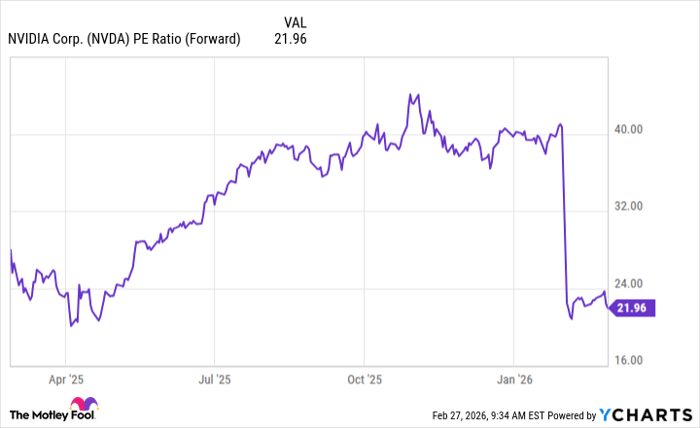
NVDA PE Ratio (Forward) data by YCharts
Near-term turbulence
Is Nvidia a no-brainer buy at this level? It's important to note that the near-term turbulence may not be over. Investors might continue to worry about the AI situation until they see additional evidence in the quarters to come that AI growth isn't a short-term trend -- and that investment is justified. So Nvidia stock may not immediately soar.
That said, it's never a good idea to time the market -- it's almost impossible to get in on a stock at its very lowest. Instead, it's a better idea to buy when the stock looks reasonably priced, and you're confident about the company's long-term prospects.
Today, Nvidia's price is dirt cheap, and the company is well-positioned to deliver solid growth over time, and this makes it a no-brainer AI stock to get in on right now.
Should you buy stock in Nvidia right now?
Before you buy stock in Nvidia, consider this:
The Motley Fool Stock Advisor analyst team just identified what they believe are the 10 best stocks for investors to buy now… and Nvidia wasn’t one of them. The 10 stocks that made the cut could produce monster returns in the coming years.
Consider when Netflix made this list on December 17, 2004... if you invested $1,000 at the time of our recommendation, you’d have $519,015!* Or when Nvidia made this list on April 15, 2005... if you invested $1,000 at the time of our recommendation, you’d have $1,086,211!*
Now, it’s worth noting Stock Advisor’s total average return is 941% — a market-crushing outperformance compared to 194% for the S&P 500. Don't miss the latest top 10 list, available with Stock Advisor, and join an investing community built by individual investors for individual investors.
See the 10 stocks »
*Stock Advisor returns as of March 3, 2026.
Adria Cimino has no position in any of the stocks mentioned. The Motley Fool has positions in and recommends Nvidia. The Motley Fool has a disclosure policy.
Recommended Articles


