




Trump’s ‘At All Costs’ Rhetoric Shorts Global Assets? Gold and Silver Not Spared
TradingKey - Against a backdrop of intensifying geopolitical tensions, investors once bet on risk premiums in precious metals and safe-haven assets. On February 28, 2026, the United States and Israel launched localized airstrikes against Iran, which resulted in the death of Iran's supreme leader and triggered multi-directional retaliatory actions in the region. Subsequently, Trump declared that the strike against Iran would be "at all costs."
Trump's remarks once again caused panic in global markets, and unlike previous hedging measures, Gold (XAUUSD) and Silver (XAGUSD) assets with strong safe-haven attributes also lost their traditional hedging logic.
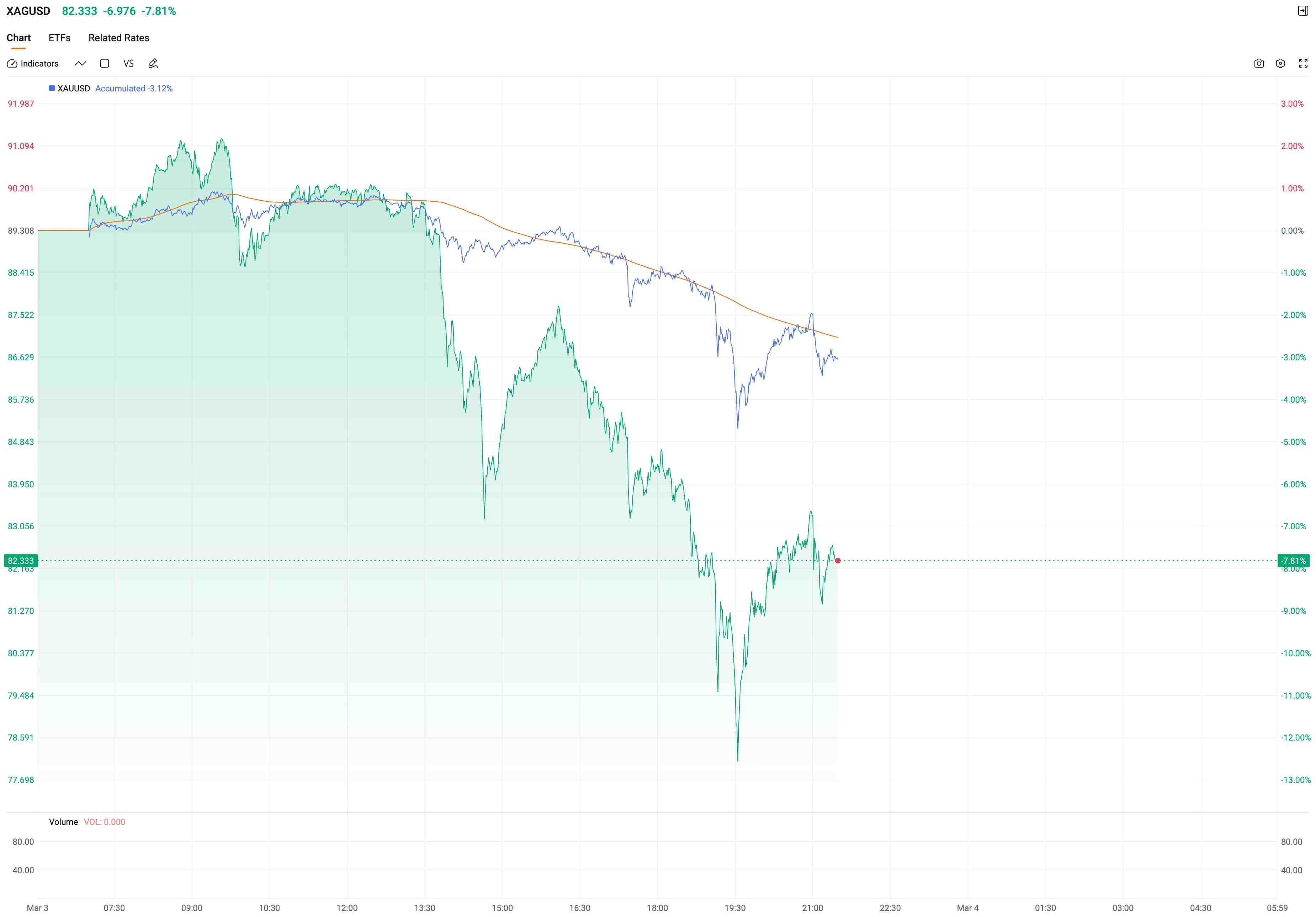
The performance of precious metals showed significant divergence; gold recently broke above $5,400/oz before pulling back below $5,100, while silver surged nearly 12% in the short term, hitting a high of $96/oz before rapidly plunging over 10% to return to $78/oz.
Such market behavior is highly similar to the common "buy the rumor, sell the news" pattern: safe-haven asset prices are pushed higher rapidly in the lead-up to and early stages of a geopolitical conflict, but as the event enters a "normalization" phase, buying momentum quickly dissipates.
Analyses from mainstream institutions generally point out that while such safe-haven rallies have their logic, they do not equate to a fundamental trend reversal. Bloomberg analysis suggests that this type of "panic buying" is particularly prominent at the onset of a war but is often unsustainable; if a conflict enters a stalemate rather than an explosive shock, safe-haven demand tends to subside after a day or two of trading.
Several investment banks have also warned that the rise in safe-haven assets largely reflects a short-term spike in risk premiums, making them susceptible to sharp pullbacks or even "sell the fact" scenarios.
Reuters also reported a similar phenomenon, noting that even amid geopolitical risks, the tug-of-war between a strengthening U.S. dollar and safe-haven inflows into gold has caused prices to spike and then retreat in the short term. In trading on March 3, despite lingering risk-off sentiment, dollar strength constrained gold and silver, causing metal prices to face resistance at highs or undergo corrections.
This "surge-then-sideways" market behavior shares some essential similarities with the impact of the Trump tariff era on global assets.
During the Trump 2.0 tariff period, expectations of global supply chain restructuring triggered by trade tariff policies led to significant "risk repricing" volatility in the market. Risk assets experienced sharp price fluctuations as policy expectations heated up, but once policies were implemented or the market digested the event's impact, rallies often stalled, leading to range-bound trading.
In this round of Middle East conflict, while safe-haven logic remains valid, investors must recognize that its duration and magnitude are limited. Major institutions like JPMorgan Chase have emphasized when evaluating precious metals that while geopolitical risk factors indeed drive up gold prices, such premiums are difficult to sustain at high levels without a substantive shift in fundamentals.
This phenomenon is even more pronounced in the silver market, as silver possesses significant industrial demand attributes in addition to its safe-haven properties. Following the "panic buying" in the early stages of a geopolitical conflict, silver prices are prone to retreating from highs once market sentiment rationalizes and physical supply-demand imbalances show no significant deterioration.
Overall, current market trading behavior shows that in environments of extreme uncertainty, investors tend to bet on safe-haven assets first, rather than making medium-to-long-term allocations based on fundamental assessments.
This "hot-money-driven" short-term hedging logic can amplify prices during the breakout of a geopolitical conflict, but once market sentiment cools, capital often opts for profit-taking, which can lead to violent fluctuations in precious metal prices.
Recommended Articles


