




Indian Rupee rallies further as RBI’s Malhotra opens door for further intervention
- The Indian Rupee strengthens following RBI Malhotra’s comments regarding further intervention and US-Iran deal hopes.
- RBI Governor Malhotra states that the central bank has more means to ensure INR’s orderly price discovery.
- US President Trump said that an agreement with Iran has “largely negotiated”.
The Indian Rupee (INR) opens on a strong note against the US Dollar (USD) at the start of the week. The USD/INR pair extends its losing streak for the fourth trading day on Monday, sliding to near 95.20, the lowest level seen in almost two weeks.
The Indian currency has appreciated due to multiple tailwinds: hopes of further Reserve Bank of India’s (RBI) intervention in forex markets, and a sharp decline in oil prices due to improved hopes of the United States (US)-Iran deal.
RBI Governor Malhotra ensures orderly price discovery in forex markets
In an interview with Mint, earlier in the day, RBI Governor Sanjay Malhotra assured that the central bank is ready to intervene against one-way excessive moves against the domestic currency. Malhotra added the central bank has enough tools in its kit, including nearly $700 billion in reserves to quell any undue speculative movement, which backs his confidence.
RBI’s Malhotra also expressed confidence that the Indian Rupee would start appreciating once the Middle East situation will start normalizing.
A significant Indian Rupee’s recovery after RBI Governor Malhotra’s interview suggests that his comments have brought at least an immediate improvement in investors’ sentiment toward the domestic currency. The Indian Rupee’s performance in the last year has been the worst among its Asian peers due to several reasons, especially the trade war with the US, elevated oil prices and significant Gold imports.
Oil prices crash on US-Iran deal hopes
As of writing, the WTI Oil price is down almost 6% to near $90, the lowest level seen in over two weeks. Oil prices crack after US President Donald Trump expressed confidence, through post on Truth Social, that the agreement is “largely negotiated” with Iran and the Strait of Hormuz will be reopened soon. Trump added, “In addition to many other elements of the Agreement, the Strait of Hormuz will be opened.”
However, later in a post, US President Trump said that Washington is in “no rush for a deal” as “time is on our side”, adding, “The negotiations are proceeding in an orderly and constructive manner.”
Currencies from economies, such as India, which rely heavily on oil imports to meet their energy needs, attract bids following a sharp correction in oil prices.
FIIs offloaded stake in Indian stock market again
Foreign Institutional Investors (FIIs) are turning out to be net sellers in the Indian stock market for the last four trading days, and have offloaded their stake worth Rs. 10,386.52 crore. Overseas investors continue to pare their stake in the Indian equity market due to growing concerns over India Inc.’s projected earnings amid energy price shock.
Lower US Dollar also hurts USD/INR
A decent correction in the US Dollar amid hopes of a breakthrough in the US-Iran negotiations has also hurt the USD/INR pair. During the press time, the US Dollar Index (DXY), which gauges the Greenback’s value against six major currencies, trades 0.3% lower to near 99.00. Lower oil prices and hopes of the US-Iran resolution have diminished US Dollar’s safe-haven appeal and hawkish Federal Reserve (Fed) prospects for the year.
According to the CME FedWatch tool, the odds of the Fed delivering at least one interest rate hike this year are almost 57%, down from 67% recorded on Friday.
Technical Analysis: USD/INR corrects sharply to near 95.20
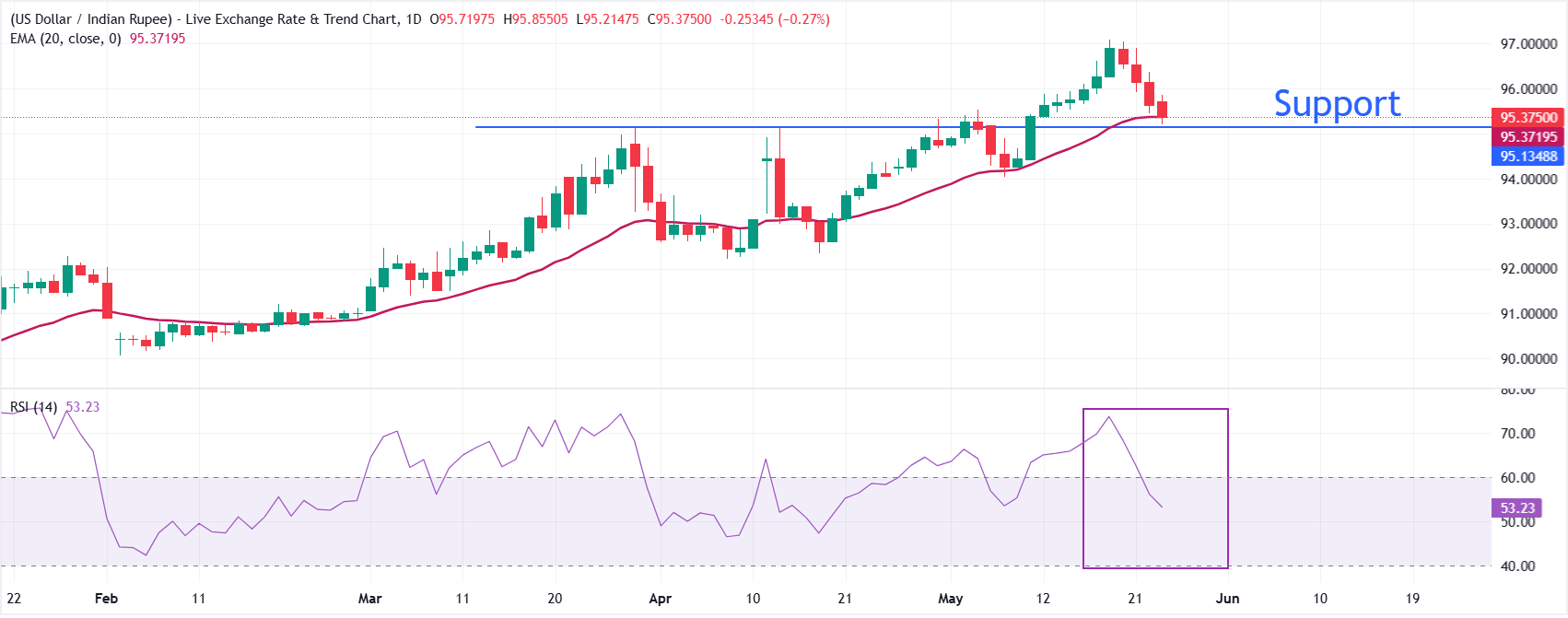
USD/INR trades weakly at around 95.20 at press time. There has been a mean-reversion move in the pair toward the 20-day exponential moving average (EMA), which is at 95.3719, after a strong rally.
The Relative Strength Index (RSI) around 53 suggests neutral-to-slightly positive momentum, hinting that buyers still retain a modest edge while price action stabilizes above short-term trend support.
On the downside, the pair could slide toward 95.00 if it fails to hold the intraday low at 95.20. A downside move below 95.00 would open the door for further correction toward 94.00. Looking up, the pair needs to recover above the May 22 high at 96.37 to ease the downside pressure; and it could return toward 97.00 if it manages to do so.
(The technical analysis of this story was written with the help of an AI tool.)
Indian Rupee FAQs
The Indian Rupee (INR) is one of the most sensitive currencies to external factors. The price of Crude Oil (the country is highly dependent on imported Oil), the value of the US Dollar – most trade is conducted in USD – and the level of foreign investment, are all influential. Direct intervention by the Reserve Bank of India (RBI) in FX markets to keep the exchange rate stable, as well as the level of interest rates set by the RBI, are further major influencing factors on the Rupee.
The Reserve Bank of India (RBI) actively intervenes in forex markets to maintain a stable exchange rate, to help facilitate trade. In addition, the RBI tries to maintain the inflation rate at its 4% target by adjusting interest rates. Higher interest rates usually strengthen the Rupee. This is due to the role of the ‘carry trade’ in which investors borrow in countries with lower interest rates so as to place their money in countries’ offering relatively higher interest rates and profit from the difference.
Macroeconomic factors that influence the value of the Rupee include inflation, interest rates, the economic growth rate (GDP), the balance of trade, and inflows from foreign investment. A higher growth rate can lead to more overseas investment, pushing up demand for the Rupee. A less negative balance of trade will eventually lead to a stronger Rupee. Higher interest rates, especially real rates (interest rates less inflation) are also positive for the Rupee. A risk-on environment can lead to greater inflows of Foreign Direct and Indirect Investment (FDI and FII), which also benefit the Rupee.
Higher inflation, particularly, if it is comparatively higher than India’s peers, is generally negative for the currency as it reflects devaluation through oversupply. Inflation also increases the cost of exports, leading to more Rupees being sold to purchase foreign imports, which is Rupee-negative. At the same time, higher inflation usually leads to the Reserve Bank of India (RBI) raising interest rates and this can be positive for the Rupee, due to increased demand from international investors. The opposite effect is true of lower inflation.
Recommended Articles


