



Are South Korean traders returning to crypto after the KOSPI crash?

Source Cryptopolitan

The South Korean KOSPI index crashed by 8.95% in a single day, with a 15% intraday drop. This triggered a circuit breaker on the market, showing the recent KOSPI rally was fragile. 

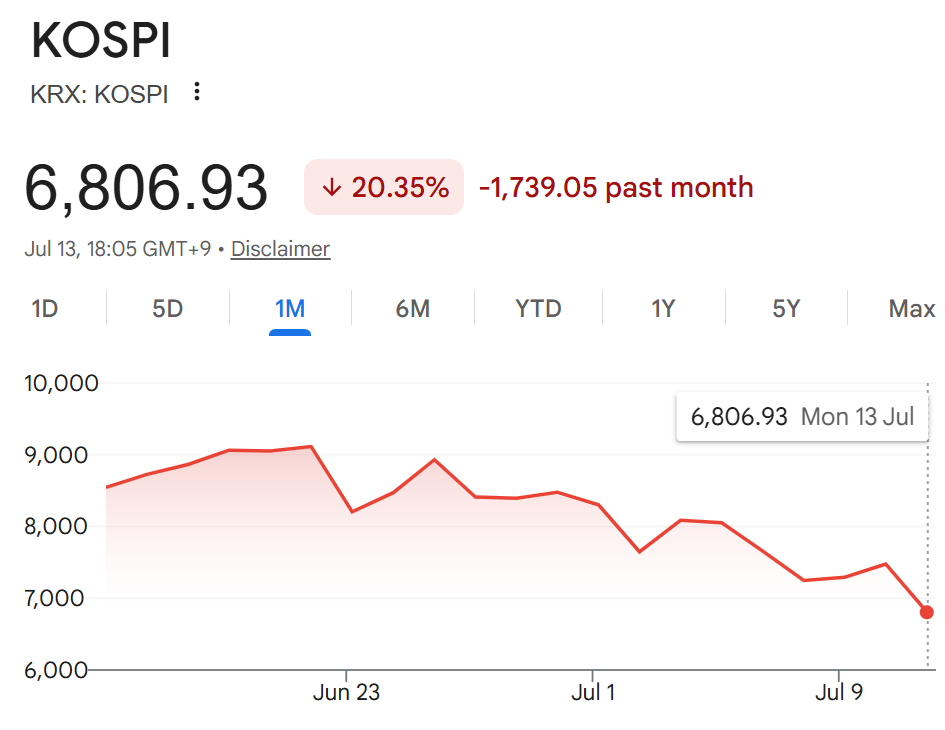
KOSPI broke its rally in June, with a maximum value of 9,155 points. In the past month, the index has been sliding rapidly, plunging below the 6,800 range. 
Can the recent KOSPI crash affect the crypto market?
KOSPI broke down from its peak on June 25, causing more panic-selling and the seventh circuit breaker event for 2026. | Source: Google Finance

As Cryptopolitan reported, KOSPI trading was highly leveraged, and more positions may await liquidation. 

The rapid rise of the KOSPI index also took some of the liquidity from South Korean crypto markets. This also meant KOSPI was boosted by retail inflows, which may be more unstable and lead to panic selling. 

The South Korean HYNIX index also slid by over 19% in the past week, reflecting the tidal shift of the recent rally.

KOSPI signals the unwinding of the AI and semiconductor trade

The South Korean trade was heavily dependent on the semiconductor sector. KOSPI currently trades at a price/earnings ratio of 6.4% for forward earnings. As semiconductor earnings climbed, the index traded at the lowest ratio since the 2008 financial crisis. This does not mean the KOSPI is still cheap, but rather a distrust of the possibility of keeping up semiconductor sales at these levels. 

As the index is highly dependent on semiconductor sales, the current drawdown reflects a worsening confidence in sales for the upcoming quarters. 

The recent circuit breaker event shows the unwinding is more chaotic than expected, potentially leading to a further crash and liquidations. For KOSPI, this is the seventh circuit breaker event in 2026, showing the market’s potential fragility and exposure to sentiment shifts.

The unwinding of the AI trade in South Korea may also affect other sectors. The recent market crash further revealed the risk-off attitudes for risky assets. A slide in KOSPI may have diverse effects on crypto, either moving retail investors back to BTC and tokens or creating a bigger risk-off wave of selling. 

Can the KOSPI slide affect crypto markets?

Coinciding with the recent KOSPI crash, BTC also rejected the $64,000 level. BTC moved down to a lower range, later recovering to $63,000. 

The KOSPI slide also caused more turbulent trading of stock perpetual futures on Hyperliquid. Samsung fell by 8.38% in the past day, with peak volumes. The correction in semiconductor markets may affect trading on HIP-3, leading to liquidations and liquidity. 

The KOSPI crash is still watched for its contagion potential. US markets are waiting to react to Asia’s closing. If stock sentiment shifts, overall crypto selling may worsen. The KOSPI crash may have repercussions across markets and asset classes, once again breaking the BTC recovery. 

In 2026, BTC and crypto behaved as a risk-on asset, meaning any shocks to other sectors often caused a negative reaction. The index is trading with a strong sell recommendation, as pressure comes from South Korean retail liquidations. Additionally, the KOSPI rally invited foreign buyers, who started divesting at the end of June. 

At its 2026 peak, KOSPI accrued 122% in net gains for the year to date. After the recent crash, the net gain shrank to around 60%. 

Don’t just read crypto news. Understand it. Subscribe to our newsletter. It's free.

Disclaimer: For information purposes only. Past performance is not indicative of future results.
placeholder
OpenAI, Meta and SpaceXAI at war to make enterprise AI dramatically cheaperThere is fierce competition among OpenAI, Meta Platforms ($META), and SpaceXAI (NASDAQ: SPCX) on prices of enterprise AI, not just the scores for the models. They launched their latest models this week, promising improved performance but reduced prices to win the corporate scrutiny. This year, some firms had their employees work with AI all day...
Author  Cryptopolitan
16 hours ago
There is fierce competition among OpenAI, Meta Platforms ($META), and SpaceXAI (NASDAQ: SPCX) on prices of enterprise AI, not just the scores for the models. They launched their latest models this week, promising improved performance but reduced prices to win the corporate scrutiny. This year, some firms had their employees work with AI all day...
placeholder
TSMC, Samsung and SK Hynix now make up nearly 30% of emerging marketsTaiwan Semiconductor Manufacturing Co. (NYSE: TSM), Samsung Electronics (KRX: 005930) and SK Hynix (KRX: 000660) now make up more than 30% of the MSCI Emerging Markets Index. Their combined share is close to the Magnificent Seven’s weight in the S&P 500. Technology now covers about 45% of the emerging-market gauge. These three chipmakers are worth...
Author  Cryptopolitan
16 hours ago
Taiwan Semiconductor Manufacturing Co. (NYSE: TSM), Samsung Electronics (KRX: 005930) and SK Hynix (KRX: 000660) now make up more than 30% of the MSCI Emerging Markets Index. Their combined share is close to the Magnificent Seven’s weight in the S&P 500. Technology now covers about 45% of the emerging-market gauge. These three chipmakers are worth...
placeholder
Analysts push back on Musk's space computing timelineSpaceX's AI returns over the coming years will not come from outer space. According to Wall Street analysts, the money is coming from Earth data centers.
Author  Cryptopolitan
17 hours ago
SpaceX's AI returns over the coming years will not come from outer space. According to Wall Street analysts, the money is coming from Earth data centers.
placeholder
Economists See Lower Recession Risk: Will Fed Still Hike Interest Rates?US economists lowered their recession odds to 25% while raising inflation forecasts, according to a Wall Street Journal survey, leaving the Federal Reserve little room to cut interest rates this year.
Author  Beincrypto
17 hours ago
US economists lowered their recession odds to 25% while raising inflation forecasts, according to a Wall Street Journal survey, leaving the Federal Reserve little room to cut interest rates this year.
placeholder
South Korea Crypto Volume Hits a Two-Year Low Amid the KOSDAQ CrashSouth Korea’s crypto trading volume hit a two-year low, dropping below 10 trillion won ($6.7 billion) for the first time since September 2023.The slump coincides with a dramatic collapse across the co
Author  Beincrypto
17 hours ago
South Korea’s crypto trading volume hit a two-year low, dropping below 10 trillion won ($6.7 billion) for the first time since September 2023.The slump coincides with a dramatic collapse across the co
goTop
quote