




Is the digital euro failing before it even launches?
The European Union has been cautioned that the restrictive nature of the MiCA (Markets in Crypto-Assets) regulation will harm the bloc’s global competitiveness when it comes to stablecoin development and proliferation.
Despite the digital euro facing heavy skepticism, euro-dominated stablecoins have experienced an increase in popularity due to increased regulatory clarity. Meanwhile, the digital euro’s pilot has been delayed until late 2027, as the ECB tries to cut costs by using open standards and officials refuse to disclose the project’s current spending.
Is the digital euro failing before it even launches?
A new report from Blockchain for Europe, co-authored by former ECB Director General Dr. Ulrich Bindseil, warns that the Markets in Crypto-Assets (MiCA) framework is too restrictive.
The paper argues that the overly strict requirements are weakening the EU’s competitiveness and pushing business outside the bloc, risking placing Europe on the wrong side of the regulatory “Laffer curve.”
Erwin Voloder, Director of Research & Strategy at Blockchain for Europe, is proposing targeted reforms to ensure MiCA supports a globally relevant euro stablecoin ecosystem.
Policymakers are being urged to consolidate recent growth in digital assets rather than relying on a central bank digital currency (CBDC) that critics argue is dead on arrival.
The ECB recently signed agreements with three European standards bodies, namely European Card Payment Cooperation (ECPC), nexo standards, and the Berlin Group. The goal is to reuse existing open payment standards for contactless payments, merchant system links, and alias-based transactions.
The ECB argues that using open standards will cut adoption costs for banks and merchants, ensuring a uniform user experience across the euro area.
ECB Executive Board member Piero Cipollone stated that this “provides a European free alternative to current proprietary standards,” making it easier for new providers to enter the market.
Cryptopolitan recently reported that the Cato Institute’s Nicholas Anthony was denied access to spending records after the bank refused to process his request because he was not an EU citizen.
A subsequent request from a European citizen was also rejected. Based on limited public figures, estimates suggest at least €1.12 billion (approximately $1.28 billion) has already been set aside for the project, with another €2.62 billion (approximately $2.99 billion) expected in the launch year.
A pilot for the digital euro is not expected to start until the second half of 2027, with a 12-month timeline involving only a limited number of banks and merchants.
Meanwhile, the ECB has confirmed that if issued, the digital euro will be free for basic services, but the central bank has no plans to let people make programmed payments for regular bills to avoid competing with commercial banks.
Are euro stablecoins actually taking over the market?
According to TRM Labs’ Q1 2026 Global Crypto Adoption Index, global retail crypto activity slowed for the second consecutive quarter. Total volume fell to $979 billion, down 11% from the previous year.
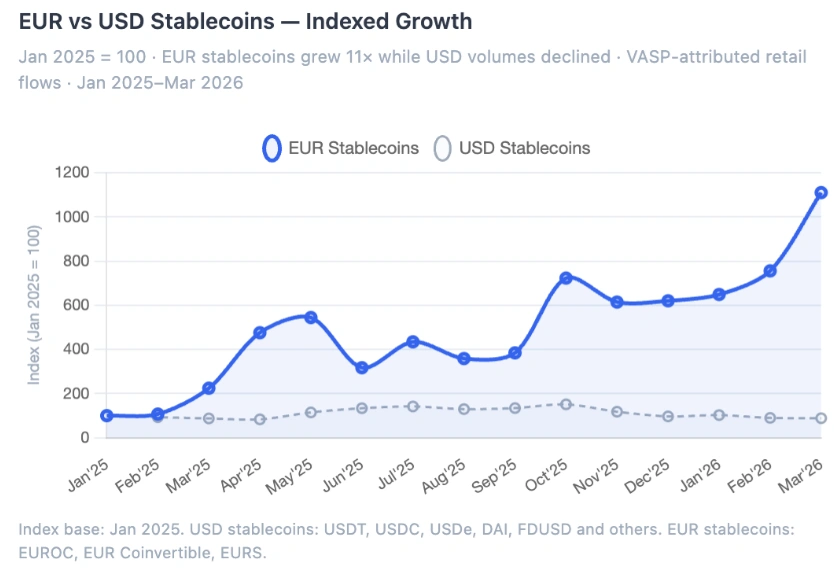
However, data shows that the volume of euro-denominated stablecoins from January 2025 to March 2026 grew from $69 million to $777 million. TRM Labs attributes this growth directly to MiCA regulatory clarity, which has reduced uncertainty for issuers and users.
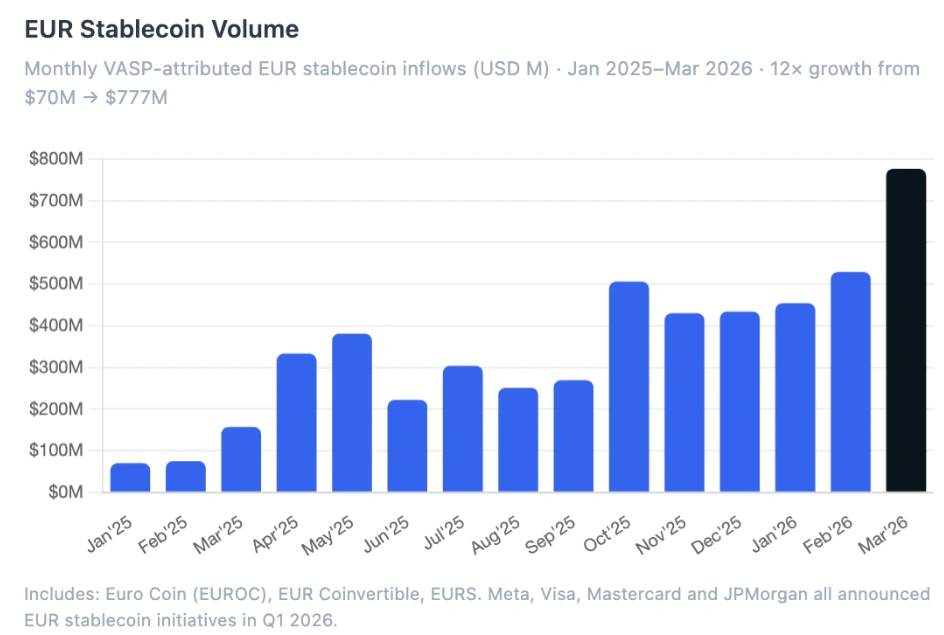
Circle’s EURC now holds over 50% of the euro stablecoin market share after securing an early French EMI license, allowing it to operate across all 27 EU member states. Cryptopolitan reported that transaction volume for EURC has surged over 1,100%, while Société Générale-FORGE’s EURCV has seen growth of over 340%.
Ten major European banks, including BNP Paribas, ING, and UniCredit have formed a consortium to launch a euro-backed stablecoin by mid-2026 through a new entity called Qivalis.
The consortium has already applied for an electronic money institution license with the Dutch Central Bank to provide a regulated, euro-pegged alternative to U.S. dollar stablecoins.
There’s a middle ground between leaving money in the bank and rolling the dice in crypto. Start with this free video on decentralized finance.
Recommended Articles


