




Crude Oil finds a toll booth where its ceasefire used to be
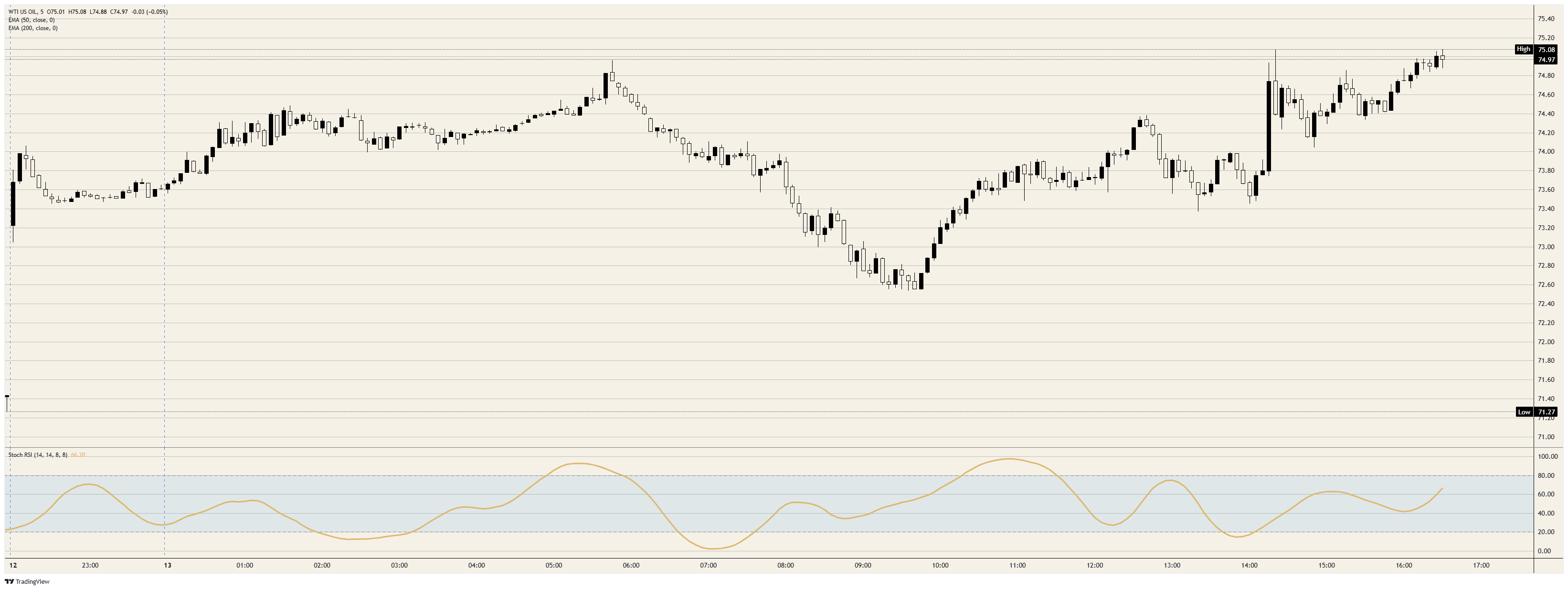
- WTI trades near $75.00, up close to 5% on the session, after rebounding from an early low at $72.53 on renewed Strait of Hormuz escalation.
- Trump reinstated the naval blockade on Iranian shipping and attached a 20% levy to all cargo the United States allows through the waterway.
- The Strategic Petroleum Reserve sits at its lowest level since 1983, stripping the market of its buffer against the next disruption.
Crude Oil is repricing the death of a framework rather than any single missile exchange. West Texas Intermediate trades near $75.00, up close to 5%, with Brent near $80.00, after Trump declared the United States will reinstate its blockade of Iranian shipping and collect 20% of the value of every cargo it allows through the Strait of Hormuz. Barely a week ago the barrel had bled back to pre-war levels near $67.00 as the market priced three weeks of partial normalization; it has now un-priced nearly all of it.
A toll both sides swore was illegal
The memorandum of understanding (MOU) signed in mid-June explicitly barred Tehran from charging commercial ships for passage, a clause Washington spent weeks defending as principle. Oman filed its position at the United Nations' shipping agency, the International Maritime Organization (IMO), that transit through an international strait cannot be tolled, and the IMO's secretary-general said only days ago that charging for Hormuz passage has no legal basis. Every word of that case was aimed at Iran's fee plans; on Monday, Washington photocopied them.
The doctrine is collector-agnostic, which is the detail the announcement ignores. The law of the sea does not care whose navy runs the toll booth, so the market is not truly pricing a 20% levy; it is pricing the fact that neither combatant now accepts a rules-based route back to normal traffic, which turns the strait from a war-risk story with an expiry date into a revenue dispute with none.
The market already pays the fee
Freight is where the toll already exists. Chartering a tanker to lift a cargo from inside the strait to Asia costs roughly double the rate for the same voyage starting outside it, according to shipping-market estimates, with war-risk insurance premiums stacked on top of every transit. Traffic through the waterway runs at roughly a third of its normal pace, and Iranian forces fired warning shots at two ships attempting the passage on Monday morning. Monday's strikes also reached Khuzestan, Iran's main producing province, so the risk now runs on both sides of the ledger, barrels blocked at the strait and barrels hit at the source.
Tehran's own messaging does half the work. Its Strait Authority declared passage unfeasible until stability returns while its diplomats advertised a safe corridor through the same water, and shippers reading both statements sensibly conclude that the only reliable policy is the one priced into their insurance.
An emergency reserve with an emergency of its own
The Strategic Petroleum Reserve (SPR) sits at 319.5 million barrels as of the week ending July 3, its lowest level since April 1983, drained by weekly draws near 6 million barrels under a 172 million barrel pledge made alongside a coordinated International Energy Agency release of 400 million barrels. The stockpile holds less than half its capacity, and Trump conceded at the G7 that without the June deal the reserve was roughly four weeks from running dry.
The commercial side offers no cushion either. Total US inventories including the SPR sit at 734 million barrels, the lowest since 1984; commercial stocks have fallen for ten straight weeks; the hub at Cushing holds under 20 million barrels, near the level where the facility struggles to move Crude Oil out to refiners; and refineries run above 96% utilization into peak driving season. The promised 200 million barrel refill over the coming year quietly adds a new source of demand under the tape.
The week hands the barrel two more tests
The June Consumer Price Index lands Tuesday at 12:30 GMT, with consensus looking for a 0.1% monthly decline on the headline and a deceleration to 3.8% YoY. Monday's energy move arrives too late for June's data but rewrites what the July and August prints are allowed to look like, and the Federal Reserve Chair testifies before Congress at 14:00 GMT the same day with an inflation shock forming in real time.
Wednesday's government inventory data then shows whether the reserve draws and the ten-week commercial slide extended into July. Another large draw against a throttled strait would confirm the squeeze, while a surprise build is the one datapoint that could cool the bid without a peace headline.
Levels and bias
Resistance: The session high at $75.07 caps the day so far; above it, the 200-day Exponential Moving Average at $77.25 is the first real test, with the 50-day at $80.21 behind it, and both still slope lower after the spring collapse from the May peak at $107.35.
Support: The early low at $72.53 is the near boundary and guards the $70.00 handle; beneath that, the pre-war shelf near $67.09 is the level a genuine de-escalation would target.
Bias: Higher. The daily Stochastic Relative Strength Index is curling up from the mid-30s, the strait runs at a third of capacity, and the buffer that used to cap these squeezes now sits at a 43-year low; dips toward $72.53 are for buying, and only a daily close below that level puts the $70.00 handle back in play.
WTI spot 5-minute chart
WTI Oil FAQs
WTI Oil is a type of Crude Oil sold on international markets. The WTI stands for West Texas Intermediate, one of three major types including Brent and Dubai Crude. WTI is also referred to as “light” and “sweet” because of its relatively low gravity and sulfur content respectively. It is considered a high quality Oil that is easily refined. It is sourced in the United States and distributed via the Cushing hub, which is considered “The Pipeline Crossroads of the World”. It is a benchmark for the Oil market and WTI price is frequently quoted in the media.
Like all assets, supply and demand are the key drivers of WTI Oil price. As such, global growth can be a driver of increased demand and vice versa for weak global growth. Political instability, wars, and sanctions can disrupt supply and impact prices. The decisions of OPEC, a group of major Oil-producing countries, is another key driver of price. The value of the US Dollar influences the price of WTI Crude Oil, since Oil is predominantly traded in US Dollars, thus a weaker US Dollar can make Oil more affordable and vice versa.
The weekly Oil inventory reports published by the American Petroleum Institute (API) and the Energy Information Agency (EIA) impact the price of WTI Oil. Changes in inventories reflect fluctuating supply and demand. If the data shows a drop in inventories it can indicate increased demand, pushing up Oil price. Higher inventories can reflect increased supply, pushing down prices. API’s report is published every Tuesday and EIA’s the day after. Their results are usually similar, falling within 1% of each other 75% of the time. The EIA data is considered more reliable, since it is a government agency.
OPEC (Organization of the Petroleum Exporting Countries) is a group of 12 Oil-producing nations who collectively decide production quotas for member countries at twice-yearly meetings. Their decisions often impact WTI Oil prices. When OPEC decides to lower quotas, it can tighten supply, pushing up Oil prices. When OPEC increases production, it has the opposite effect. OPEC+ refers to an expanded group that includes ten extra non-OPEC members, the most notable of which is Russia.
Recommended Articles


