




Trump Claims US Will Take Over Strait of Hormuz: Spot Gold Plunges Over 2%, Set to Fall Below $4,000
TradingKey - On July 13, Eastern Time, spot gold fell over 2%, trading at $4,014 per ounce as of press time. It is reported that U.S. President Trump stated on social media: "We are going to take over the Strait of Hormuz, and Iran will have nothing."
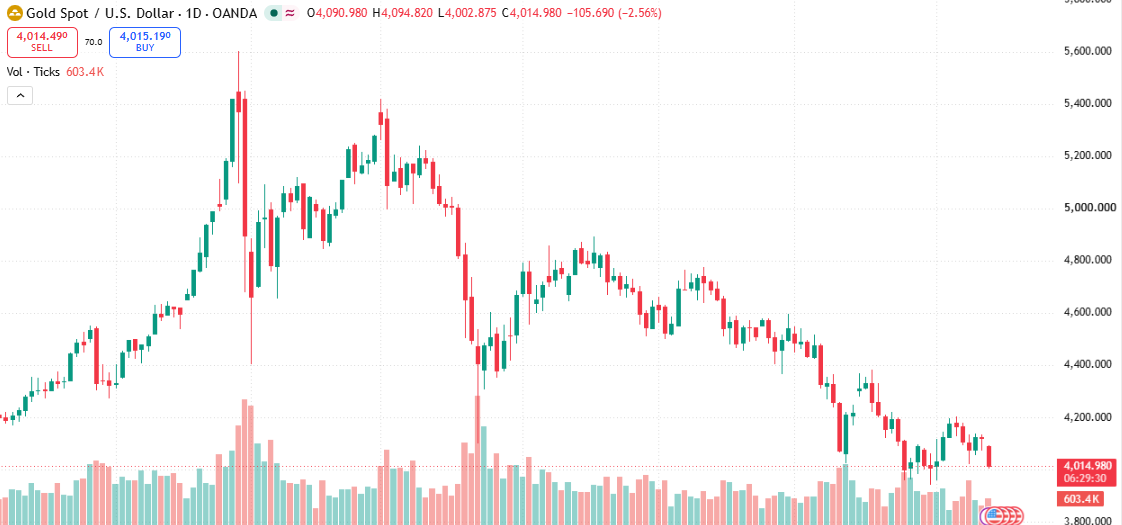
[Source: TradingView]
Specifically, U.S. President Trump stated that the Strait of Hormuz is open and will remain open with or without Iran. We will resume the "Blockade Iran" operation, so named because it only blocks Iranian ships or clients from entering or leaving. All other countries will have fair and open access to the strait. From now on, the United States will be known as the "Guardian of the Strait of Hormuz," but as guardian, and out of fairness, the U.S. will charge a 20% fee on all cargo shipments to offset all costs required to provide safety and security for this volatile region of the world. Relevant procedures and formation work will begin immediately. Thank you all for your attention to this matter!
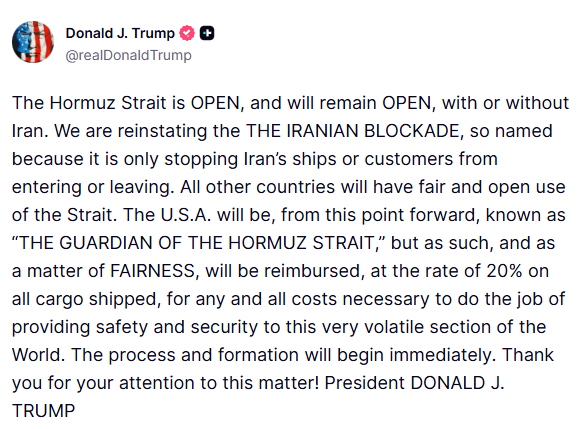
[Source: Truth Social]
The Iranian side immediately responded firmly, with Iran's Joint Military Command issuing a statement through the state media outlet IRIB, declaring that "under no circumstances, now or in the future, will the U.S. be allowed to interfere in the management of the Strait of Hormuz," and warning that if the conflict expands in the region, "the flames of war will engulf all countries in the region."
The dispute between the two sides over the control of the Strait of Hormuz has suddenly escalated. As a core global oil transport route, its security situation has rapidly triggered intense market concern. Affected by this, international oil prices rose sharply, and the US Dollar Index (DXY) strengthened in tandem with US Treasury yields, indicating robust buying demand for the greenback. This has further suppressed the investment appeal of non-yielding precious metal assets like gold, triggering market sell-offs, and capital continues to flow out of gold commodities.
If the Middle East conflict escalates further, continuing to raise the appeal of allocating to the bond market and US dollar assets, the room for a short-term rebound in gold prices will be heavily compressed, and XAU/USD may continue to face selling pressure going forward.
On the other hand, continuous gold purchases by global central banks, coupled with weak growth in primary mining supply, continue to support gold price trends. The latest survey results from the World Gold Council show that over the next 12 months, 45% of central banks plan to continue increasing their gold holdings through proprietary accounts, and 89% of surveyed institutions predict that global official gold reserves will maintain an upward trend.
Market analysts noted that the renewed conflict between the US and Iran has driven crude oil prices higher and pulled gold prices back, but the correction in gold prices has been very limited. Apart from the market's belief that this low-intensity symbolic mutual strike between the two sides is unlikely to escalate continuously, the more core reason is that the market has reached a consensus expectation: Warsh will push for rate cuts at all costs.
The World Gold Council stated that based on current consensus macro expectations, gold prices are highly likely to remain range-bound in the second half of the year; gold prices will unlock upward potential when three major signals emerge: the escalation of geopolitical conflicts, a shift in rate hike expectations, and the massive entry of long-term capital. Meanwhile, continuous gold purchases by central banks and the entry of global long-term allocation capital provide structural bottom support, significantly limiting the room for deep corrections. In a global environment fraught with geopolitical and policy uncertainties, gold still possesses the attributes of a strategic volatility-resistant asset.
Recommended Articles


