




Gold steadies after sliding to fresh seven-month low, Fed rate-hike bets weigh
- Gold bounces after touching a fresh seven-month low of $3,941.
- Hawkish Fed expectations and a stronger US Dollar continue to weigh on the non-yielding metal.
- XAU/USD is attempting to stabilize above the $4,000 mark, but technical indicators continue to favor sellers.
Gold (XAU/USD) rebounds on Tuesday after falling to a fresh seven-month low of $3,941 in the Asian session, as dip buyers help the precious metal recover some of its losses. At the time of writing, XAU/USD trades around $4,028.
Despite the modest intraday recovery, Gold remains on track for its worst quarter since 2013, having erased all of its gains for the year. The precious metal is down nearly 18% this quarter and is heading for its biggest monthly decline since 2008, with losses of about 11%.
The downside came as geopolitical tensions in the Middle East triggered an energy-driven inflation shock, causing a hawkish repricing of Federal Reserve (Fed) interest rate expectations.
While Gold typically benefits from geopolitical tensions and rising inflation, higher interest rates reduce its appeal because the non-yielding metal becomes less attractive relative to interest-bearing assets.
Meanwhile, uncertainty over a potential round of talks between the US and Iran in Qatar and expectations that the Fed could raise borrowing costs in the second half of the year continue to support the US Dollar (USD). A stronger Greenback adds further pressure on Gold by making it more expensive for overseas buyers.
The US Dollar Index (DXY), which tracks the Greenback's value against a basket of six major currencies, is trading around 101.36, near levels last seen in May 2025, and is on track for a second consecutive monthly gain.
According to the CME FedWatch Tool, traders are currently pricing in a 63% probability of a rate hike at the September meeting.
This week's US labor market data will be carefully watched for fresh clues on the Fed's next policy move. The Job Openings and Labor Turnover Survey (JOLTS) report is due later on Tuesday, followed by the ADP Employment Change report on Wednesday and the Nonfarm Payrolls (NFP) report on Thursday, this time for a change – due to the 4th of July holiday weekend beginning on Friday.
The upcoming data are also likely to determine Gold's near-term direction. The $4,000 level remains an important psychological support, and unless it is decisively broken, XAU/USD may continue to consolidate near recent lows.
Strategists at Societe Generale said, "While the decline appears somewhat stretched, signals of a meaningful rebound are not yet visible. Should a short-term bounce emerge, the recent pivot high at $4,100 may act as the initial resistance. Below $3,885, the next projections could be located at $3,750 and $3,600."
Technical Analysis: Bearish bias persists below key moving averages
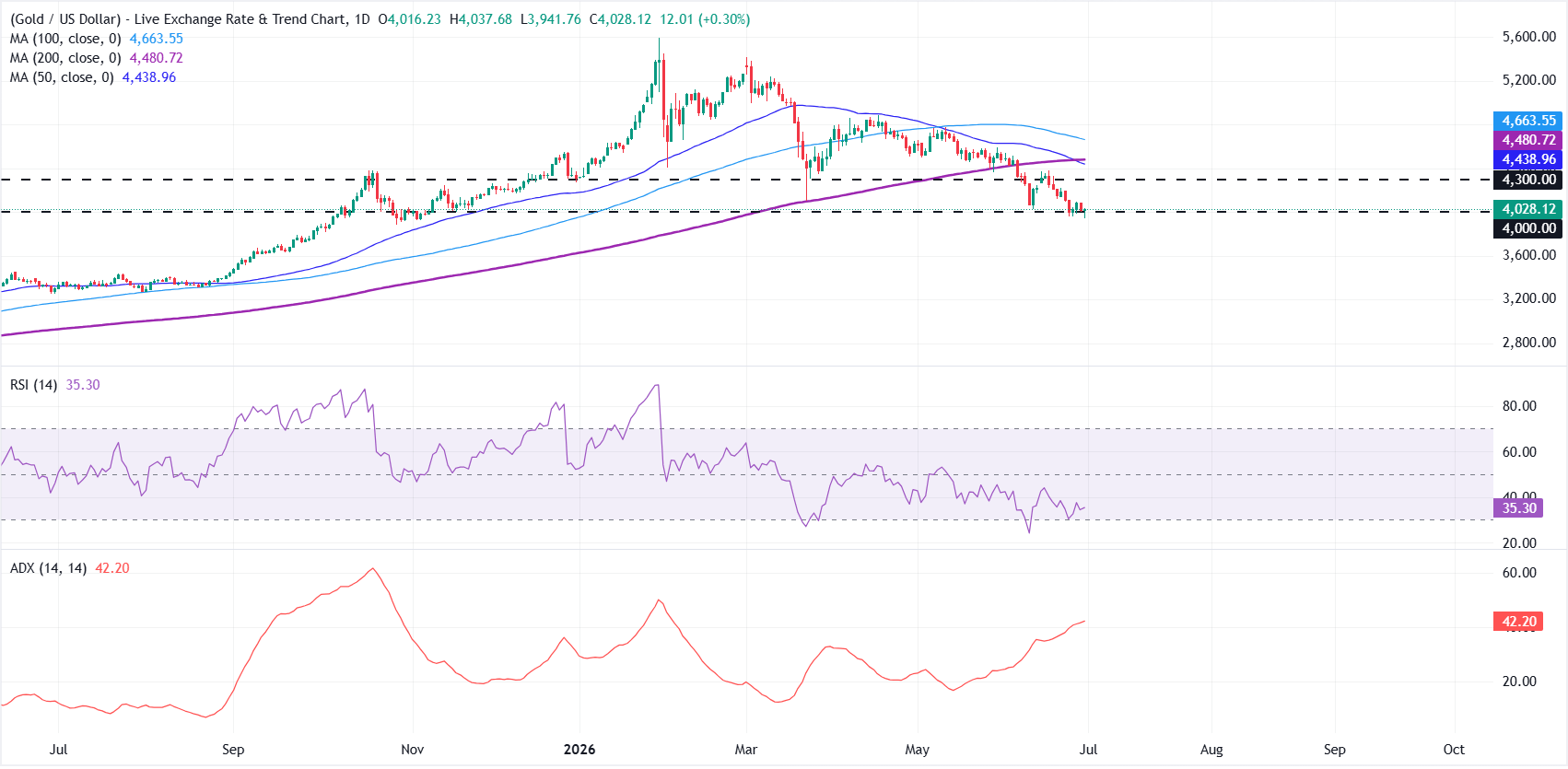
On the daily chart, XAU/USD keeps a bearish near-term tone as price holds well beneath the 50-day, 100-day and 200-day Simple Moving Averages (SMAs) clustered between roughly $4,440 and $4,660.
The metal is attempting to stabilize just above the $4,000 area, but the Relative Strength Index (RSI) at 35 remains weak, while the Average Directional Index (ADX) at 42 suggests a still-solid underlying trend, hinting that downside pressure could persist unless key overhead levels are reclaimed.
On the downside, immediate support is located at the horizontal floor around $4,000, where a sustained break would open the way to further losses in the coming sessions.
On the topside, initial resistance emerges at $4,300, followed by the 50-day SMA near $4,438 and the 200-day SMA at $4,480, with the 100-day SMA up at $4,663 acting as a broader cap on any corrective bounce while the bearish structure remains in place.
(The technical analysis of this story was written with the help of an AI tool.)
Gold FAQs
Gold has played a key role in human’s history as it has been widely used as a store of value and medium of exchange. Currently, apart from its shine and usage for jewelry, the precious metal is widely seen as a safe-haven asset, meaning that it is considered a good investment during turbulent times. Gold is also widely seen as a hedge against inflation and against depreciating currencies as it doesn’t rely on any specific issuer or government.
Central banks are the biggest Gold holders. In their aim to support their currencies in turbulent times, central banks tend to diversify their reserves and buy Gold to improve the perceived strength of the economy and the currency. High Gold reserves can be a source of trust for a country’s solvency. Central banks added 1,136 tonnes of Gold worth around $70 billion to their reserves in 2022, according to data from the World Gold Council. This is the highest yearly purchase since records began. Central banks from emerging economies such as China, India and Turkey are quickly increasing their Gold reserves.
Gold has an inverse correlation with the US Dollar and US Treasuries, which are both major reserve and safe-haven assets. When the Dollar depreciates, Gold tends to rise, enabling investors and central banks to diversify their assets in turbulent times. Gold is also inversely correlated with risk assets. A rally in the stock market tends to weaken Gold price, while sell-offs in riskier markets tend to favor the precious metal.
The price can move due to a wide range of factors. Geopolitical instability or fears of a deep recession can quickly make Gold price escalate due to its safe-haven status. As a yield-less asset, Gold tends to rise with lower interest rates, while higher cost of money usually weighs down on the yellow metal. Still, most moves depend on how the US Dollar (USD) behaves as the asset is priced in dollars (XAU/USD). A strong Dollar tends to keep the price of Gold controlled, whereas a weaker Dollar is likely to push Gold prices up.
Recommended Articles


