


Surging 90% This Year. World’s Best Stock Market Knocks on MSCI, Can South Korea Shed “Emerging” Label?
TradingKey - South Korea's stock market is approaching a milestone it has been chasing for more than a decade.
Bloomberg reports indicate that as MSCI prepares to announce its annual market classification review results on June 23, Seoul is more eager than ever to secure its entry into the developed markets club.
While the KOSPI has experienced its most intense volatility in years over the past week, it has not dampened market focus on the prospect of an upgrade—the index has gained over 90% year-to-date, leading major global benchmarks as the AI frenzy drives massive inflows into semiconductor titans Samsung Electronics and SK Hynix, lifting the entire market to record levels.
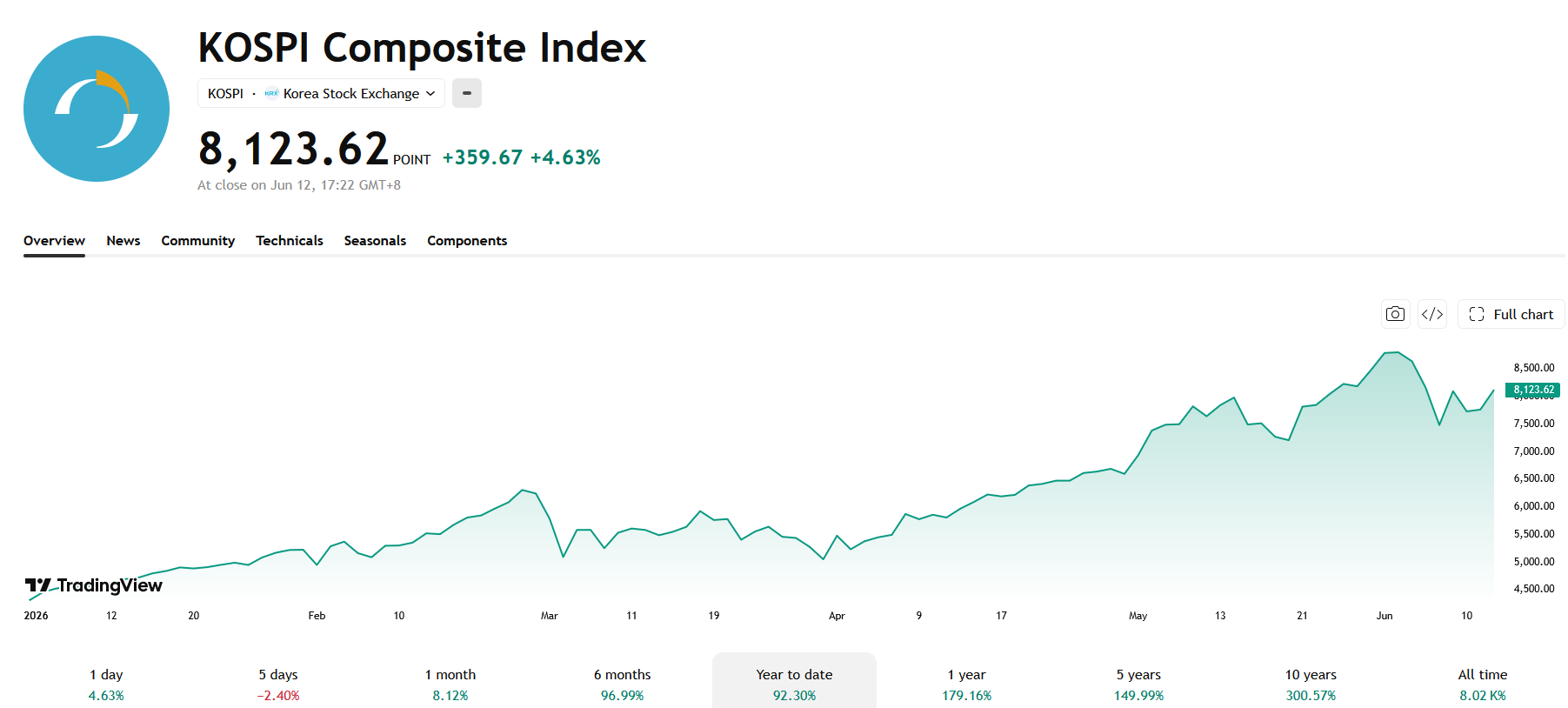
Market capitalization ranks among the world’s top tier; industrial fundamentals transcend index labels.
By nearly every conventional metric, South Korea has long been a bona fide advanced economy. In the past year, the total market capitalization of South Korean equities has nearly tripled to approximately $4.4 trillion, briefly eclipsing India to rank as the world’s sixth-largest stock market.
Samsung and SK Hynix combined account for more than half of the KOSPI’s weighting, rendering the South Korean stock market virtually synonymous with the global AI value chain.
Arjun Jayaraman, a portfolio manager at Causeway Capital Management, encapsulated the situation succinctly: the point is not investing in South Korea per se, but rather investing in AI-related plays. In other words, for a South Korean market occupying a central node in the semiconductor supply chain, its investment proposition has long transcended the boundaries defined by any index classification.
Capital Revaluation and the "Korea Discount" Dynamics Under Upgrade Expectations
However, the label itself is not without significance. BNP Paribas Securities estimates that once MSCI officially includes South Korea in its developed market index, funds tracking the benchmark could bring approximately $30 billion in capital inflows as they rebalance their portfolios.
The more far-reaching impact is that this change in status is expected to fundamentally address the "Korea Discount" that has long plagued the domestic stock market—a structural phenomenon where Korean corporate valuations are consistently lower than those of their peers in developed markets.
Wei Li, Head of Multi-Asset Investments at BNP Paribas, noted that this would completely redefine South Korea's market positioning, moving it from a "high-growth emerging market play" to a "core developed market allocation within strategic supply chain pillar industries." This shift in perception carries far more long-term value than simple capital inflows.
Looking back, South Korea's path through the MSCI review process has been rocky. After being placed on the developed market watch list in 2009, it was removed in 2014 due to currency trading restrictions and market access barriers. Last year, MSCI again cited lagging foreign exchange reforms and excessive compliance burdens, maintaining its emerging market status.
South Korea has been on this path for so long that the assessment by Young Jae Lee, Senior Investment Manager at Pictet Asset Management, carries a sense of resolute resignation: "It's just a matter of time. My base case is that South Korea will become a developed market within the next few years."
Nevertheless, the majority of the 15 investors and strategists interviewed by Bloomberg expect South Korea to remain in the emerging market category in this review. The reason is straightforward—while recent reforms, such as restoring short-selling and plans to extend won trading hours, are moving in the right direction, they need more time to demonstrate sustainability and execution.
Reform Breakthroughs: From Lifting Short-Selling Bans to Extending Trading Hours
The South Korean government is clearly aware of the urgency of the issue. Current President Lee Jae-myung has made capital market reform a policy priority; from restoring short-selling to preparing to extend won trading hours, a series of measures directly address market access pain points long criticized by foreign investors.
Yi Ping Liao, a portfolio manager at Franklin Templeton, observed that the current administration's clear policy priority of driving the market's transition from emerging to developed status has significantly increased the likelihood of an upgrade.
The underlying logic is that diversifying the investor base is expected to provide a stabilizer for the currently volatile market. South Korea has experienced record foreign capital outflows exceeding $78 billion this year, largely because surges in the share prices of Samsung and SK Hynix forced related funds to reduce their holdings after hitting individual stock exposure limits.
Park Jinho, head of equity investment at NH-Amundi Asset Management, noted that once the market joins the ranks of developed nations, these position limits may be eased accordingly.
Kieron Poon, director of Asian equities at abrdn, added a more long-term perspective: developed market investors typically focus on corporate sustainability, corporate governance, and shareholder returns rather than merely chasing short-term growth, a shift in mindset that helps reduce market volatility in the long run.
Of course, some argue that MSCI’s classification labels are losing their former weight at a time when the South Korean stock market is increasingly tied to the global AI and semiconductor cycles.
When the share price performance of Samsung and SK Hynix dictates capital flows more than any index classification, the debate over developed versus emerging market labels has, to some extent, become a game where symbolic significance outweighs substantive impact.
Recommended Articles


