



The cryptocurrency network is a system that allows individuals to send and receive money without a bank. There are multiple technologies that supports each transaction on this network behind the scenes. One of those technologies is called a nonce.
You cannot avoid the word nonce when you're discussing cryptocurrency. A nonce helps blockchains validate transactions, makes a network secure and prevents any attacks. This guide is all about learning what a nonce is in crypto.
What is a Nonce in Crypto?
A nonce in crypto is an arbitrary number used only once in a cryptographic process or blockchain transaction. The word itself comes from the phrase“number used once.” Nonces are used in cryptography primarily to guarantee that each and every transaction or communication is unique. Since a nonce can only be used once, it stops duplicate transactions, replay attacks and the unauthorized reuse of information.
In blockchains, a nonce is used in different ways across different networks. For example, a nonce is used to create a valid block hash in proof-of-work mining. Meanwhile, a nonce is used to ensure that the transactions are done and processed in order when it comes to transaction systems such as Ethereum.
Here's one way to look at it. Imagine writing dozens of letters to a friend without any clear timeline; they would easily become confused. You came up with the idea to add a “Letter Number” to the top of each letter. This will help tie together related letters. The first letter gets the number one and each consecutive letter gets the next number up. So in this case, the letter number is like a nonce. Your letters have not changed, but the "Letter Number" makes each one of them unique.
How Does a Nonce Work in Blockchain?
You can see how a nonce works in blockchain when looking at Proof-of-Work systems like Bitcoin and account-based systems like Ethereum. For example, mining for new blocks means solving cryptographic puzzles. This requires creating a hash that is under a target threshold determined by the network. A hash is a fixed-length string of characters produced by a cryptographic algorithm. The hash output is guaranteed to differ even with the smallest input changes.
The catch is that the data in a block’s transaction is mostly permanent. If miners did the same hashing over and over, the output would be the same. This is where the nonce is important.
Meanwhile, a nonce works on account-based networks like a sequential counter. The nonce is assigned to every transaction sent from one address. This helps the transactions become processed one by one in the correct order.
The Different Types of Nonce
The idea for a single-use number stays the same but there are different types of nonces depending on the structure of the network. The first one is the miner nonce which is used in Proof-of-Work systems. Its only function is to be the variable used in the blockchain's proof of work puzzle. To discover a solution, miners must keep adjusting the miner nonce until a hash is made that meets the network’s target.
A nonce also exists in account-based networks and is referred to as a transaction nonce. This nonce is mostly found in blockchains like Polygon, Optimism, Ethereum etc. In this case, a transaction nonce is a sequential counter for a particular address on the network, rather than a variable for a puzzle.
When a user sends a transaction from their wallet, the transaction nonce increases by one. To arrange the sequence of transactions, the network deploys a sequential counter. If your transaction reuses a nonce or skips a count, the nodes will refuse to carry out the transaction.
There is also the extra nonce. When miners run out of their standard nonce range, they adjust additional data fields as extra nonces. Extra nonces are usually added in the coinbase transaction, providing them complete freedom in choosing the hash value. Every network has different structures, but the same cryptography principles are applied across all networks to guarantee security.
A Summary of Nonce Types
The Necessity and Limitations of Nonce
The Necessity of Nonce
Nonces provide several critical security and operational benefits for blockchain networks.
One of the most valuable uses of nonces in crypto is that they prevent double-spending. For example, if a malicious user attempts to submit a transaction you made to the network again, the network will not accept the transaction since the nonce has already been used.
Additionally, nonces help prevent replay attacks. A replay attack is when an attacker attempts to reuse a valid transaction on another network which is invalid. Since nonces guarantee that each transaction will be unique and will not be able to be executed again, they will not be able to perform the replay attack.
On a network like Ethereum, a nonce is used to ensure that each transaction from an account is performed one after the other. If a nonce were not present, transactions could be launched and processed in a random and out-of-order manner. This would lead to an inconsistent balance and undesirable smart contract interactions.
The Limitations of Nonce
Nevertheless, nonces do have their drawbacks.
Since valid nonces are random, it is hard to predict how long it takes to create blocks. When there are numerous activities on a network, it can become congested and transaction confirmations can be delayed.
Not only that, using sequential nonces means both the sender and the receiver must stay exactly in sync. If a message is lost or goes out of order, communication between the two is then totally stopped.
Nonce in Bitcoin
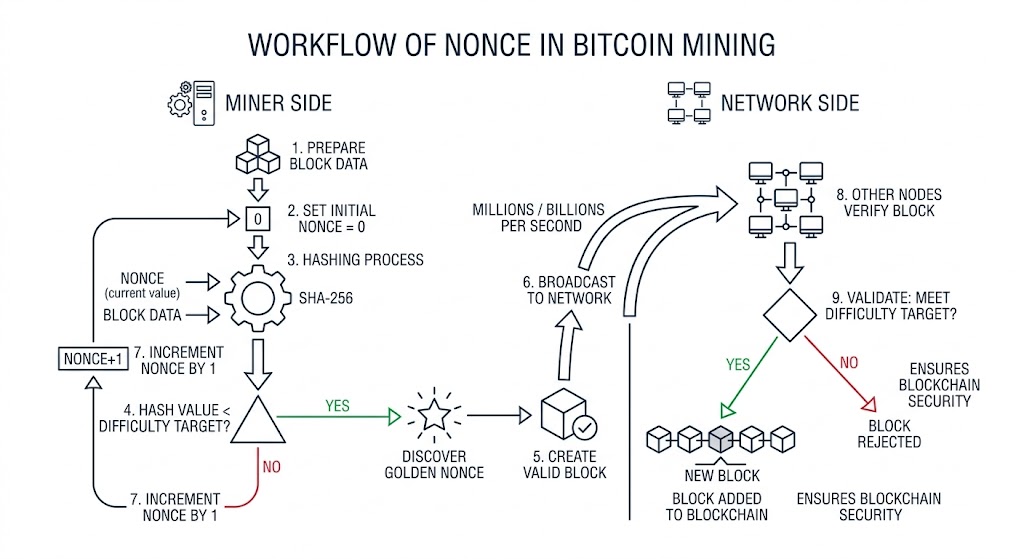
A nonce is a unique number that you put in the Bitcoin block header when mining. Miners put different nonces in the block header and hash it to see if a valid hash has been made. Creating a block is a tough process because of this design. This is how the Bitcoin blockchain ensures its security.
To clarify, miners start with a nonce of zero. The miner hashes the block data and the nonce together. Then the network checks it to make sure it meets the difficulty target. A failure to meet it means the miner needs to increase the nonce by one and hashes the data again. The only way to create a legitimate hash is by brute force. There are about 4.3 billion possible nonce values and miners must hash the combination for each one. This is a “trial-and-error” process and takes place millions, often even billions of times per second.
The task at hand is for the miner to discover a nonce value that produces a valid hash. A valid hash is often referred to as a golden nonce. So, it becomes necessary for miners to cycle through potential nonce values and see if a valid hash is produced. The block is sent to the network when a valid hash is discovered. Other nodes then verify the block by running the data and the golden nonce to check if the output is the target difficulty.
What Is the Nonce Limit and Extra Variation in Bitcoin?
The Bitcoin nonce is capped at only 32 bits. This leads to just over 4 billion values. Once miners have tried all of the nonce combos, they have to change something in the block header to keep the process going since they are searching for valid hashes. Here's where the extra nonce comes in. The extra nonce is in the coinbase transaction and brings miners more variation on top of the standard nonce range.
Hash vs. Nonce
It is also worth noting that hashes and nonces work together in the process of Bitcoin mining. A nonce changes and acts as an input value. The hash is an output that’s created using cryptography with block data and a nonce. Miners must change the nonce over and over again to generate a different hash. A correct nonce produces a hash with a value that's less than the target difficulty threshold. Brute-force searching is necessary because small alterations in a nonce yield entirely different hash outputs.
Nonce in Ethereum
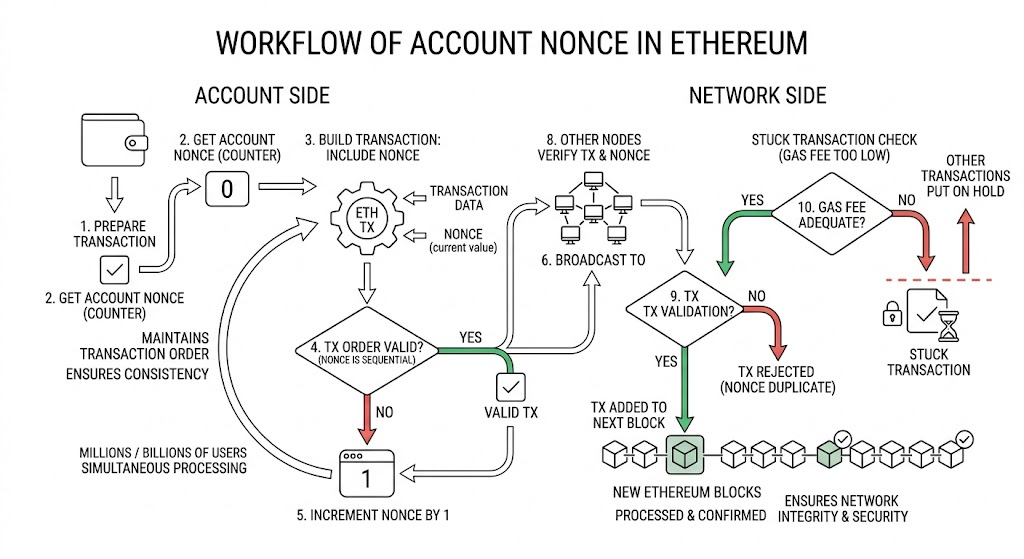
As we mentioned before, Ethereum approaches nonces differently compared to Bitcoin. Ethereum is more about organizing account activities with transaction nonces than it is with mining nonces like Bitcoin. Each account in Ethereum has a nonce counter that only increases when an outgoing transaction is made.
For example, if you send one ETH somewhere, the nonce will be zero. But, the next transaction will have a nonce value of one etc. The network will deny the transaction since the nonce has already been used if someone attempts to remake the original transaction. This ensures network consistency while also maintaining transaction order.
However, this process may face some challenges. Notably, a transaction can get stuck if your gas fee is too low for the current network demand. Therefore, if your first transaction gets stuck all other ones will be put on hold.
How To Fix a Stuck Transaction Using Nonce?
To fix this, you can replace the stuck transaction. Simply send yourself a new transaction with the same nonce as the stuck one. But, be sure to put a higher gas fee for this one as Ethereum prioritizes them. Once this transaction is processed, the nonce on the stuck translation is considered "used" and your stuck transaction will be dropped.
Nonce in Other Cryptos
Nonces can be found when talking about other cryptos as well. For instance, mining nonces can be heard when talking about Litecoin too. Litecoin's Proof-of-Work design is similar to Bitcoin, but it uses the Scrypt hashing algorithm instead of SHA-256. Mining nonces work the same as they help miners create valid hashes on Litecoin.
On the other hand, the BNB Chain uses account-based transaction nonces like Ethereum does. The BNB Chain prevents replay attacks and maintains transaction ordering using these transaction nonces.
Meanwhile, Solana uses what is called a “durable nonce”. To clarify, Solana controls transaction uniqueness by using a recent blockhash. Blockhashes expire after 150 blocks or about 90 seconds. To get around this problem developers use a durable nonce. This system exchanges the blockhash with a stored nonce value. The advantage is this nonce value never expires and is only valid for one-time use.
It does not matter how different the nonces for making blockchains work might be from one network to another. They all share one key idea. That key idea is systems which bring unique identifiers for every transaction. These systems protect the network and keep transactions in the right order.
A Summary of Nonce in The Most 10 Popular Cryptos
Conclusion
Nonces are a fundamental element used throughout blockchain technology. This is very impressive since they are one of the least visible components. They are tasked with some of the most important jobs in the industry. Nonces maintain the integrity and help secure Proof-of-Work mining in Bitcoin while organizing transactions in Ethereum. Not to mention the important work they do with other cryptos as well.
It is safe to say that they will continue being a fundamental component of the cryptographic system as blockchain technology keeps evolving. Even consensus systems that are new still use nonce-like systems to maintain the order of transactions while ensuring that the actions have not occurred more than once.
Learning more about them is crucial if you are interested in discovering how the blockchain system works at its core.
 What does Mitrade offer? Mitrade helps you seize market opportunities in real-time, providing a simpler and more efficient way to trade cryptocurrencies.
What is a nonce in crypto?
A nonce in crypto refers to a number used only once for a blockchain or cryptographic process. Nonces secure transactions and prevent duplicate activity. Nonces also support transaction ordering and mining, depending on the blockchain.
How is an Ethereum nonce different from a Bitcoin nonce?
A Bitcoin nonce is for mining and making valid block hashes for the Proof-of-Work consensus. An Ethereum nonce is connected to transactions in a wallet. This type of nonce guarantees that that transactions are processed in the correct sequential order.
How does a nonce prevent replay attacks?
Nonces help every transaction be different. The network detects that the nonce has already been used and immediately rejects the duplicate transaction.
Is there a limit to the size of a nonce?
Yes. A mining nonce in Bitcoin is a 32 bit number with a limit of a little over 4.29 billion. Once miners go through this range, they start using extra nonces and variations of the block to search for valid hashes.
* The content presented above, whether from a third party or not, is considered as general advice only. This article should not be construed as containing investment advice, investment recommendations, an offer of or solicitation for any transactions in financial instruments.


