


Is the Trump Bull Market Coming to an End? The Evidence is Piling Up, and the Message is Strikingly Clear.
Key Points
The S&P 500 has climbed in the double digits since President Donald Trump’s inauguration.
But the index has slipped on occasion over the past year amid various headwinds.
- 10 stocks we like better than S&P 500 Index ›
Since President Donald Trump's inauguration, the S&P 500 bull market has been roaring higher, with the index advancing 21% and reaching multiple new record highs. It hasn't been a completely steady path, though: Concerns about U.S. import tariffs and turmoil in Iran, as well as worries about economic growth, have weighed on sentiment and stock performance periodically.
Overall, however, the Trump bull market has prevailed as investors piled into growth stocks, particularly those involved in artificial intelligence (AI). Names such as AI chip designer Nvidia, cloud services provider Alphabet, and memory and storage giant Micron Technology have soared in the double and triple digits. These are the companies that are already monetizing AI, and investors have aimed to get in on these success stories early.
Will AI create the world's first trillionaire? Our team just released a report on the one little-known company, called an "Indispensable Monopoly" providing the critical technology Nvidia and Intel both need. Continue »
Meanwhile, against this bright backdrop, investors haven't been completely sanguine. With the bull market well into its third year, they've questioned its longevity -- particularly during moments when headwinds have interrupted the momentum. Is the Trump bull market coming to an end? The evidence is piling up, and the message is strikingly clear...

Image source: Getty Images.
AI stocks drive gains
So, first, a closer look at some of the main points that have driven market direction since Trump took office. As mentioned, investors continued to rush into AI stocks as well as other high-growth players such as quantum computing stocks. They were optimistic about growth and the possibility of interest rate cuts to further boost it.
But various factors have rocked that boat over the past year or so. Last spring, the president's announcement of import tariffs sparked concern that these duties would weigh on the earnings of U.S. companies and the wallets of consumers. Negotiations with various countries to lower tariff levels tempered the concerns, but certain companies are still dealing with pressures from these added costs.
Last year, the president clashed with Jerome Powell, then chair of the Federal Reserve, regarding interest rates: Trump wanted them lowered to support growth, while Powell took a wait-and-see approach. And this uncertainty regarding rates also weighed on sentiment.
Finally, this year, turmoil in Iran, resulting in supply chain disruptions and higher energy prices, also put the brakes on positive momentum.
The S&P 500's first-half performance
Still, the S&P 500 recovered from those times of difficulty, and even today, with the Iran troubles ongoing, the index is on track for a first-half increase of 6%.
Now, let's consider whether this bull market may continue -- or if it's in danger. Though AI companies continue to report spectacular earnings and forecast more to come, investors have become more cautious on the sector. Any small disappointment may weigh heavily on a stock. We saw this when Broadcom's forecast fell short of certain analysts' expectations, and this triggered declines in chip stocks.
Meanwhile, Kevin Warsh took over as Fed chair last month, and investors are on the edge of their seats as the next Fed meetings approach. Economists don't expect a change in rates during the June 16 meeting, but they and other market participants will be listening closely for clues about policy ahead.
Investors may be particularly interested in Warsh's comments due to the latest data regarding inflation -- consumer prices jumped 4.2% last month, the highest rate in three years.
All of these elements have represented headwinds for stocks, and if these problems deepen, they could lead to the end of the bull market. But the evidence that's most compelling is the following.
Stocks are historically expensive
The S&P 500 has done something it's only done once before in the past, and that's always led to declines. The index has reached valuation levels it only surpassed during the dot-com bubble, showing that today, stocks are historically expensive. We can see this through the S&P 500 Shiller CAPE ratio, an inflation-adjusted view of stock price in relation to earnings per share.
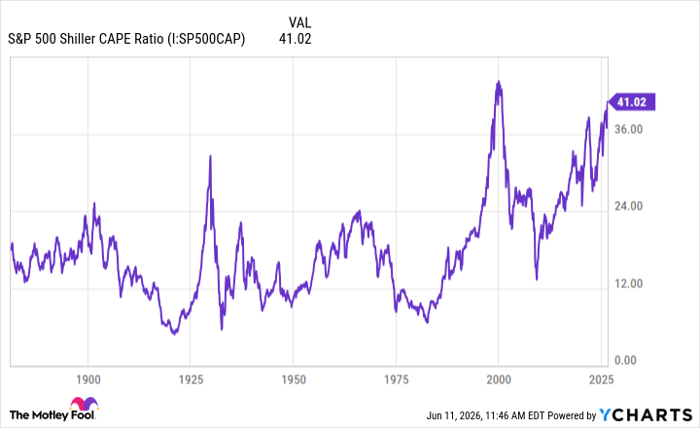
S&P 500 Shiller CAPE Ratio data by YCharts
If we zoom in to get a closer look at what happens to the index when peaks in valuation occur, the message is clear: The S&P 500 goes on to decline.
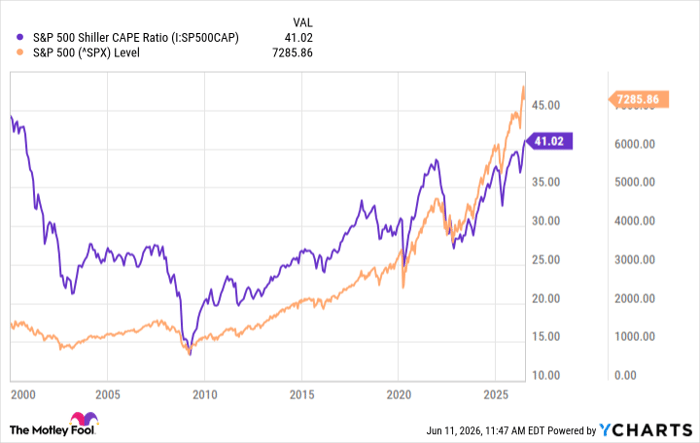
S&P 500 Shiller CAPE Ratio data by YCharts
So, the evidence is piling up, and the message is strikingly clear: The Trump bull market could be coming to an end amid high valuations, increasing inflation, and general market uncertainties.
But here's the good news: We don't know the exact timing for such a transition, meaning the bull market could have further to go. Second, markets shift through bull and bear cycles, so we know downturns always are temporary. And this means that investors who hold onto quality stocks over time are likely to score an investing win, regardless of near-term shifts.
Should you buy stock in S&P 500 Index right now?
Before you buy stock in S&P 500 Index, consider this:
The Motley Fool Stock Advisor analyst team just identified what they believe are the 10 best stocks for investors to buy now… and S&P 500 Index wasn’t one of them. The 10 stocks that made the cut could produce monster returns in the coming years.
Consider when Netflix made this list on December 17, 2004... if you invested $1,000 at the time of our recommendation, you’d have $438,283!* Or when Nvidia made this list on April 15, 2005... if you invested $1,000 at the time of our recommendation, you’d have $1,257,427!*
Now, it’s worth noting Stock Advisor’s total average return is 938% — a market-crushing outperformance compared to 206% for the S&P 500. Don't miss the latest top 10 list, available with Stock Advisor, and join an investing community built by individual investors for individual investors.
See the 10 stocks »
*Stock Advisor returns as of June 13, 2026.
Adria Cimino has no position in any of the stocks mentioned. The Motley Fool has positions in and recommends Alphabet, Broadcom, Micron Technology, and Nvidia. The Motley Fool has a disclosure policy.
Recommended Articles


