


Inflation Just Did Something It Hasn't Done Since 2023, and It Could Trigger a Big Move in Interest Rates (and the Stock Market)
Key Points
The Consumer Price Index measure of inflation increased at an annualized rate of 4.2% in May, more than twice the Federal Reserve's 2% target.
Inflation hasn't been this high since 2023, and the Fed was aggressively hiking interest rates to bring it down back then.
The S&P 500 stock market index might be especially vulnerable to an increase in interest rates right now because of its high valuation.
- 10 stocks we like better than S&P 500 Index ›
Inflation is a crucial economic indicator, and understanding it can help investors make more-informed decisions. It's primarily measured by the Consumer Price Index (CPI), which tracks the change in price of a basket of goods and services on a year-over-year basis.
The Federal Reserve will adjust the federal funds rate (the overnight interest rate) when the CPI deviates too far from its annualized target of 2%. The Bureau of Labor Statistics (BLS) just released its inflation report for May, and the CPI surged to an annualized rate of 4.2%. The last time it was above 4% was April 2023, and the Fed was aggressively increasing interest rates.
Will AI create the world's first trillionaire? Our team just released a report on the one little-known company, called an "Indispensable Monopoly" providing the critical technology Nvidia and Intel both need. Continue »
As a result, Wall Street is now forecasting at least one interest rate hike by the end of this year, and here's why the move could derail the momentum in the S&P 500 stock market index.
Image source: Getty Images.
The Fed is in a tough position
After defeating the inflation surge from 2022 that saw the CPI explode to 8%, the Fed has cut interest rates six times since September 2024. But the ongoing conflict between the U.S. and Iran has driven a surge in oil prices, with a barrel of West Texas Intermediate crude currently trading for $90, which is 56% higher than where it started the year.
Iran continues to restrict commercial shipping lanes in the Strait of Hormuz, through which 25% of the world's seaborne oil transits every day. The subsequent rise in energy prices is affecting the cost of every product that travels by ship, plane, and truck, so consumers are feeling the pain not only at the gas station, but also at the grocery store and at their favorite retailers.
The Producer Price Index (PPI), which measures the change in the price of input costs for businesses, came in at an annualized rate of 6.5% in May, with the energy component alone surging to 36.6%. Businesses will probably pass at least some of those increased costs on to consumers, so the price of goods and services could trend even higher over the next few months.
That doesn't bode well for the CPI, which is already increasing at twice the rate of the Fed's 2% target. In April 2023, when the CPI last soared by over 4%, the effective federal funds rate was 4.8% -- a full 120 basis points higher than where it is today. In other words, the Fed will have to execute five 25-basis-point rate hikes if it wants to fight inflation with the same level of force as it did back then.
According to the CME Group's FedWatch tool, which analyzes the 30-day fed funds futures market to predict potential interest rate moves, Wall Street thinks there is a 66% chance of at least one rate hike by December.
Rising interest rates are like kryptonite for the stock market
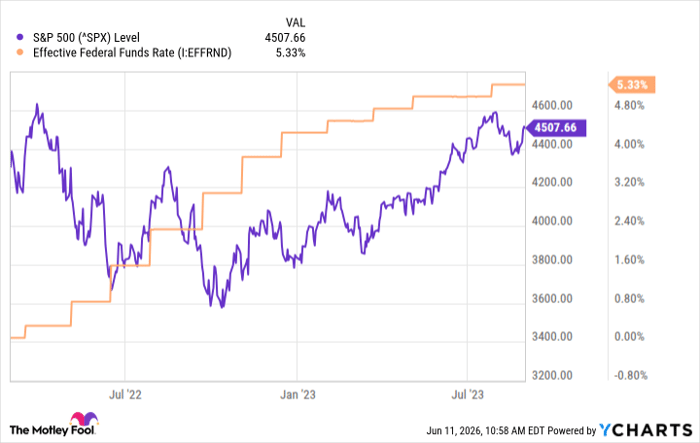
During the entirety of the Fed's last rate-hiking cycle, which started in March 2022 and ended in August 2023, the S&P 500 delivered practically no return. It actually fell by more than 20% from its peak during that window, which constituted a technical bear market.
^SPX data by YCharts.
Rising interest rates are bad for the stock market for a few reasons. First, they increase the yield on risk-free assets like cash and government bonds, giving investors some very attractive alternatives. Second, rising rates force consumers to allocate more of their household budget to debt repayments, leaving them with less money for discretionary spending.
Third, businesses don't have as much borrowing capacity when rates are rising, so they can't invest as aggressively in growth. Lastly, higher interest costs can directly reduce a business' profits. Together, these factors can be a serious drag on corporate earnings, and earnings drive stock prices over the long term.
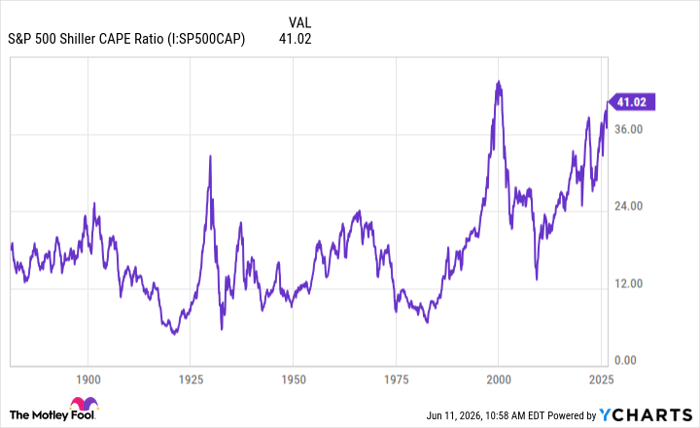
On that note, the S&P 500 currently trades at a cyclically adjusted price-to-earnings (CAPE) ratio of 41, so this is officially the second-most expensive stock market in history behind the dot-com internet bubble in the year 2000.
S&P 500 Shiller CAPE Ratio data by YCharts.
Since the S&P 500 is starting from such a high valuation, a series of interest rate hikes could legitimately threaten the current bull market. However, as was the case after 2022, the index is likely to recover to new highs over the long term, so investors should be on the lookout for buying opportunities if there is a significant downswing.
Should you buy stock in S&P 500 Index right now?
Before you buy stock in S&P 500 Index, consider this:
The Motley Fool Stock Advisor analyst team just identified what they believe are the 10 best stocks for investors to buy now… and S&P 500 Index wasn’t one of them. The 10 stocks that made the cut could produce monster returns in the coming years.
Consider when Netflix made this list on December 17, 2004... if you invested $1,000 at the time of our recommendation, you’d have $438,283!* Or when Nvidia made this list on April 15, 2005... if you invested $1,000 at the time of our recommendation, you’d have $1,257,427!*
Now, it’s worth noting Stock Advisor’s total average return is 938% — a market-crushing outperformance compared to 206% for the S&P 500. Don't miss the latest top 10 list, available with Stock Advisor, and join an investing community built by individual investors for individual investors.
See the 10 stocks »
*Stock Advisor returns as of June 13, 2026.
Anthony Di Pizio has no position in any of the stocks mentioned. The Motley Fool has positions in and recommends CME Group. The Motley Fool has a disclosure policy.
Recommended Articles


