


SpaceX's Thesis Sounds Far-Fetched. Is There Any Way This Company Could Ever Make Money?
Key Points
SpaceX believes it has a major growth opportunity in AI.
The company proposes putting AI infrastructure into orbit to harness solar power.
This expensive plan has obvious flaws and drawbacks, and relies on faulty logic.
- 10 stocks we like better than Space Exploration Technologies ›
There's an old adage that if you're a hammer, everything looks like a nail.
Will AI create the world's first trillionaire? Our team just released a report on the one little-known company, called an "Indispensable Monopoly" providing the critical technology Nvidia and Intel both need. Continue »
Well, maybe when you're a rocket company, everything looks like an opportunity to launch things into space. That seems to be true for SpaceX (NASDAQ: SPCX), which has scheduled its initial public offering (IPO) for today. The company's estimated $1.75 trillion valuation rests on the premise that launching things into space will help it capture a $26.5 trillion artificial intelligence (AI) market.
If you think that sounds far-fetched, you're right. SpaceX's primary thesis revolves around expensive, unproven, space-oriented technology and a healthy dose of faulty logic. Here's why SpaceX's plans seem destined to waste money rather than earn it.

Image source: Getty Images.
To orbit and beyond
"Our mission is to build the systems and technologies necessary to make life multiplanetary ... and ultimately to build a base on the Moon and cities on other planets," SpaceX boldly claims.
Now, I'm not knocking SpaceX Chief Executive Officer Elon Musk's goal of colonizing Mars. I think it's an admirable goal, and one I would love to see come to fruition during my lifetime. If Musk wants to devote his considerable personal resources to advancing that goal, more power to him.
But an admirable goal for a society is not necessarily an admirable goal for a corporation. A corporation's primary purpose is to make money for its shareholders. And establishing extraterrestrial bases and colonies would cost enormous amounts of money -- not to mention technology that hasn't yet been invented -- and probably wouldn't ever produce a positive return on investment.
But let's assume that this goal is purely rhetorical and look at SpaceX's nearer-term moneymaking prospects, which come primarily from AI.
A plus B equals C...
Time to play a game. I'll lay out SpaceX's core AI growth strategy in three parts, taken from its S-1 prospectus filed with the Securities and Exchange Commission. Note the question at the end:
- "Advanced AI models require substantial computational resources." In other words, AI takes a lot of energy.
- "Improvement in the cost of building and operating this compute infrastructure [including] lower data center construction cost [and] lower power infrastructure cost ... translates directly into lower cost per token." So, the fewer costs you incur, the less you need to charge.
- "The Sun contains approximately 99.8% of the solar system's energy and offers what we believe is the only truly scalable solution to the challenge of accelerating demand for compute relative to terrestrial energy constraints." In other words, solar energy (also called "sunlight") is free and very abundant.
It concludes, "The logical path forward is..."
How would you finish that sentence?
...or not
You probably said something like, "The logical path forward is... to power AI infrastructure with solar energy" or "...to build more solar farms." That's what I'd say. But SpaceX has a different take:
"The logical path forward is to move power-intensive AI workloads into orbit, where solar energy is near-constant and uninterrupted." Ummm... OK?
The prospectus continues, "With such accessibility to energy, we believe that our launch business will enable us to consistently activate the highest performing hardware before our competitors without such access, shrinking the timeline to useful tokens on bleeding-edge hardware and sustaining our token cost advantage."
So, basically, SpaceX is saying: "AI workloads require lots of electrical power. Sunlight is the biggest source of such power. Therefore, we need to do our AI computing in outer space, because that's where the most sunlight is."
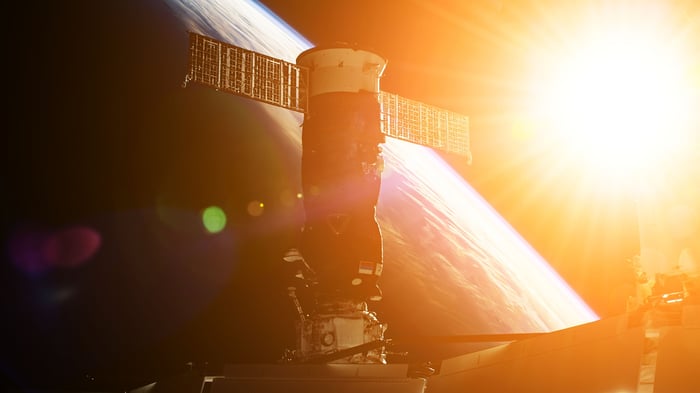
Image source: Getty Images.
The dark side of the argument
Just because sunlight is more abundant and powerful in space doesn't mean it's scarce on Earth.
On clear days, only about 70% of sunlight makes it through Earth's atmosphere to the ground, and of course, only during daylight hours. But a terrestrial solar array will still be able to generate many times the energy of an orbital solar array, because terrestrial solar arrays can be tens of thousands of times larger. The largest solar farm in the U.S. spans 4,600 acres, and the world's largest, in China, covers 235 square miles.
Meanwhile, SpaceX recognizes that higher throughput is an important factor in AI compute, but it seems to be unaware that AI compute relies on external connections to transmit data, queries, and results. On Earth, that often happens through a reliable high-speed fiber optic cable network. In space, it would need to rely on a slower, less secure satellite signal or other wireless transmission. Needless to say, SpaceX doesn't even attempt to quantify the impact of slower transmission speeds on its orbital AI growth strategy.
Finally, when something breaks in one of these terrestrial solar farms or data centers, you don't have to outfit a technician in a space suit and launch them into orbit to fix it, which alone would astronomically increase the cost.
Regardless of whether SpaceX has a viable path to orbital AI infrastructure or Martian colonization -- now or years in the future -- it doesn't seem to have considered the drawbacks or the obvious alternatives. Unless the company radically rethinks its AI growth strategy, it's unlikely to ever make money for its shareholders.
Should you buy stock in Space Exploration Technologies right now?
Before you buy stock in Space Exploration Technologies, consider this:
The Motley Fool Stock Advisor analyst team just identified what they believe are the 10 best stocks for investors to buy now… and Space Exploration Technologies wasn’t one of them. The 10 stocks that made the cut could produce monster returns in the coming years.
Consider when Netflix made this list on December 17, 2004... if you invested $1,000 at the time of our recommendation, you’d have $442,220!* Or when Nvidia made this list on April 15, 2005... if you invested $1,000 at the time of our recommendation, you’d have $1,230,114!*
Now, it’s worth noting Stock Advisor’s total average return is 926% — a market-crushing outperformance compared to 203% for the S&P 500. Don't miss the latest top 10 list, available with Stock Advisor, and join an investing community built by individual investors for individual investors.
See the 10 stocks »
*Stock Advisor returns as of June 12, 2026.
John Bromels has no position in any of the stocks mentioned. The Motley Fool has no position in any of the stocks mentioned. The Motley Fool has a disclosure policy.
Recommended Articles


