


Jensen Huang Just Told Investors to Buy This Under-the-Radar Artificial Intelligence (AI) Chip Stock (Hint: It's Not Marvell)
Key Points
Nvidia CEO Jensen Huang says his company's GPUs do not thrive in mobile AI environments.
He praised Qualcomm's advances in edge computing, including mobile phones, autos, and IoT devices.
Huang went so far as to recommend Qualcomm stock -- and with good reason.
- 10 stocks we like better than Qualcomm ›
During a recent visit to Seoul, South Korea, Nvidia (NASDAQ: NVDA) CEO Jensen Huang openly praised another artificial intelligence (AI) semiconductor stock: Qualcomm (NASDAQ: QCOM). Huang acknowledged Qualcomm's success in mobile devices and AI-enabled smartphones, even telling investors to buy Qualcomm stock.
This endorsement comes at a pivotal time, as the AI infrastructure boom accelerates demand for specialized chips across data centers, personal devices, and vehicles. Huang's comments quietly highlight deeper strategic differences between Nvidia and the competitive landscape: Not every pocket of the AI realm requires Nvidia's high-performance GPUs.
Will AI create the world's first trillionaire? Our team just released a report on the one little-known company, called an "Indispensable Monopoly" providing the critical technology Nvidia and Intel both need. Continue »
Let's dive into what makes Qualcomm unique and assess whether the stock is a good buy right now, as Huang suggests.
Why does Jensen Huang like Qualcomm?
Huang notes that Nvidia's bread and butter is in accelerated computing for data centers, robotics, and AI infrastructure. However, he acknowledges that Nvidia lacks the same competitive advantages in edge devices -- mobile phones and consumer electronics. Huang said, "I don't think we're incredibly good at mobile devices, and I don't think it's necessary," directing investors toward Qualcomm instead.
Qualcomm has demonstrated strong performance in on-device AI for smartphones, where chips must deliver inference while also drawing minimal power to preserve battery life. I don't think Huang was simply being polite. Rather, he seems to recognize that Qualcomm's focus complements Nvidia's strengths -- allowing both companies to succeed in an ever-expanding chip landscape without direct overlap in mobile AI.

Image source: Getty Images.
What is Qualcomm's role in the AI chip stack?
While Nvidia's GPUs dominate data centers, these chip clusters typically handle the heavy training required to build AI models at scale. By contrast, Qualcomm's Snapdragon chip platform is marketed toward on-device processing across smartphones, laptops, automotive systems, and Internet of Things (IoT) devices. These solutions prioritize low latency and energy efficiency -- enabling AI to run locally rather than constantly relying on remote cloud environments.
Qualcomm has also aggressively expanded into AI inference for data centers with its AI200 and AI250 accelerators, optimized for lower power consumption and memory management. This architecture directly targets workloads where Nvidia's ecosystem may be too costly.
Is Qualcomm stock a buy?
Per the company's second-quarter earnings, Qualcomm's automotive revenue accelerated 38% year over year, while the IoT segment posted high-single-digit growth. This traction is notable as Qualcomm works hard to diversify beyond a soft handset device market.
As investment in AI infrastructure continues compounding, the company's new initiatives across inference and memory deployments could prove promising as enterprises seek efficient alternatives for edge-to-cloud workloads.
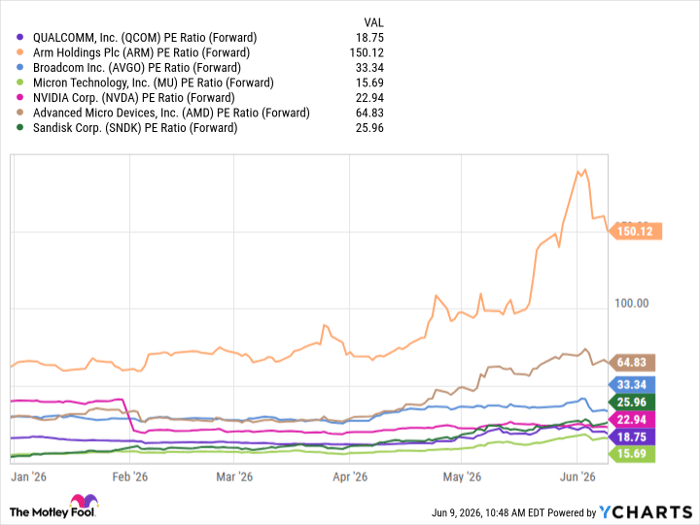
QCOM PE Ratio (Forward) data by YCharts
On the valuation side, Qualcomm trades at a modest forward price-to-earnings (P/E) multiple relative to the premiums seen in many other leading AI chip stocks. While competition in AI PCs is heating up, Qualcomm's established foothold and cost-effective designs should provide resilience for the time being.
As Huang suggests, Qualcomm looks poised for further upside as on-device AI adoption accelerates across consumer and enterprise markets. In my eyes, Qualcomm offers a rare balance of growth at a reasonable price in a chip sector dominated by AI-driven hype.
Should you buy stock in Qualcomm right now?
Before you buy stock in Qualcomm, consider this:
The Motley Fool Stock Advisor analyst team just identified what they believe are the 10 best stocks for investors to buy now… and Qualcomm wasn’t one of them. The 10 stocks that made the cut could produce monster returns in the coming years.
Consider when Netflix made this list on December 17, 2004... if you invested $1,000 at the time of our recommendation, you’d have $442,220!* Or when Nvidia made this list on April 15, 2005... if you invested $1,000 at the time of our recommendation, you’d have $1,230,114!*
Now, it’s worth noting Stock Advisor’s total average return is 926% — a market-crushing outperformance compared to 203% for the S&P 500. Don't miss the latest top 10 list, available with Stock Advisor, and join an investing community built by individual investors for individual investors.
See the 10 stocks »
*Stock Advisor returns as of June 11, 2026.
Adam Spatacco has positions in Nvidia. The Motley Fool has positions in and recommends Advanced Micro Devices, Broadcom, Marvell Technology, Micron Technology, Nvidia, and Qualcomm. The Motley Fool recommends Arm Holdings. The Motley Fool has a disclosure policy.
Recommended Articles


