


Tether unveils modular Bitcoin mining systems with Canaan and ACME Swisstech
- Tether introduces expanded modular Bitcoin mining systems designed to improve efficiency, scalability and cost control.
- The new infrastructure was developed in collaboration with Canaan and ACME Swisstech, tapping custom hash board modules.
- The modular Bitcoin mining systems separate compute, power and cooling to enable flexible upgrades and optimized performance.
Tether, the largest stablecoin company, has unveiled a new custom compute Bitcoin (BTC) mining infrastructure in collaboration with Canaan, the world’s leading manufacturer of BTC miners, and ACME Swisstech, a Swiss-based project management firm.
The high-density mining system is designed to improve efficiency and performance at scale using application-specific hash board modules.
Tether’s new Bitcoin mining systems maximize performance and flexibility
Tether explained in a press release on Tuesday that the motivation behind the new system was to reduce reliance on off-the-shelf mining rigs that come fully assembled and build application-specific hash board modules. These modules are then integrated into Tether’s existing infrastructure, including thermal management systems and the software stack.
“The result is a more flexible design that allows operators to maximize performance, manage heat more efficiently, and upgrade individual components without replacing entire machines,” Tether added in the press release.
Tether’s modular Bitcoin mining systems address the fragmented mining infrastructure by separating compute, power and enclosure. These components are then optimized independently using immersion-cooling techniques that reduce energy costs, improve efficiency and increase performance.
Operators using Tether’s systems will, for the first time, be able to replace individual components, optimize the ecosystem based on real-time conditions and scale incrementally.
Although the new modular mining infrastructure is optimized for immersion cooling, Tether says other cooling systems are currently in development, providing operators with more localized control in real-time conditions.
Tether’s CEO Paolo Ardoino emphasized that the new concept can “be tuned, upgraded, and cooled independently, so we can directly control cost, efficiency, and how these systems perform at scale.”
Meanwhile, Bitcoin is trading around $76,000 at the time of writing on Tuesday, extending losses from its weekly high of $79,486. Sentiment in the broader crypto market is also fading, with the Fear & Greed Index holding at 33, from 47 the previous week.
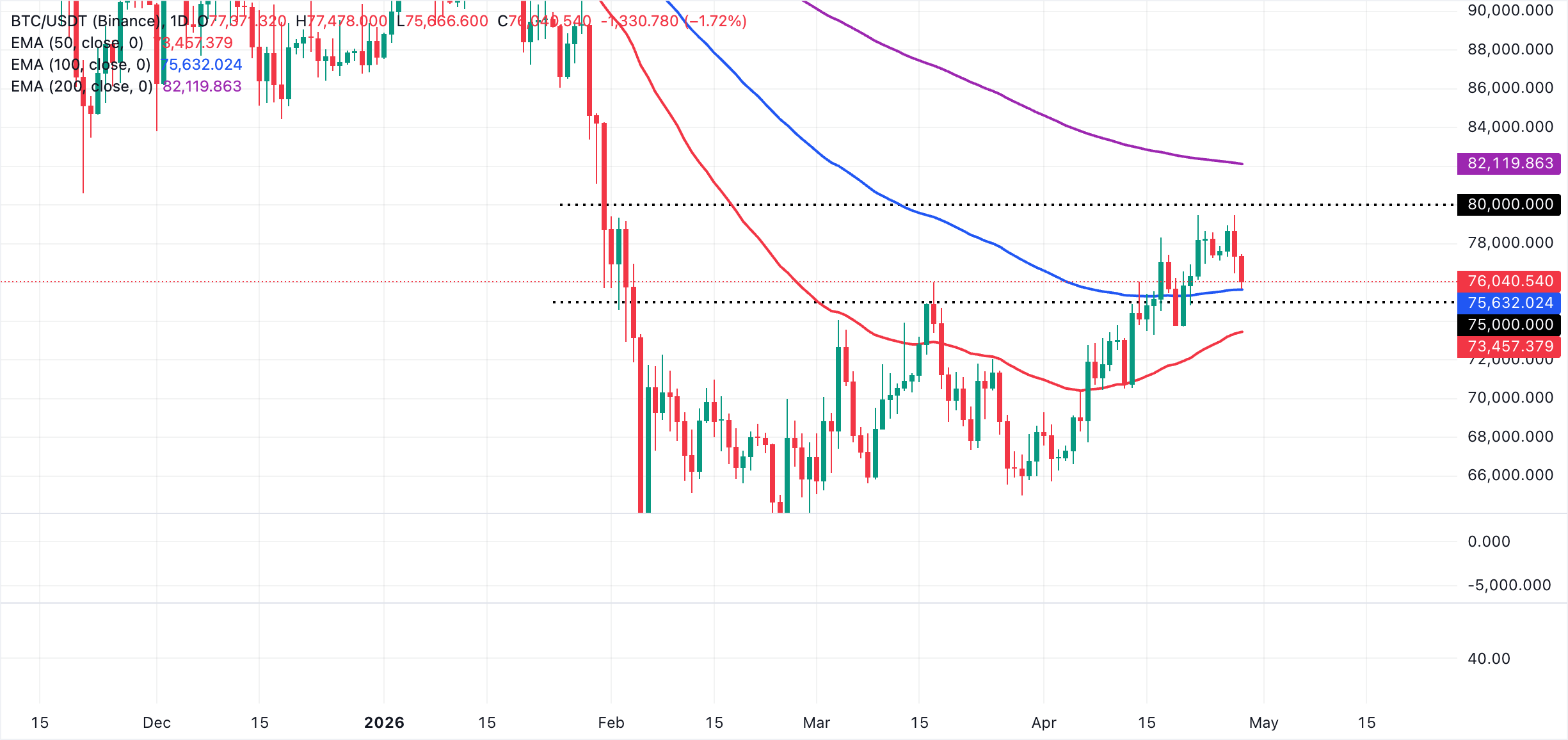
Key levels of interest for investors include the support at $75,000 and the demand at $70,000. On the topside, the $80,000 threshold is critical for the continuation of Bitcoin’s uptrend.
Bitcoin, altcoins, stablecoins FAQs
Bitcoin is the largest cryptocurrency by market capitalization, a virtual currency designed to serve as money. This form of payment cannot be controlled by any one person, group, or entity, which eliminates the need for third-party participation during financial transactions.
Altcoins are any cryptocurrency apart from Bitcoin, but some also regard Ethereum as a non-altcoin because it is from these two cryptocurrencies that forking happens. If this is true, then Litecoin is the first altcoin, forked from the Bitcoin protocol and, therefore, an “improved” version of it.
Stablecoins are cryptocurrencies designed to have a stable price, with their value backed by a reserve of the asset it represents. To achieve this, the value of any one stablecoin is pegged to a commodity or financial instrument, such as the US Dollar (USD), with its supply regulated by an algorithm or demand. The main goal of stablecoins is to provide an on/off-ramp for investors willing to trade and invest in cryptocurrencies. Stablecoins also allow investors to store value since cryptocurrencies, in general, are subject to volatility.
Bitcoin dominance is the ratio of Bitcoin's market capitalization to the total market capitalization of all cryptocurrencies combined. It provides a clear picture of Bitcoin’s interest among investors. A high BTC dominance typically happens before and during a bull run, in which investors resort to investing in relatively stable and high market capitalization cryptocurrency like Bitcoin. A drop in BTC dominance usually means that investors are moving their capital and/or profits to altcoins in a quest for higher returns, which usually triggers an explosion of altcoin rallies.
บทความแนะนำ


