


Indian Rupee extends its downward streak as oil prices keep rising
- The Indian Rupee faces intense selling pressure as oil prices continue to soar.
- Oil prices extend their rally as US-Iran tensions remain intact.
- The RBI seems to be failing to counter excessive downside moves in the Indian currency.
The Indian Rupee (INR) extends its losing run against the US Dollar (USD) for the third trading day on Thursday. The USD/INR pair posts a fresh 10-day high at 95.31 as the ongoing rally in oil prices continues to batter the Indian currency.
In the opening session, the MCX Crude Oil contract expiring on September 21 trades 0.5% higher, closer to its over three-month high of Rs. 9,189.
Currencies from economies, such as India, which rely heavily on oil imports to meet their energy needs, tend to underperform in a high-oil-price environment.
Oil rally extends as conflict risks keep market tight
According to TD Securities, crude prices continue to rally as the conflict backdrop shows “seemingly no end to conflict in sight,” with “another round of escalation and an apparent preference for limited attacks and economic squeeze as opposed to deal-making” keeping the energy market on “a continued tightening trajectory.” The bank notes that “while the level of market deficit in crude has eased amid a stabilization of higher dark flow volumes, the market remains tight overall,” reinforcing the view that “the path of least resistance remains to the upside for crude oil even as prices reach triple digits again.”
RBI remains active to counter excessive volatility in INR
The Reserve Bank of India (RBI) continues to intervene in spot and Non-Deliverable Forward (NDF) markets to support the Indian currency against one-way excessive depreciating moves.
"The RBI has maintained its intervention, including a fairly forceful presence at one point yesterday. However, that support has so far provided only limited relief."
Strong foreign flows received by the Indian central bank through the Foreign Currency Non-Resident (FCNR) (B) window indicate the RBI has significant liquidity to support the Indian currency.
Societe Generale’s EM strategists highlight that the Reserve Bank of India has materially strengthened its external buffers, noting that “the RBI disclosed earlier this month that it had raised $136.38bn through its FX mobilisation schemes, including the FCNR(B) window launched in early June, significantly bolstering reserve buffers and intervention capacity.” The bank argues that this sizeable build-up in reserves enhances the RBI’s ability to manage currency volatility and underpins its more constructive stance on the Rupee.
US inflation data awaited
This week, the major trigger for global markets is the United States (US) Consumer Price Index (CPI) for August, which will be released on Friday.
According to TD Securities, the upcoming August CPI report should show that underlying price pressures remain contained, with the bank expecting that "underlying inflation stayed under control, with core likely rising 0.19% m/m (2.3% y/y)." Strategists there highlight that "the services segment should be the main driver, while core goods prices likely acted as a drag by posting a modest m/m drop." In contrast, they anticipate that "headline CPI will likely be a stronger 0.37% m/m (3.4% y/y) due to rising energy prices and a slight pickup in food inflation."
USD/INR Technical Analysis
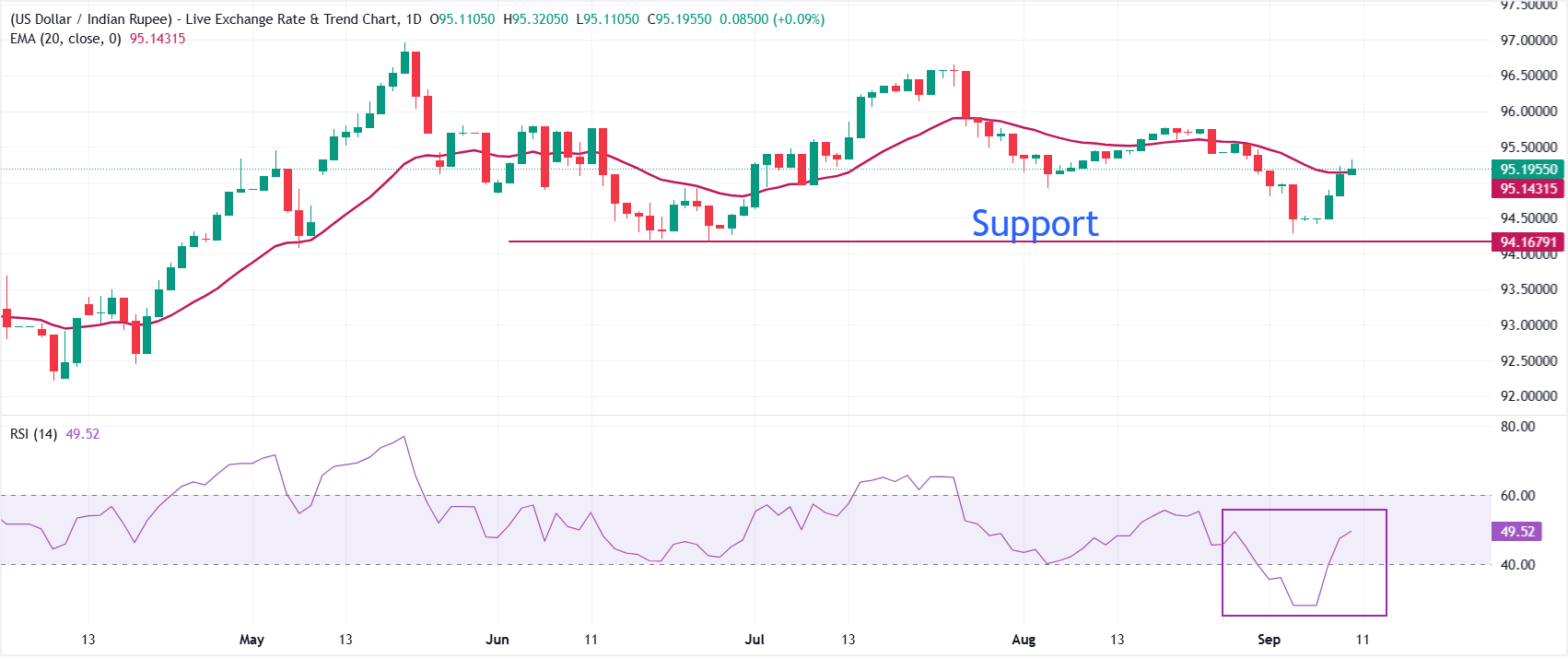
In the daily chart, USD/INR trades at 95.19. The pair returns quickly to near the 20-period exponential moving average (EMA) at 95.14 after last week's decline, which turns the near-term bias broadly neutral.
A V-shaped recovery in the Relative Strength Index (RSI) into the 40.00-60.00 zone suggests strong demand at lower levels.
On the downside, the June low at 94.15 is the key support level. Looking up, the pair is expected to find a hurdle near 96.00.
(The technical analysis of this story was written with the help of an AI tool. Know more.)
Indian Rupee FAQs
The Indian Rupee (INR) is one of the most sensitive currencies to external factors. The price of Crude Oil (the country is highly dependent on imported Oil), the value of the US Dollar – most trade is conducted in USD – and the level of foreign investment, are all influential. Direct intervention by the Reserve Bank of India (RBI) in FX markets to keep the exchange rate stable, as well as the level of interest rates set by the RBI, are further major influencing factors on the Rupee.
The Reserve Bank of India (RBI) actively intervenes in forex markets to maintain a stable exchange rate, to help facilitate trade. In addition, the RBI tries to maintain the inflation rate at its 4% target by adjusting interest rates. Higher interest rates usually strengthen the Rupee. This is due to the role of the ‘carry trade’ in which investors borrow in countries with lower interest rates so as to place their money in countries’ offering relatively higher interest rates and profit from the difference.
Macroeconomic factors that influence the value of the Rupee include inflation, interest rates, the economic growth rate (GDP), the balance of trade, and inflows from foreign investment. A higher growth rate can lead to more overseas investment, pushing up demand for the Rupee. A less negative balance of trade will eventually lead to a stronger Rupee. Higher interest rates, especially real rates (interest rates less inflation) are also positive for the Rupee. A risk-on environment can lead to greater inflows of Foreign Direct and Indirect Investment (FDI and FII), which also benefit the Rupee.
Higher inflation, particularly, if it is comparatively higher than India’s peers, is generally negative for the currency as it reflects devaluation through oversupply. Inflation also increases the cost of exports, leading to more Rupees being sold to purchase foreign imports, which is Rupee-negative. At the same time, higher inflation usually leads to the Reserve Bank of India (RBI) raising interest rates and this can be positive for the Rupee, due to increased demand from international investors. The opposite effect is true of lower inflation.
Artigos Recomendados


