


New Zealand Dollar rallies after RBNZ delivers hawkish hold amid softer US Dollar
- NZD/USD jumps more than 1% after the RBNZ delivers a hawkish hold and signals higher rates may be needed sooner.
- Cautious optimism surrounding US-Iran negotiations weighs on the US Dollar and supports risk-sensitive currencies.
- Technically, NZD/USD climbs above the 50-day and 100-day SMAs, with momentum indicators pointing to improving bullish momentum.
The New Zealand Dollar (NZD) strengthens against the US Dollar (USD) on Wednesday after the Reserve Bank of New Zealand (RBNZ) delivered a hawkish hold at its latest monetary policy meeting, signaling that the Official Cash Rate (OCR) will likely need to rise sooner and by more than projected in the February Monetary Policy Statement.
At the time of writing, NZD/USD trades around 0.5895, hovering near two-week highs and up more than 1% on the day.
Meanwhile, cautious optimism surrounding ongoing US-Iran negotiations weighs on the Greenback, further supporting risk-sensitive currencies.
Sentiment improved after Iran’s State TV reported that Tehran and Washington had drafted an initial unofficial framework for a memorandum of understanding (MOU). According to the draft framework, US military forces would withdraw from the vicinity of Iran and lift the naval blockade, while Iran would restore commercial transit through the Strait of Hormuz to pre-war levels within one month.
The report also stated that any final agreement reached within 60 days would be approved through a binding United Nations Security Council resolution. In reaction, the US Dollar Index (DXY), which tracks the Greenback’s value against a basket of six major currencies, retreats toward the 99.00 mark, reversing the previous day’s gains.
Technical Analysis:
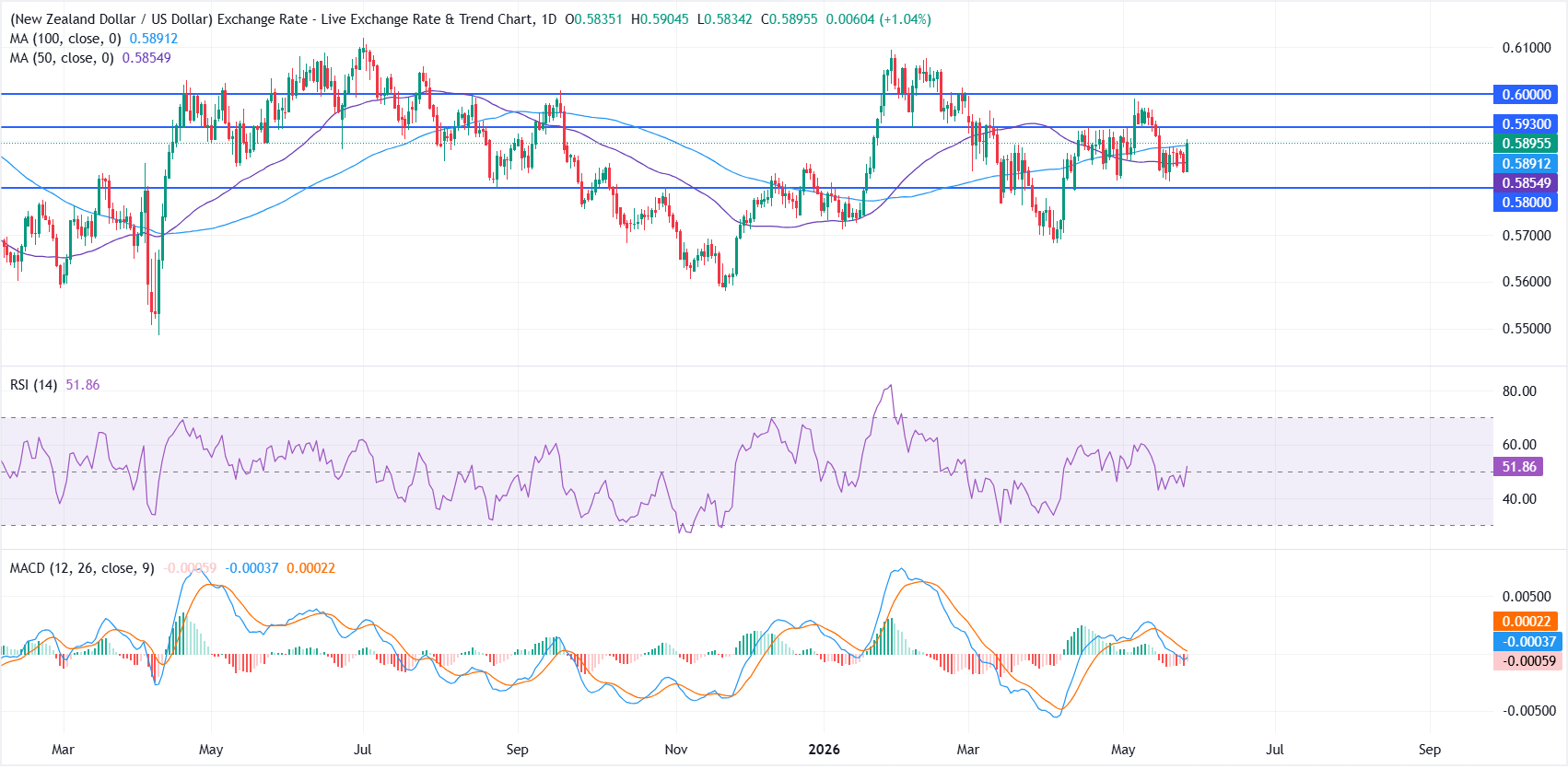
On the daily chart, NZD/USD holds a modestly bullish near-term bias as spot climbs above both the 50-day Simple Moving Average (SMA) at 0.5854 and the 100-day SMA at 0.5891.
The Relative Strength Index (RSI) is around 52 points to neutral-to-firm momentum, while the Moving Average Convergence Divergence (MACD) line holds slightly below zero, hinting that upside momentum remains tentative for now.
On the topside, initial resistance is located at the horizontal barrier near 0.5930, ahead of a more significant cap around 0.6000.
On the downside, immediate support is seen at the 100-day SMA around 0.5891, followed by the 50-day SMA at 0.5855, while a deeper pullback would likely look toward the 0.5800 horizontal level as a more substantial floor.
(The technical analysis of this story was written with the help of an AI tool.)
RBNZ FAQs
The Reserve Bank of New Zealand (RBNZ) is the country’s central bank. Its economic objectives are achieving and maintaining price stability – achieved when inflation, measured by the Consumer Price Index (CPI), falls within the band of between 1% and 3% – and supporting maximum sustainable employment.
The Reserve Bank of New Zealand’s (RBNZ) Monetary Policy Committee (MPC) decides the appropriate level of the Official Cash Rate (OCR) according to its objectives. When inflation is above target, the bank will attempt to tame it by raising its key OCR, making it more expensive for households and businesses to borrow money and thus cooling the economy. Higher interest rates are generally positive for the New Zealand Dollar (NZD) as they lead to higher yields, making the country a more attractive place for investors. On the contrary, lower interest rates tend to weaken NZD.
Employment is important for the Reserve Bank of New Zealand (RBNZ) because a tight labor market can fuel inflation. The RBNZ’s goal of “maximum sustainable employment” is defined as the highest use of labor resources that can be sustained over time without creating an acceleration in inflation. “When employment is at its maximum sustainable level, there will be low and stable inflation. However, if employment is above the maximum sustainable level for too long, it will eventually cause prices to rise more and more quickly, requiring the MPC to raise interest rates to keep inflation under control,” the bank says.
In extreme situations, the Reserve Bank of New Zealand (RBNZ) can enact a monetary policy tool called Quantitative Easing. QE is the process by which the RBNZ prints local currency and uses it to buy assets – usually government or corporate bonds – from banks and other financial institutions with the aim to increase the domestic money supply and spur economic activity. QE usually results in a weaker New Zealand Dollar (NZD). QE is a last resort when simply lowering interest rates is unlikely to achieve the objectives of the central bank. The RBNZ used it during the Covid-19 pandemic.
Artigos Recomendados


