




USD/INR plummets as US-India confirms long-awaited trade deal
- The Indian Rupee rallies against the US Dollar, following the trade deal announcement by the US and India.
- The US slashes tariffs on India to 18% in exchange for zero import duty on goods from Washington.
- Investors await the RBI’s monetary policy and the US NFP data for January.
The Indian Rupee (INR) opens on a strong note against the US Dollar (USD) on Tuesday, following the confirmation of a long-awaited trade deal between the United States (US) and India the previous day. The USD/INR pair opens with a gap down to near 90.35, the lowest level seen in almost three weeks.
On Monday, US President Donald Trump confirmed a bilateral trade pact with India in which Washington slashed tariffs on imports from New Delhi to 18% from 50%, which is lower than or equal to most economies in South Asia and the Association of South-East Asian Nations (ASEAN). This scenario will be favorable for Indian exporters to get a competitive edge over their competitors in other Asian nations.
In exchange, the Indian economy agreed to reduce tariffs on imports from Washington to zero, no oil purchase from Russia, and commit to buying several American goods, including energy, agriculture, coal, and technology, worth $500 billion.
The US-India trade deal euphoria has resulted in a significant upside move in the Indian stock market. The Nifty50 opens almost 3.5% higher to near 26,330, led by a strong jump in technology, gems and jewelry, textile, and capital market stocks.
Daily Digest Market Movers: US Dollar edges down after a two-day rally
- The US Dollar ticks lower after a strong upside move in the last two trading days, with investors shifting focus to an array of US economic data releases this week.
- As of writing, the US Dollar Index (DXY), which tracks the Greenback’s value against six major currencies, trades 0.2% lower to near 97.45.
- The US Dollar has retraced slightly due to the partial US federal shutdown, which will suspend key economic data releases.
- On Monday, the US ISM Manufacturing PMI report for January showed that the manufacturing sector activity returned to growth after declining for several months. The Manufacturing PMI came in at 52.6, higher than estimates of 48.5 and the prior release of 47.9. A figure above 50.00 is seen as an expansion in the business activity.
- The US Dollar has been outperforming since Friday after US President Donald Trump nominated former Governor Kevin Warsh for the Fed’s new Chairman. Investors expected Warsh to avoid rapid interest rate cuts, given his historic preference for a firmer US Dollar in his previous tenure at the Fed.
- This week, the major trigger for the Indian Rupee will be the monetary policy announcement by the Reserve Bank of India (RBI) on Friday.
Technical Analysis: USD/INR skids below 20-day EMA
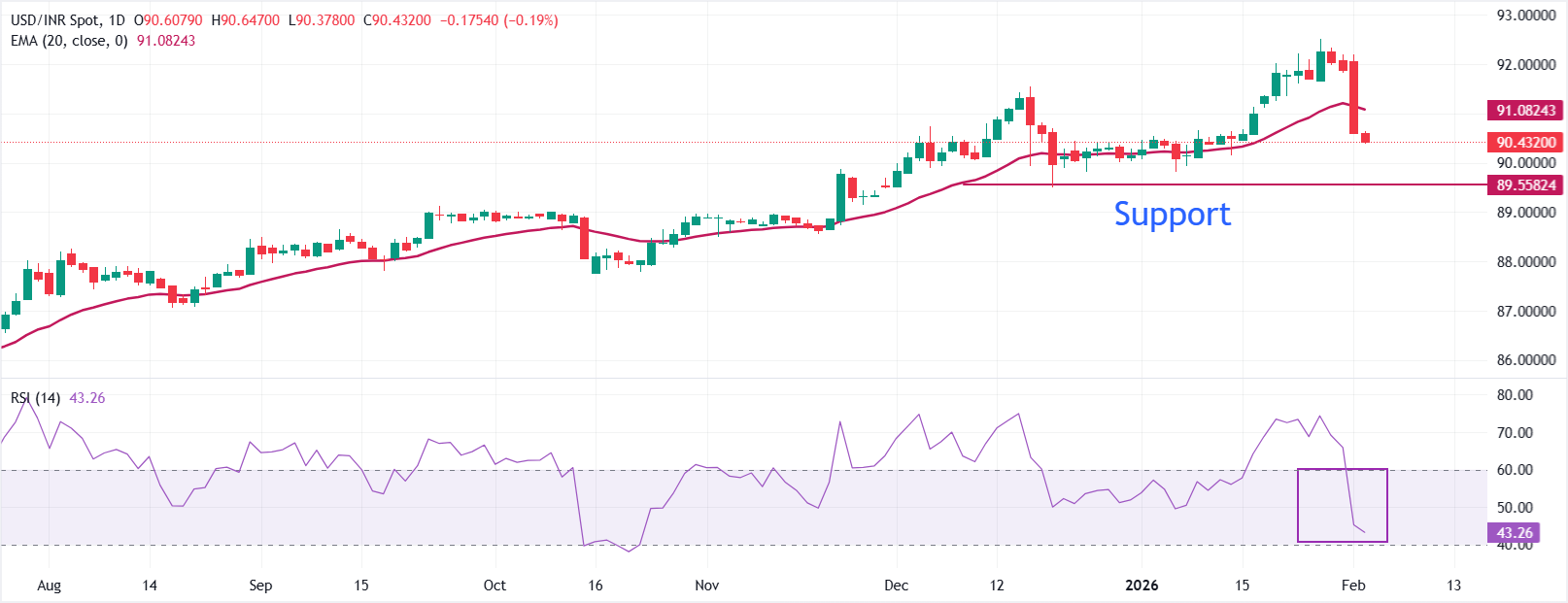
USD/INR trades sharply lower to near 90.35 as of writing. The price slides below the 20-day Exponential Moving Average (EMA) at 91.0816, keeping the near-term bias soft. The 20-day EMA has started to roll over, reinforcing a corrective tone. Rallies could be capped at the EMA.
The 14-day Relative Strength Index (RSI) at 43.17 is below the 50 midline, confirming waning momentum.
Unless USD/INR reclaims the 20-day EMA on a closing basis, the risk stays skewed toward further range compression or downside probes. A push in RSI back above 50 would improve momentum and support recovery attempts, while a slide toward 30 would extend bearish pressure. A decisive close above the EMA would shift the tone toward stabilization and reduce the downside bias.
(The technical analysis of this story was written with the help of an AI tool.)
Indian Rupee FAQs
The Indian Rupee (INR) is one of the most sensitive currencies to external factors. The price of Crude Oil (the country is highly dependent on imported Oil), the value of the US Dollar – most trade is conducted in USD – and the level of foreign investment, are all influential. Direct intervention by the Reserve Bank of India (RBI) in FX markets to keep the exchange rate stable, as well as the level of interest rates set by the RBI, are further major influencing factors on the Rupee.
The Reserve Bank of India (RBI) actively intervenes in forex markets to maintain a stable exchange rate, to help facilitate trade. In addition, the RBI tries to maintain the inflation rate at its 4% target by adjusting interest rates. Higher interest rates usually strengthen the Rupee. This is due to the role of the ‘carry trade’ in which investors borrow in countries with lower interest rates so as to place their money in countries’ offering relatively higher interest rates and profit from the difference.
Macroeconomic factors that influence the value of the Rupee include inflation, interest rates, the economic growth rate (GDP), the balance of trade, and inflows from foreign investment. A higher growth rate can lead to more overseas investment, pushing up demand for the Rupee. A less negative balance of trade will eventually lead to a stronger Rupee. Higher interest rates, especially real rates (interest rates less inflation) are also positive for the Rupee. A risk-on environment can lead to greater inflows of Foreign Direct and Indirect Investment (FDI and FII), which also benefit the Rupee.
Higher inflation, particularly, if it is comparatively higher than India’s peers, is generally negative for the currency as it reflects devaluation through oversupply. Inflation also increases the cost of exports, leading to more Rupees being sold to purchase foreign imports, which is Rupee-negative. At the same time, higher inflation usually leads to the Reserve Bank of India (RBI) raising interest rates and this can be positive for the Rupee, due to increased demand from international investors. The opposite effect is true of lower inflation.
Artigos Recomendados


