




USD/INR refreshes all-time high amid FIIs outflow, risk-off mood
- The Indian Rupee falls to record lows at 91.58 at open against the US Dollar.
- Consistent outflow of foreign funds from the Indian stock market has weakened the Indian Rupee.
- US-EU disputes over Greenland have weighed on the appeal of US assets.
The Indian Rupee (INR) slumps to a record low against the US Dollar (USD) at open on Wednesday. The USD/INR jumps to near 91.58 as the Indian Rupee faces intense selling pressure due to consistent outflow of foreign funds from the Indian stock market and the risk-off market mood amid tensions between the United States (US) and the European Union (EU) over Greenland.
Foreign Institutional Investors (FIIs) are consistently dumping their stake in the Indian stock market due to the absence of a trade deal announcement between the US and India, keeping demand for US Dollars sustained among Indian importers. So far in January, FIIs have remained net sellers in 12 out of 13 trading days and have offloaded their stake worth Rs. 32,253.55 crore.
Consistent outflow of overseas funds from the Indian equity market is weighing heavily on Indian bourses. Nifty50 is down almost 4.3% to near 25,250 from its highest level of 26,373 recorded on January 5.
Trade tensions between the US and India were caused by the imposition of 25% punitive tariffs in mid 2025 by Washington on imports from New Delhi for buying Oil from Russia.
Going forward, the major trigger for the Indian Rupee will be the announcement of the fiscal budget for the Financial Year (FY) 2026-2027 on February 1.
Daily Digest Market Movers: US-EU disputes batter Greenback and US assets
- The Indian Rupee underperforms the US Dollar, even as the latter has been battered heavily due to ongoing tensions between the US and the EU. At the time of writing, the US Dollar Index (DXY), which tracks the Greenback’s value against six major currencies, trades vulnerably near Tuesday’s closing price around 98.50.
- The dispute between the world’s largest economies over the future of Greenland has also diminished the appeal of US assets. US markets were down almost 2% on Tuesday after an extended weekend.
- US-EU relations have been impacted significantly as President Donald Trump has imposed 10% tariffs on several members of the old continent and the United Kingdom (UK) in retaliation for opposing Washington’s plans to hold Greenland’s entitlement.
- In response, several nations across the globe have criticized Trump’s tariff tactic, warning that it could impact world peace. French President Emmanuel Macron of France has strongly condemned Trump’s use of tariffs for blackmailing the continent to stop opposing Greenland’s purchase by Washington in his speech at the World Economic Forum (WEF) in Davos on Tuesday.
- “Endless accumulation of new tariffs was unacceptable, particularly when used as leverage against territorial sovereignty,” Macron said, The New York Times (NYT) reported.
- Meanwhile, market experts have warned that US assets could see further weakness as strained US-EU relations could weigh on exports from the nation, given that US relations are already fragile with other large economies, such as India, China, and Russia.
- On the domestic front, US Treasury Secretary Scott Bessent announced on Tuesday at the WEF that the White House could announce the name of the new Federal Reserve (Fed) Chairman as early as next week, and there are four candidates for the position presently.
Technical Analysis: USD/INR jumps above 91.50
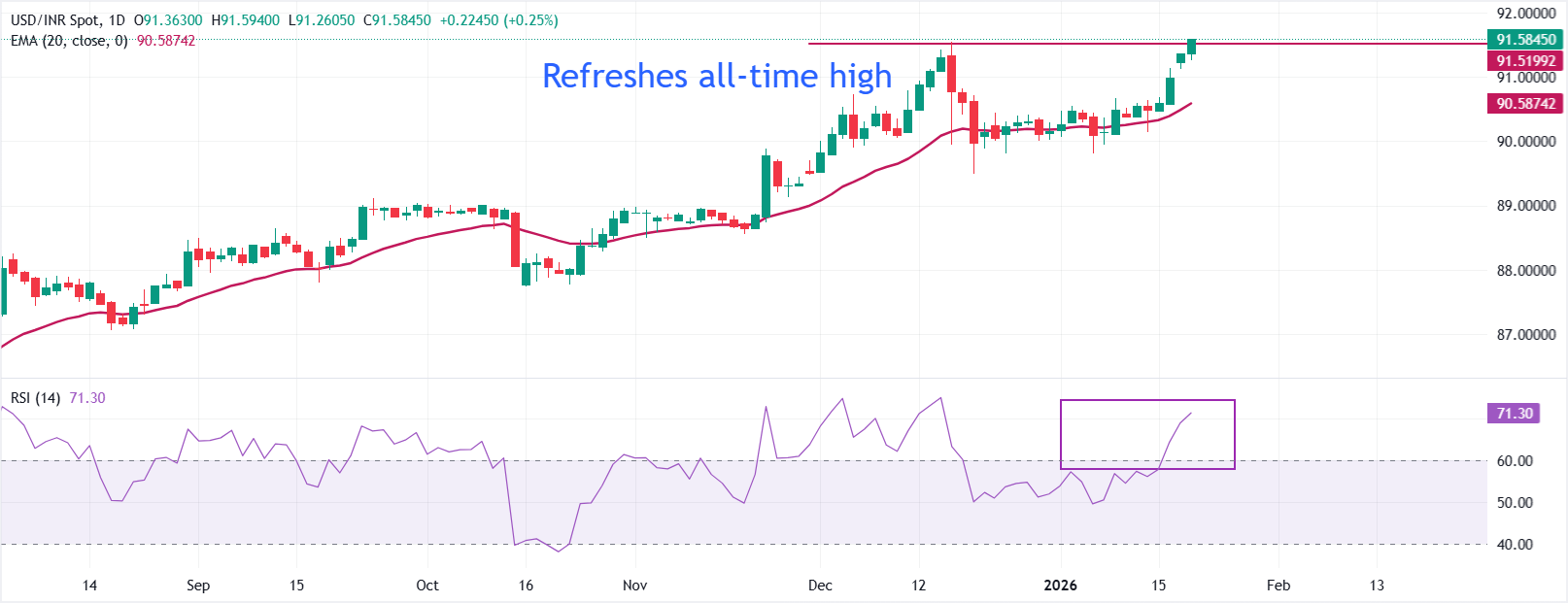
In the daily chart, USD/INR trades at 91.5880. The 20-day EMA at 90.5878 rises and supports the advance, with price holding above this dynamic base. RSI at 71 (overbought) confirms stretched momentum that could curb immediate follow-through. Initial support sits at the rising EMA, and consolidation above this gauge would help stabilize the short-term trend.
With the EMA sloping higher, the path of least resistance remains to the upside, and dips toward the average would be treated as a retest of support. A moderation of RSI back below 70 would signal a healthy momentum reset without undermining the bullish bias. Overall, the setup favors continuation while the pair holds above the rising EMA; a clear break below that gauge would open room for a deeper pullback.
(The technical analysis of this story was written with the help of an AI tool.)
Indian Rupee FAQs
The Indian Rupee (INR) is one of the most sensitive currencies to external factors. The price of Crude Oil (the country is highly dependent on imported Oil), the value of the US Dollar – most trade is conducted in USD – and the level of foreign investment, are all influential. Direct intervention by the Reserve Bank of India (RBI) in FX markets to keep the exchange rate stable, as well as the level of interest rates set by the RBI, are further major influencing factors on the Rupee.
The Reserve Bank of India (RBI) actively intervenes in forex markets to maintain a stable exchange rate, to help facilitate trade. In addition, the RBI tries to maintain the inflation rate at its 4% target by adjusting interest rates. Higher interest rates usually strengthen the Rupee. This is due to the role of the ‘carry trade’ in which investors borrow in countries with lower interest rates so as to place their money in countries’ offering relatively higher interest rates and profit from the difference.
Macroeconomic factors that influence the value of the Rupee include inflation, interest rates, the economic growth rate (GDP), the balance of trade, and inflows from foreign investment. A higher growth rate can lead to more overseas investment, pushing up demand for the Rupee. A less negative balance of trade will eventually lead to a stronger Rupee. Higher interest rates, especially real rates (interest rates less inflation) are also positive for the Rupee. A risk-on environment can lead to greater inflows of Foreign Direct and Indirect Investment (FDI and FII), which also benefit the Rupee.
Higher inflation, particularly, if it is comparatively higher than India’s peers, is generally negative for the currency as it reflects devaluation through oversupply. Inflation also increases the cost of exports, leading to more Rupees being sold to purchase foreign imports, which is Rupee-negative. At the same time, higher inflation usually leads to the Reserve Bank of India (RBI) raising interest rates and this can be positive for the Rupee, due to increased demand from international investors. The opposite effect is true of lower inflation.
Artigos Recomendados


