




Silver Price Forecast: XAG/USD wobbles near all-time highs around $96 ahead of Trump’s speech
- Silver price holds onto gains near all-time highs around $96 ahead of Trump’s speech in WEF at Davos.
- US-EU disputes over Greenland’s entitlement have been a major drag on the US Dollar.
- EU members warns of retaliatory measures against Trump’s tariff threats.
Silver price (XAG/USD) turns sideways near the all-time high of 95.90 during the early European session on Wednesday. The white metal consolidates as investors await speech from United States (US) President Donald Trump in the World Economic Forum (WEF) at Davos, scheduled at 13:00 GMT.
Trump’s speech will be closely watched by financial market participants as it will indicate what other measures Washington has at disposal to extend the pressure on European Union (EU) members, who are opposing US intentions to acquire Greenland.
So far, US President Trump has announced 10% tariffs on several EU members and the United Kingdom (UK), which will become effective from February 1, and has threatened that he could raise them further.
The appeal of safe-haven assets, such as Silver, has strengthened, in an uncertain geopolitical environment. However, the appeal of US Dollar (USD) and US assets has diminished amid US-EU disputes. Technically, weak US Dollar makes the Silver price an attractive bet for investors.
In response, EU members have called Trump’s tariff threats as “undesirable” and warned of equal retaliatory measures. French President Emmanuel Macron has condemned Trump’s tariff tactic and has stressed the old continent to invoke “anti-coercion instrument”.
Silver price technical analysis
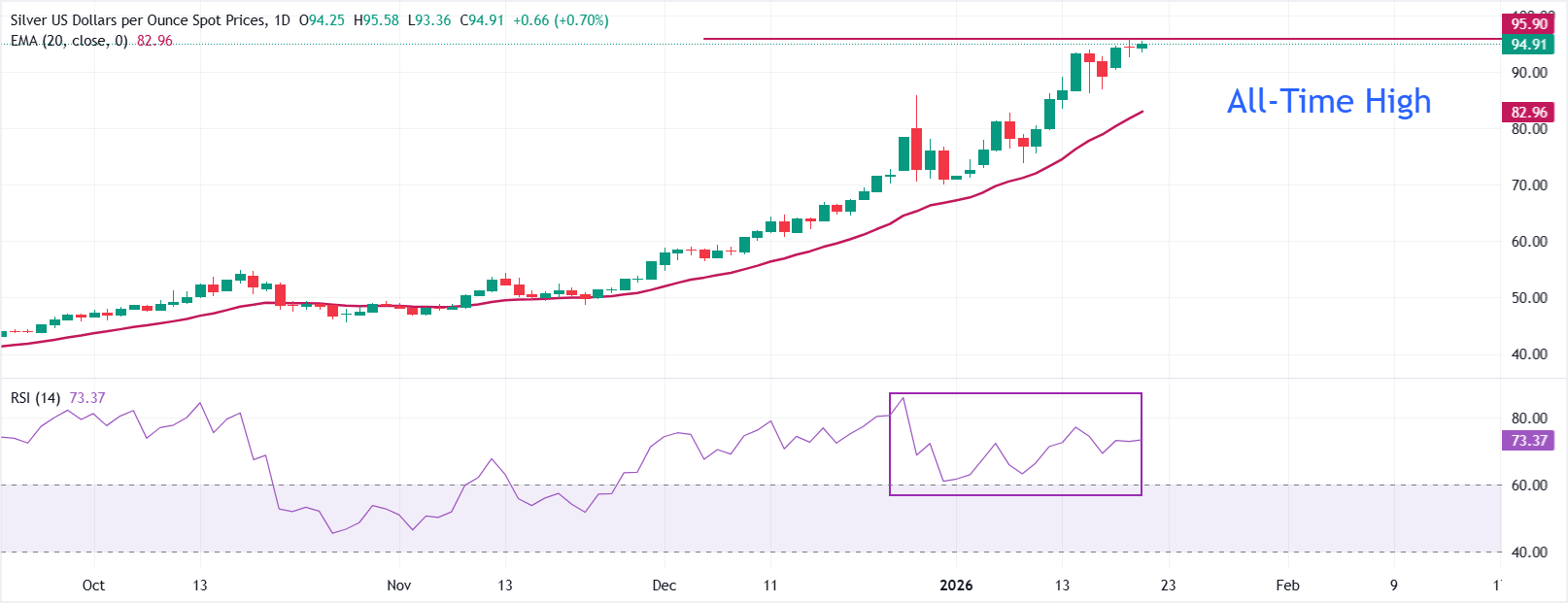
In the daily chart, XAG/USD trades at $94.92. Price holds well above the rising 20-Exponential Moving Average (EMA) at $82.96, keeping the bullish trend intact. The 20-day EMA’s upward slope reinforces positive momentum.
The 14-day Relative Strength Index (RSI) at 73.38 (overbought) underscores strength, though stretched readings could precede brief consolidation.
The distance above the moving average has widened, and trend extension prevails while pullbacks could stall near the rising mean. A close back below the average would weaken the setup, whereas continued acceptance above it would favor further upside. RSI has stayed elevated through recent sessions, confirming momentum; a moderation toward neutral would reset conditions without undermining the broader advance.
(The technical analysis of this story was written with the help of an AI tool.)
Silver FAQs
Silver is a precious metal highly traded among investors. It has been historically used as a store of value and a medium of exchange. Although less popular than Gold, traders may turn to Silver to diversify their investment portfolio, for its intrinsic value or as a potential hedge during high-inflation periods. Investors can buy physical Silver, in coins or in bars, or trade it through vehicles such as Exchange Traded Funds, which track its price on international markets.
Silver prices can move due to a wide range of factors. Geopolitical instability or fears of a deep recession can make Silver price escalate due to its safe-haven status, although to a lesser extent than Gold's. As a yieldless asset, Silver tends to rise with lower interest rates. Its moves also depend on how the US Dollar (USD) behaves as the asset is priced in dollars (XAG/USD). A strong Dollar tends to keep the price of Silver at bay, whereas a weaker Dollar is likely to propel prices up. Other factors such as investment demand, mining supply – Silver is much more abundant than Gold – and recycling rates can also affect prices.
Silver is widely used in industry, particularly in sectors such as electronics or solar energy, as it has one of the highest electric conductivity of all metals – more than Copper and Gold. A surge in demand can increase prices, while a decline tends to lower them. Dynamics in the US, Chinese and Indian economies can also contribute to price swings: for the US and particularly China, their big industrial sectors use Silver in various processes; in India, consumers’ demand for the precious metal for jewellery also plays a key role in setting prices.
Silver prices tend to follow Gold's moves. When Gold prices rise, Silver typically follows suit, as their status as safe-haven assets is similar. The Gold/Silver ratio, which shows the number of ounces of Silver needed to equal the value of one ounce of Gold, may help to determine the relative valuation between both metals. Some investors may consider a high ratio as an indicator that Silver is undervalued, or Gold is overvalued. On the contrary, a low ratio might suggest that Gold is undervalued relative to Silver.
Artigos Recomendados


